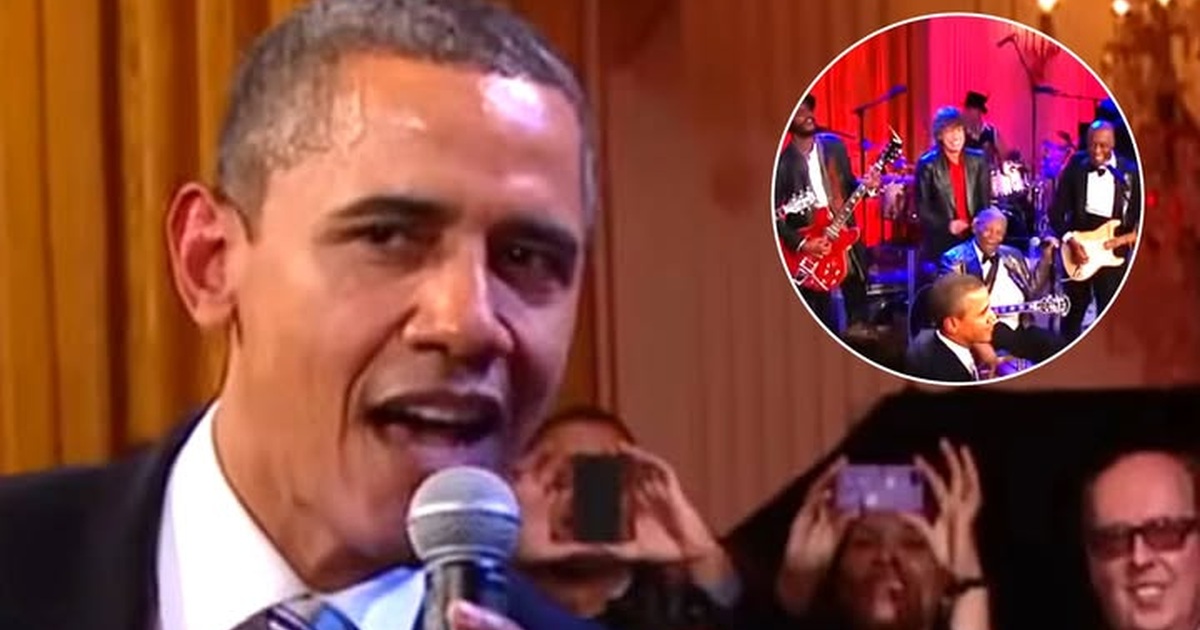
A microphone changes hands, and the host briefly becomes a singer. That is the small event at the center of the White House’s recording of Barack Obama joining Sweet Home Chicago. The surrounding occasion matters: this was a blues concert with established musicians, and the president entered a performance they were already carrying.
The White House archive dates the concert to February 21, 2012, in the East Room. Its account identifies encouragement from B.B. King and the microphone passed by Mick Jagger. Obama sang a short contribution to the ensemble finale. Those details describe a guest turn within a concert, rather than a separate presidential musical performance.
The invitation inside the finale
Watch on YouTube ↗
Three jobs behind one brief appearance
There are several kinds of responsibility in an exchange like this. An invitation identifies an opening; a microphone makes the response audible; the musicians preserve the performance around it. The person suddenly holding the microphone is the most conspicuous part of the story, but that person does not create the whole situation alone.
This distinction changes how the clip can be understood. Instead of asking only whether a politician can sing, consider how experienced performers make participation possible. A guest needs somewhere to enter and some sense of what is expected. A familiar song supplies material that can be recognized without a lengthy explanation, while an ongoing ensemble supplies continuity.
A handoff also has a practical limit. Offering a microphone does not automatically make its recipient the musical director or the principal attraction for the remainder of a number. A short response can acknowledge the invitation and then give the performance back. The limited scale of Obama’s contribution is therefore part of its form, rather than evidence of an unfinished solo.
The setting adds a second kind of reversal
A host normally welcomes guests and helps frame an occasion. Here, the performers offer the host an opening within their activity. For a moment, the direction of the welcome changes. The musicians decide how a musical invitation is offered, and the president answers on the terms of the song.
That is enough to make the event interesting without assigning a political message to every gesture. An official building supplies a particular setting, but it does not settle the meaning of each musical exchange. The recording can be approached as a meeting between a formal occasion and an ordinary concert mechanism: someone makes room for another voice.
The same restraint is useful when describing the participants’ feelings. The archive establishes who passed the microphone and who encouraged the contribution. It does not provide access to private thoughts. The public sequence is clear enough to discuss without inventing backstage hesitation or a conversation that the record does not establish.
Return the focus to Buddy Guy
The next selection puts Buddy Guy at the center of a performance in a different setting. Guitar Center’s own upload identifies Damn Right, I’ve Got the Blues as a Guitar Center Sessions recording. It provides a worthwhile shift from an unusual guest appearance to a musician carrying his own featured number.
Watch on YouTube ↗
Compare the distribution of attention rather than trying to score the two recordings against each other. In one, a brief participant enters an established gathering. In the other, the title and presentation identify Guy as the featured artist. These are different assignments, even when both belong within a broad blues repertoire.
A contrasting song completes the selection
Reelin’ In The Years Archive labels the final clip as Guy performing Feels Like Rain in 1993. Placing a second Guy selection here also prevents his role in the White House story from becoming only that of someone who helped a famous guest join in.
Watch on YouTube ↗
The three recordings offer different points of entry: an ensemble invitation, a named artist’s session performance and another song from his repertoire. The White House handoff is the unusual incident that draws attention. Following the music outward keeps the people who made the incident possible in the picture.