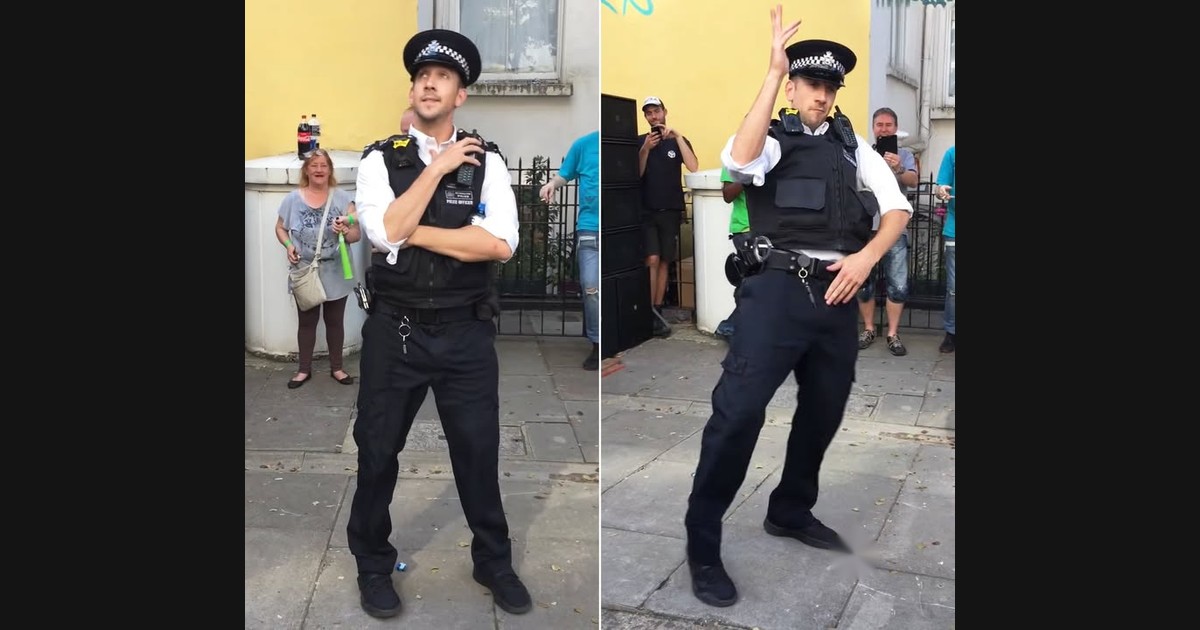
A uniformed officer dancing at Notting Hill Carnival creates an immediate contrast between an official role and participation in street music. The longer 2017 recording is more useful when that contrast remains inside its actual setting: the Rampage sound system, with music and a gathered public already providing a performance environment.
The original filmmakers, Or Noir Caviar, identify the location and year in their own description. They also explain that their footage had been wrongly credited elsewhere. Keeping their account attached to the video preserves a specific filmed occasion instead of turning it into an anonymous feel-good anecdote.
Watch on YouTube ↗
The sound system is part of the event
A street-music setting changes the boundary between performer and audience. Music is already present in a shared space, and attention can shift toward someone nearby without the formal beginning associated with a concert stage. A participant can become the temporary focus of an existing musical gathering.
This is why the surrounding scene matters. The officer is not creating a carnival from nothing. The moment occurs within an established celebration whose music, participants and public space make informal dancing understandable.
A community-led Caribbean tradition
The carnival organization’s own history describes Notting Hill Carnival as community-led and rooted in Caribbean culture. It identifies the 1966 outdoor festival and the role of steelband music in drawing people into the streets. It also records the introduction of static sound systems in 1973.
These details give the short dance clip a wider musical frame. A sound system is not incidental background equipment in a festival that has developed several forms of public music-making. It is one of the ways a community occupies and animates the streets.
The clip can consequently be enjoyed without making it stand for the whole relationship between police and carnival participants. One shared musical moment is a particular event, not proof that every wider social question has been settled. Its immediate interest is the shift in attention and participation visible within that gathering.
Watch how a temporary performance space forms
For a focused viewing, attend to the relationship between the central dancer and the people nearby. The surrounding audience helps define where the action is taking place. Unlike a theater, the street does not supply a permanent frame separating a performer from everyone else.
The music provides another common reference. It gives movement a continuing pace even while attention changes direction. This combination of shared sound and shifting focus helps explain how an informal dance becomes a recognizable short performance.
Other recordings are separate moments
The second video presents another officer-dance recording labeled Notting Hill Carnival. It should not be treated as a different camera angle on the 2017 event unless that relationship is established.
Watch on YouTube ↗
The third uploader identifies its recording with the 2013 carnival, placing it in a different year.
Watch on YouTube ↗
These clips share a setting and a broad premise, but each belongs to its own occasion. Restoring that distinction, and the carnival’s wider musical history, makes the opening video more interesting than a detachable reaction clip: a brief participant-focused moment takes place inside a longstanding public culture of music and movement.


