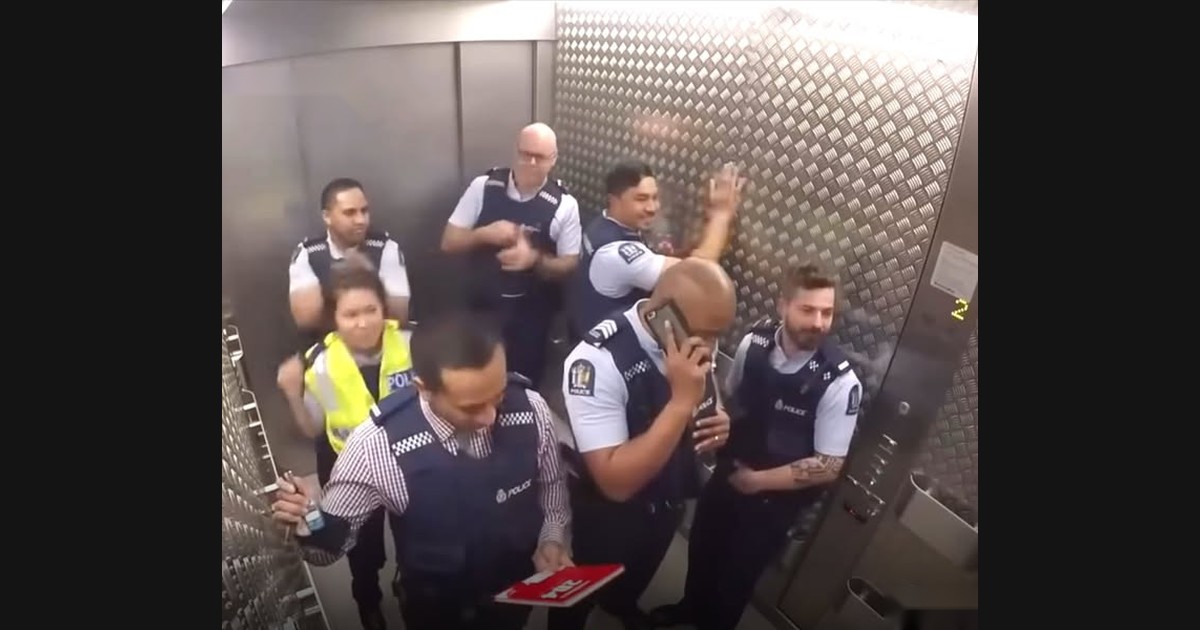
The New Zealand Police elevator rhythm video has two stories: the short performance within the frame, and the journey of that performance through other publishers. ABC and Euronews present the scene to their own audiences, while New Zealand Police’s official account supplies a more specific origin: “Elevator Cops” was a national project involving Tāmaki Makaurau staff.
That context matters because an ordinary-looking setting can encourage viewers to imagine that a camera happened to discover an unplanned moment. A performance can use everyday visual conventions without being secret surveillance footage or evidence that nobody prepared it.
Watch on YouTube ↗
What the scene shows and what the headline adds
The elevator supplies a compact premise. People share a small space, and rhythmic activity changes how that space is understood. The musical interest is available within the presentation, without needing an invented account of what the participants expected before the recording began.
A news title adds another layer. It can emphasize surprise, humor, or the contrast between uniforms and entertainment. Those choices describe how a publisher introduces a clip; they do not necessarily establish the original production circumstances.
Try separating three observations. First, describe an action visible in the recording. Second, identify something asserted only by its title or surrounding introduction. Third, note a fact supplied by the original organization. The categories help explain why a lively clip can remain enjoyable while its provenance is considered accurately.
A second publisher changes the frame
Watch on YouTube ↗
The Euronews presentation offers another editorial route into the same identified scene. A different title, excerpt, or introduction may change what a viewer notices first. That does not make the underlying performance a second event.
Compare the amount of context available before the musical activity begins. Does the presentation foreground New Zealand, policing, rhythm, or social-media entertainment? A short news clip has limited space, so its framing can make one aspect feel like the whole story.
This is also why view counts from different uploads should not be combined casually into a precise audience claim. They may refer to different platforms, dates, and measures. The scene’s cultural circulation is clear enough without turning scattered figures into a supposedly current total.
The campaign context is broader than one elevator
Watch on YouTube ↗
The official recruitment channel’s Running Man Challenge video supplies a related but separate example. New Zealand Police’s own review lists the challenge and Elevator Cops as distinct projects. The connection is organizational communication through entertainment, not a claim that the clips document one continuous incident.
Compare how the setting and format contribute to each premise. An enclosed scene and a dance challenge offer different visual structures, while both present participants through coordinated activity. Those are concrete choices to discuss without assuming that a humorous video represents every aspect of an institution’s work.
A final source check can be simple: name the original organization, the publisher of the version you watched, and the claim you can actually support. That habit preserves the difference between a performance, a news presentation, and an audience’s interpretation—three things that often travel together when a short clip spreads.


