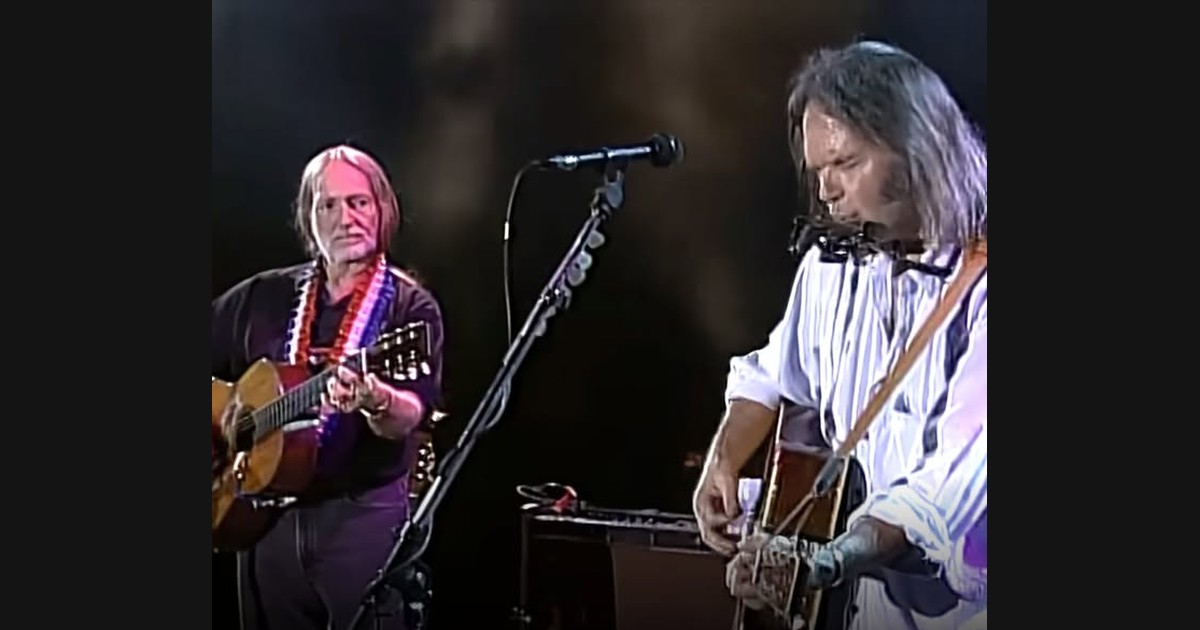
One song returning across an event’s history can become a useful archive in miniature. Farm Aid’s official “Heart of Gold” recordings connect Neil Young’s repertoire with several distinct occasions: a 1995 appearance with Willie Nelson, a 2017 performance with Promise of the Real, and a 2024 presentation.
The organizer itself has used the song this way, publishing a chronological listening feature that traces earlier Farm Aid performances. It identifies “Heart of Gold” with Young’s 1972 album Harvest. The song’s release history and each later event year should therefore remain separate.
Watch on YouTube ↗
1995: a named collaboration
The first official upload identifies Young and Nelson together. Begin by following the relationship between the featured contributions and the shared song. How is continuity maintained when attention moves between people rather than remaining with one singer throughout?
A familiar composition can give collaborators common material without making their contributions identical. One voice may carry an idea while another supports or joins it; the recording should determine which description fits a particular passage.
This is a musical relationship, not a reason to invent an informal rehearsal story. The organizer’s identification establishes the pairing and year; it does not document every decision behind the performance.
The song remains a reference, not a frozen template
A melody can stay recognizable across decades while its surroundings change. Repertoire continuity does not require every account to reproduce one original recording. Pacing, balance, and the distribution of musical jobs can vary within a shared composition.
Choose a complete phrase you recognize and follow what supports it. Describe the relationship rather than simply counting the instruments. A fuller ensemble and a more concentrated texture can each serve the same musical thought in different ways.
Watch on YouTube ↗
2017: another named ensemble context
The second upload identifies Promise of the Real with Young at Farm Aid 2017. This is a new event reference, not another camera angle on the 1995 duet. The named collaboration gives the comparison a specific change to consider.
Listen to the preparation of the same recognizable phrase. What remains stable in the song, and what feels different in its accompaniment or delivery? Avoid assuming that every difference is caused by the passage of time. The musicians involved, arrangement, recording, and event setting can also contribute.
2024: a later return
Watch on YouTube ↗
The final organizer upload identifies another year. Its title does not require an invented lineup or a claim that the appearance was the last of its kind. It supplies one more documented point in the song’s continuing relationship with Farm Aid.
Compare the beginning and conclusion as well as the central melody. A song entering and leaving a concert program has a different context from an album track heard in sequence.
A useful three-column note lists year, credited collaborators, and one musical observation. Keep the observation small enough to check: a phrase’s pacing, a supporting role, or a transition. The result recognizes a song’s durability without pretending that its repeated appearance makes all three performances the same event—or that every change can be explained by a musician’s biography.


