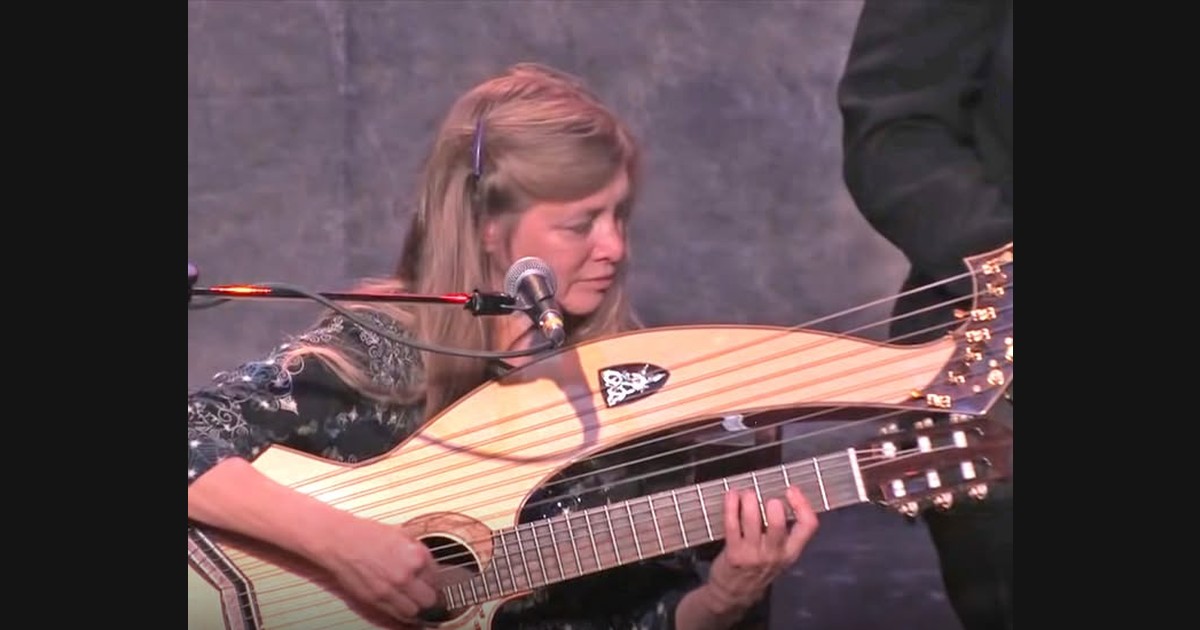
Muriel Anderson’s “Here Comes the Sun” gives a familiar song an instrumental setting on harp guitar. The instrument’s additional strings are a useful entry point, but the main listening question is how melody and accompaniment remain distinct inside one player’s performance.
Anderson describes harp guitar in a direct interview as a guitar with extra bass strings. Builder Mike Doolin’s documentation of an instrument made for her shows how individualized these designs can be. That supports a general explanation while cautioning against assigning one exact string count, tuning, or mechanism to every performance video.
The extra strings expand the available resources
A conventional fretted guitar already allows melody and support to coexist. Additional strings can extend the resources available around the neck’s part, particularly toward the lower register in the design Anderson describes. More resources create possibilities; they do not mean that every string sounds continuously.
Watch on YouTube ↗
The principal video is published by EOP Live and identifies Anderson performing the Beatles song at an Eddie Owen Presents event. Keep that documented occasion distinct from the separate Studio 55 Marin appearance supplied next.
Hear roles rather than count strings
For a focused pass, retain the melody’s broad direction. Then shift attention to the lower supporting line and the notes filling the space between phrases. These functions can remain clear even when one performer produces them.
| Musical role | Useful listening focus |
|---|---|
| Melody | The recognizable tune carried through the arrangement. |
| Lower support | The foundation beneath the tune. |
| Connecting material | The notes linking one melodic phrase with the next. |
The camera may make a particular hand movement conspicuous, but a visible action is only one part of the musical organization. Follow the sounding line across several gestures instead of assuming that each movement corresponds to a separate phrase.
A custom instrument is not a standard specification
Doolin’s account describes Anderson’s requests for a particular harp requinto, including additional strings and mechanisms suited to that design. It is a useful example of collaboration between player and builder. It is not proof that the same instrument appears in every later clip.
The practical distinction is between a family of instruments and an identified individual instrument. “Harp guitar” establishes the broader category; exact design details need a source attached to the particular setup.
Studio 55 Marin supplies another occasion
The second recording is published by Studio 55 Marin and identifies the same song and performer. It keeps the repertoire constant while changing the documented venue source.
Watch on YouTube ↗
Compare a corresponding passage to hear how the melody relates to its support in each setting. Do not assume that a change in recorded balance necessarily means a different technique or tuning. Room, recording, and arrangement are separate variables.
The catalog medley changes the larger structure
The final Topic item pairs “How High the Moon” with “Here Comes the Sun.” Its title identifies a combined selection rather than simply another standalone performance of the Beatles song.
Watch on YouTube ↗
That pairing adds a structural question: how does an instrumental interpretation move from one composition into another? Retain each tune’s identity instead of treating every change as a new section of the same work.
The harp guitar becomes most informative when heard as a set of musical possibilities. Anderson’s arrangement can bring a recognizable melody, a supporting foundation, and connecting detail into one performance without the explanation depending on an invented equipment specification.


