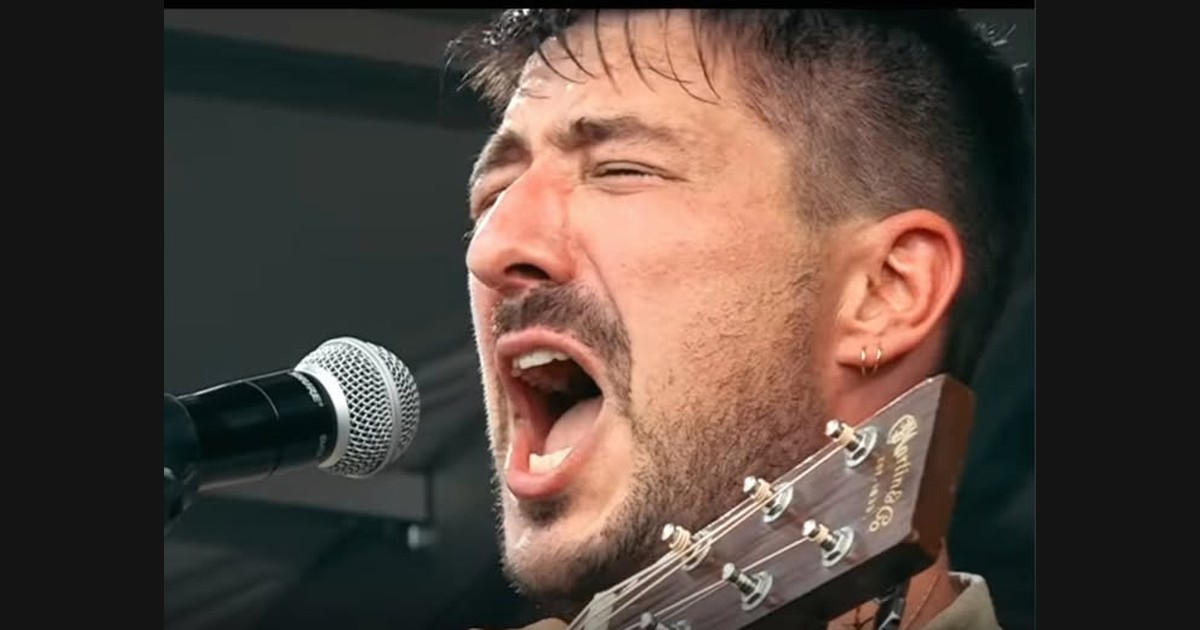
A festival collaboration becomes musically interesting when the foreground can move between participants. Adding more named guests does not mean that everybody should lead at once. Mumford & Sons’ “House of the Rising Sun” set offers a way to follow that distribution of responsibility across voices and instruments.
The band’s official tour archive includes New Orleans Jazz Fest in May 2023. The principal audience upload names Trombone Shorty and Jon Batiste, while the official “House of the Rising Sun” presentation names Celisse and Trombone Shorty. Those titles supply selected credits; the musical question here concerns how the assembled performers can share a song.
Foreground is a function, not a permanent status
A singer may carry the narrative through one passage, then an instrument may become the central line. Supporting musicians keep the transition connected. The person most prominently billed need not be the most audible participant at every moment.
Watch on YouTube ↗
Think of three layers: a featured statement, the harmony around it, and the rhythmic foundation beneath it. Those layers can be carried by different combinations of performers. A guest can contribute to more than one function over a number, while remaining silent during another passage.
For a practical viewing method, follow one foreground line until its phrase ends. Continue listening through the space before the next featured entry. The supporting continuity in that interval is part of how the collaboration avoids becoming a string of disconnected solos.
More players create an arranging problem
| Choice | What it makes possible |
|---|---|
| Alternating foreground | Different musicians can make complete statements. |
| Shared material | Several parts can reinforce one recognizable idea. |
| Supporting response | An instrument can answer without replacing the principal line. |
| Space | Not every available voice or instrument needs to sound continuously. |
This is a map of ensemble possibilities, not a claim that each appears at a particular timestamp. It directs attention toward relationships rather than assuming that the guest’s contribution must always be a solo.
“Awake My Soul” changes the repertoire
The second video is the band’s official “Awake My Soul” collaboration with Jon Batiste, identified with New Orleans Jazz. It is a different composition from “House of the Rising Sun,” not another title for the same performance.
Watch on YouTube ↗
Use it to compare the role of a guest within different material. A band’s own repertoire and an inherited song can offer different spaces for participation. Keep the composition fixed within each comparison before drawing conclusions about the ensemble.
The official cover supplies another presentation
The final selection returns to “House of the Rising Sun,” this time through the band’s official release featuring Celisse and Trombone Shorty. It offers a more direct artist-published reference for the festival collaboration while retaining its own chosen title and credits.
Watch on YouTube ↗
The Library of Congress documents a 1937 Georgia Turner recording of the traditional song. That earlier history helps explain why a modern ensemble can approach it as inherited repertoire rather than as a composition belonging exclusively to one famous arrangement.
The most useful comparison keeps the listening question narrow: how does the foreground pass between performers, and what maintains the song while it passes? That focus allows the festival’s gathering of musicians to become an account of cooperation rather than merely a list of guests.


