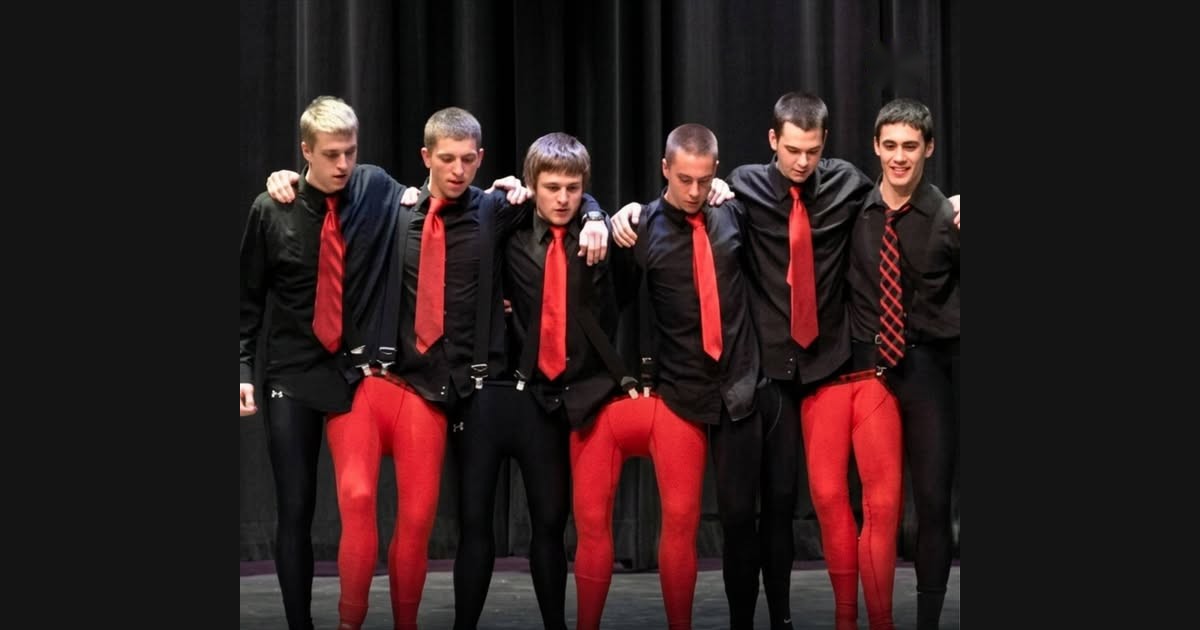
A line of dancers can produce a moving pattern that is harder to read than the people creating it. The Mr. Linganore illusion routine uses contrasting tights to make that difference the premise. A viewer can follow individual performers, or follow the shapes made by similarly colored legs, and the two readings do not always feel identical.
Lancer Media, the school’s own publication, identifies Dan Beck’s optical-illusion talent at Mr. Linganore 2014. That direct source gives the recording a clear occasion. The act does not need an invented competition title or a claim about unprecedented difficulty to make its central idea interesting.
Watch on YouTube ↗
The costume is part of the mechanism
In this kind of routine, clothing does more than give the team a common appearance. Strongly contrasting areas make some boundaries conspicuous and others harder to follow. When neighboring legs move together, a viewer may connect them through color rather than through the person to whom each belongs.
The result is a deliberately unstable visual reading. The dancers remain separate people, but the pattern below their upper bodies can suggest another arrangement. The audience’s effort to reconcile those two pictures becomes part of the entertainment.
Try two ways of watching
First choose one face or upper body as a stable reference. Follow that person’s relationship with the lower-body movement. Then begin again and attend only to one color across the row. The same performance can become easier or harder to decode depending on the reference you choose.
This is a way to examine the stage idea, not a medical test of perception. There is no need to claim that viewers are universally fooled or that a particular brain mechanism has been proved by the clip. The visual design offers a playful ambiguity that different people can follow differently.
Coordination keeps the ambiguity readable
The routine still depends on performers sharing space and time. A clear row lets neighboring forms relate, while coordinated movement keeps the pattern from becoming a collection of unrelated actions. The illusion and the choreography support each other.
For a focused pass, attend to when the pattern feels stable and when it becomes more difficult to separate. The interesting event may be a change in relationships rather than a new action by one featured performer. This redirects attention from individual tricks toward the ensemble design.
Another view of the Linganore act
The second upload also identifies Dan Beck’s Mr. Linganore illusion dance. It should be understood as another presentation of the same routine, rather than a second separately named act.
Watch on YouTube ↗
A different camera frame can change which relationships are easiest to see. A wider view preserves the row, while a closer view may help locate an individual. That is another reason an illusion can read differently across recordings.
A related school-stage approach
The final uploader identifies a Year 12 black-and-white tights dance from 2013. It provides another example of the broader costume-and-movement premise.
Watch on YouTube ↗
The comparison reveals the act’s underlying resource: a simple visual rule can generate complexity when several people coordinate it. Following the person, then the pattern, lets viewers appreciate both sides of the construction—the individual performers who remain physically distinct and the shared image they create together.


