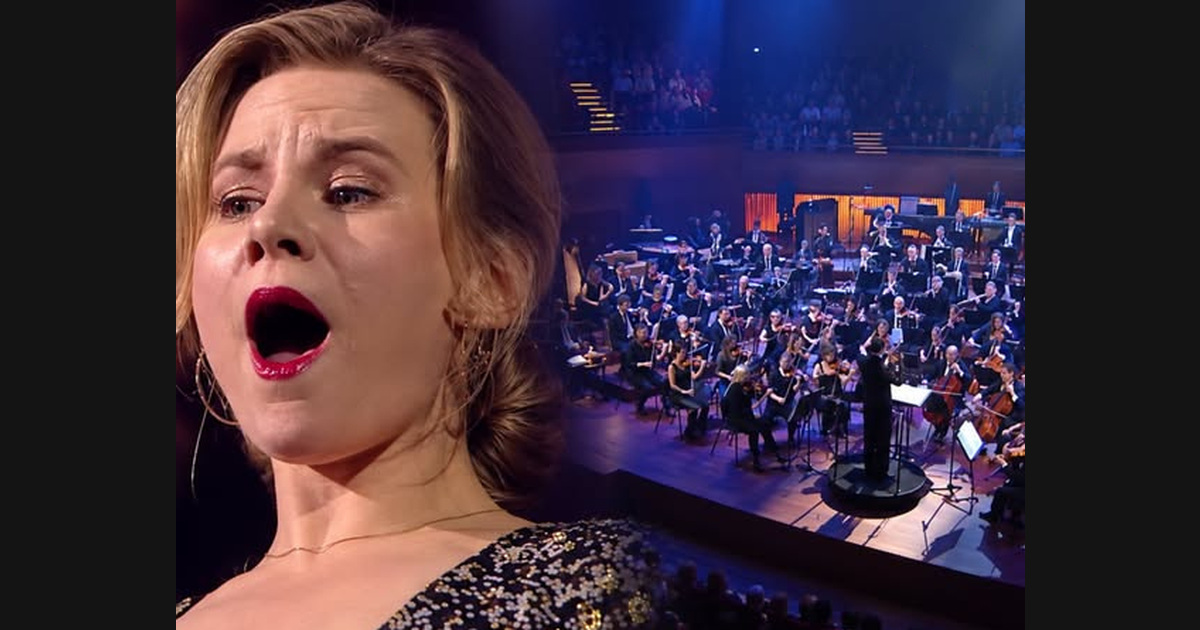
A human voice does not always have to deliver a story in words. In the Danish National Symphony Orchestra’s “The Good, the Bad and the Ugly,” vocal contributions belong to the score’s sound world alongside instrumental colors. The concert presentation makes that broader idea of musical voice especially accessible.
DR Koncerthuset identifies Ennio Morricone as composer, Sarah Hicks as conductor and the Danish National Symphony Orchestra and Concert Choir as performers. It also credits Tuva Semmingsen and Christine Nonbo Andersen on vocals, with Hans Ulrik and Russell Itani on various flutes. These are distinct contributions inside one arrangement.
Watch on YouTube ↗
Film music can identify a world without describing it
A film theme can establish character through a brief sound or recurring figure. It need not recount the plot. That is one reason soundtrack music can remain recognizable when the film image is removed: its musical vocabulary has acquired an identity that listeners can carry into another setting.
In a concert hall, attention shifts toward the people producing those sounds. A vocal gesture can be heard as a timbral contribution rather than as the beginning of a conventional verse. A wind instrument can provide another kind of call or melodic character. Their relationship helps the score function without a spoken explanation.
An adaptation is a credited act of interpretation
The official description names Martin Nygård Jørgensen for the orchestral arrangement and adaptation from the original recording. That credit matters. Presenting a familiar soundtrack in a concert hall involves decisions about how the available musicians will realize its musical material.
It is therefore useful to distinguish the composer from the arranger. Morricone supplied the work; the concert adaptation organizes that work for the performing forces in front of the audience. A listener can appreciate both contributions without assuming every sound exactly duplicates the original soundtrack production.
Follow a color, then follow its function
For one listening pass, choose the vocal contributions. Ask whether they seem to carry a principal idea, support another part or supply a contrasting color. On another pass, follow the orchestral response. A change of sound can create a new musical character even when the recurring idea remains recognizable.
This approach keeps the comparison concrete without turning it into an instrument-identification quiz. Recognizing what a sound does is often more useful than knowing its technical name immediately.
Another Morricone vocal setting
“Once Upon a Time in the West,” again presented by DR Koncerthuset with Semmingsen, offers another way for voice and orchestra to share a film-music identity.
Watch on YouTube ↗
Compare the role of a sustained melodic line with the shorter recognizable gestures that can establish another theme. Film music has room for both: one can draw out an atmosphere, while another supplies an immediate point of recognition.
A third score in the same concert vocabulary
“For a Few Dollars More” extends the comparison within Morricone’s Western repertoire. Keeping the presenting ensemble consistent makes the different compositions the main variable.
Watch on YouTube ↗
The first recording was performed and recorded at DR Koncerthuset in 2018. Its detailed credits allow the concert to be understood as a real collaboration, not an anonymous recreation of a soundtrack. Voices, instruments and an adaptation all help carry the music from its cinematic associations into a shared performance space.