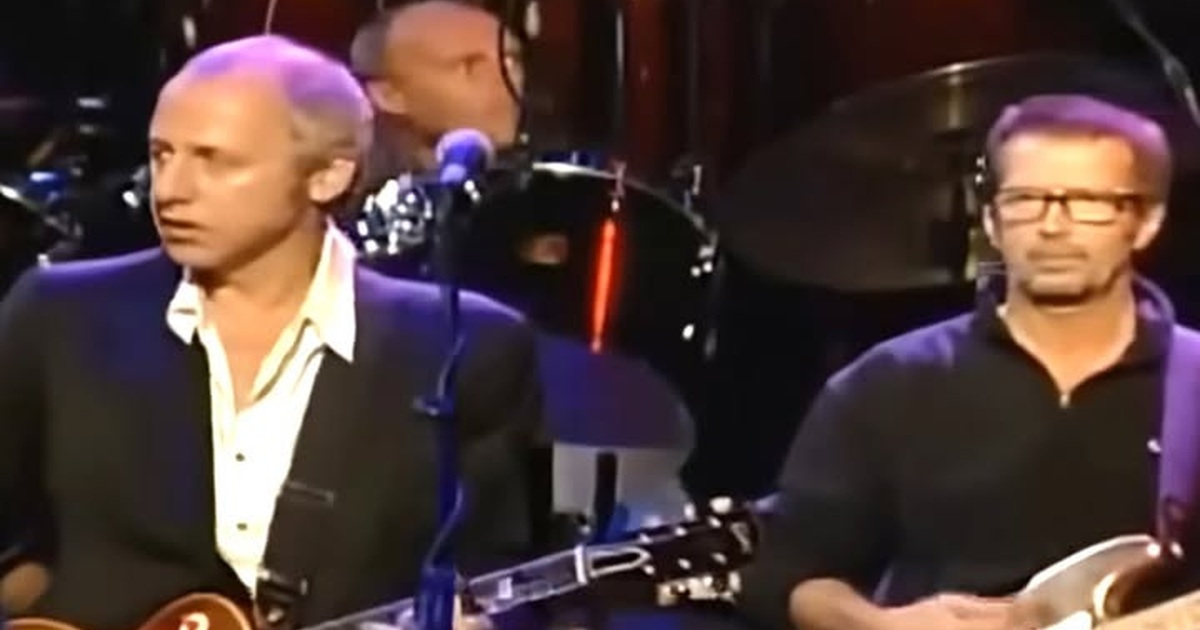
“Money for Nothing” at Music for Montserrat joins Mark Knopfler, Sting, Eric Clapton, and Phil Collins within a clearly identified benefit event. Sting’s official release information places the concert at London’s Royal Albert Hall on September 15, 1997, organized by George Martin in aid of Montserrat.
The guest list is striking, but it is not the entire musical explanation. Recognizable performers still need a shared structure through which to contribute. The Dire Straits composition supplies that structure, allowing the appearance to become a coordinated performance rather than simply a photograph of famous musicians together.
Watch on YouTube ↗
A benefit creates a temporary ensemble
An event can assemble musicians who are normally associated with different working groups. That makes the occasion a temporary partnership, not evidence that the artists have formed a permanent new band. Their existing identities are part of what makes the shared stage interesting.
The purpose of the concert also explains the unusual bill. Paul McCartney’s own event archive identifies the benefit with the disasters that had affected Montserrat. That public purpose gives the collaboration context without requiring an invented story about how every participant privately decided to attend.
More players create more relationships
A multi-artist performance needs decisions about the foreground. Who carries the principal vocal line? What supports it? Where does instrumental attention go, and what remains steady while it moves? These are arrangement questions rather than automatic consequences of adding names to a lineup.
For a useful listen, follow continuity behind a featured contribution. The ensemble’s shared movement allows one voice or instrument to attract attention without making the song feel as though it restarts each time the focus changes.
It is equally useful to resist a common shortcut: a relaxed-looking collaboration is not proof that it was completely unrehearsed. The recording can show a performance without revealing every stage of its preparation.
The original band supplies a reference
The official Dire Straits “Money for Nothing” video keeps the composition steady while changing the performance context. It provides a reference for the song’s strongly associated recorded identity, rather than a demand that the benefit arrangement duplicate every detail.
Watch on YouTube ↗
A recognizable figure can carry a substantial part of a song’s identity. Follow how that material relates to the vocal line and to returning sections. This makes it possible to compare musical organization instead of treating every difference as an improvement or a failure.
Another gala, another shared task
The final selection is the King’s Trust recording of George Harrison and Ringo Starr in “While My Guitar Gently Weeps” at the 1987 rock gala. It changes the song and occasion while retaining the broad form of established artists sharing a specially assembled stage.
Watch on YouTube ↗
Keep the two events distinct. A royal charity gala in 1987 is not part of the 1997 Montserrat program, even when musicians and recording traditions overlap.
The three selections make an all-star credit more concrete. The event explains why the musicians gather; the composition gives them something to share; the arrangement determines how their contributions fit. “Money for Nothing” becomes a particular piece of collective work within a documented benefit, rather than an undefined meeting of legends.