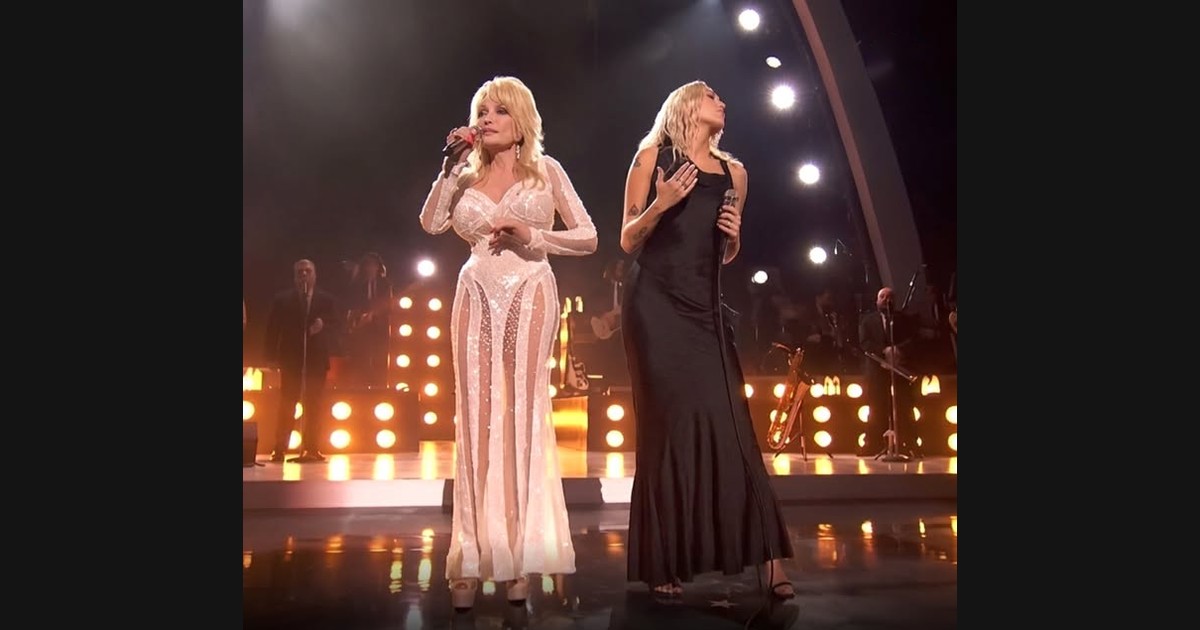
Putting “Wrecking Ball” beside “I Will Always Love You” creates more than a link between two famous repertoires. The songs approach a difficult separation from different directions: one is organized around the damage left by an overwhelming encounter, while the other makes affection part of a farewell.
Miley Cyrus and Dolly Parton’s New Year’s Eve performance lets those perspectives occupy one continuous presentation. Parton’s own 2023 announcement confirms that they first performed “Wrecking Ball” together on the NBC broadcast Miley’s New Year’s Eve Party, before releasing a duet for Rockstar.
Watch on YouTube ↗
A transition can change the meaning of what came before
In a medley, the relationship between songs is an arranging decision. The listener does not merely hear one complete work and then another; the point of connection can invite a new understanding of both. A destructive image followed by a continuing declaration of care creates a particularly clear contrast.
This does not mean the two songs tell one literal biographical story. A performance can place separate dramatic situations beside each other without claiming that their narrators are the same person. That distinction allows the pairing to work through interpretation rather than an invented account of the singers’ private lives.
Two performers can exchange musical ground
“Wrecking Ball” is closely associated with Cyrus, while “I Will Always Love You” connects the performance with Parton’s own songwriting. The partnership consequently moves in both directions. Each singer participates in material carrying a strong association with the other.
That exchange gives a duet another dimension beyond the contrast between vocal tones. The song selection itself expresses the relationship between the performers’ repertoires. A listener can follow the shared musical task without expecting either artist to imitate the other.
Parton’s song on its own
The official “I Will Always Love You” audio provides the second composition outside the medley. Its farewell is not made simple by the continuing affection it expresses; the tension between leaving and caring is part of its dramatic character.
Watch on YouTube ↗
Compare the effect of entering this song after “Wrecking Ball” with hearing it from its own beginning. A preceding composition can create an additional context, but it does not replace the song’s independent structure. The medley adds a relationship between works rather than making one disappear into the other.
For a focused listen, attend to the boundary where the musical identity changes. Consider what gives the new song enough room to establish itself. A transition can be brief and still matter, because listeners bring their recognition and expectations into the arrival.
The collaboration becomes a studio release
Parton’s official “Wrecking Ball” duet with Cyrus was released in October 2023 ahead of Rockstar. Her announcement describes the earlier New Year’s Eve performance as part of the route to including the song on the album.
Watch on YouTube ↗
The stage pairing and the album track are related records of a collaboration, not interchangeable copies of one performance. Together with Parton’s solo audio, they show how repertoire can be exchanged, combined and recorded again. The strongest connection is musical: two distinct accounts of separation make room for both rupture and affection.


