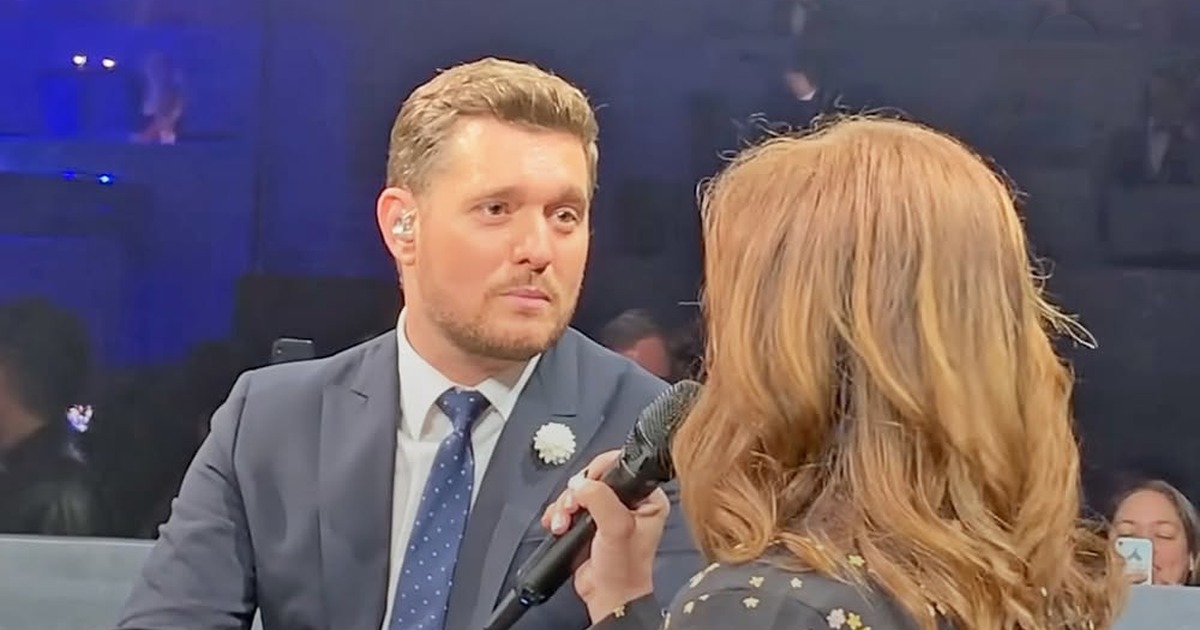
When a concert headliner shares a song with a guest, the performance creates a practical question: how do two people make a common musical task clear enough to complete together? Michael Bublé and Diana Fairbanks’s A Whole New World offers a useful example of that format without needing an invented story about how the invitation was arranged.
The clip appears on Fairbanks’s own channel, where its title identifies the duet. The song comes from Aladdin and was written by Alan Menken and Tim Rice. Its familiar two-person structure gives the performers a shared reference, even for viewers who know little about either person’s circumstances on the night.
Watch on YouTube ↗
The advantage of a song with two places in it
A duet can establish who begins, who responds and where voices might meet. Those are musical responsibilities rather than measures of status. The headliner does not need every phrase, and the guest does not need to compete for every opening. A recognizable song can supply an underlying route through the encounter.
Think of a complete exchange as three connected actions: one singer presents an idea, the other continues or answers it, and both make the transition onward. A single impressive note occupies only a small part of that structure. Listening for the transitions reveals how a duet functions as a shared performance.
Four responsibilities worth separating
| Responsibility | What it contributes |
|---|---|
| Starting a line | Establishes the next musical idea. |
| Leaving space | Makes the partner’s entrance intelligible. |
| Sharing a passage | Brings distinct voices into one musical setting. |
| Finishing together | Gives a phrase or section a clear boundary. |
These tasks can move between the singers. A listener can follow the person who is temporarily providing support rather than assuming that only the most exposed voice matters. The supporting role may be exactly what lets the other part make sense.
Camera attention can complicate this. A close-up may suggest that a moment belongs to one participant even when its musical effect depends on both. Keep the other voice in mind when the picture changes.
Another guest pairing has another purpose
Watch on YouTube ↗
The related Bublé and Josh Groban clip supplies a different kind of encounter. Compare how the performers present their relationship to each other as well as how they sing. A clip built around an exchange between familiar entertainers need not have the same purpose as a guest joining a headliner’s concert.
A useful comparison identifies a particular transition: the moment one person yields attention, takes it back or makes a new entrance possible. It does not require a judgment about whose private emotions are more sincere.
The headliner without the guest-duet task
Watch on YouTube ↗
Bublé’s official Feeling Good selection from Tour Stop 148 provides a reference for a performance organized around his own featured role. The musical job differs: a solo feature can concentrate the delivery, while a duet has to make an ongoing relationship audible.
That contrast clarifies what is distinctive about the Fairbanks clip. A guest appearance does not have to become a story about hidden fame, a career discovery or a life-changing outcome to be worth watching. It can be understood as two people using a known song to create a clear, temporary partnership in front of an audience.