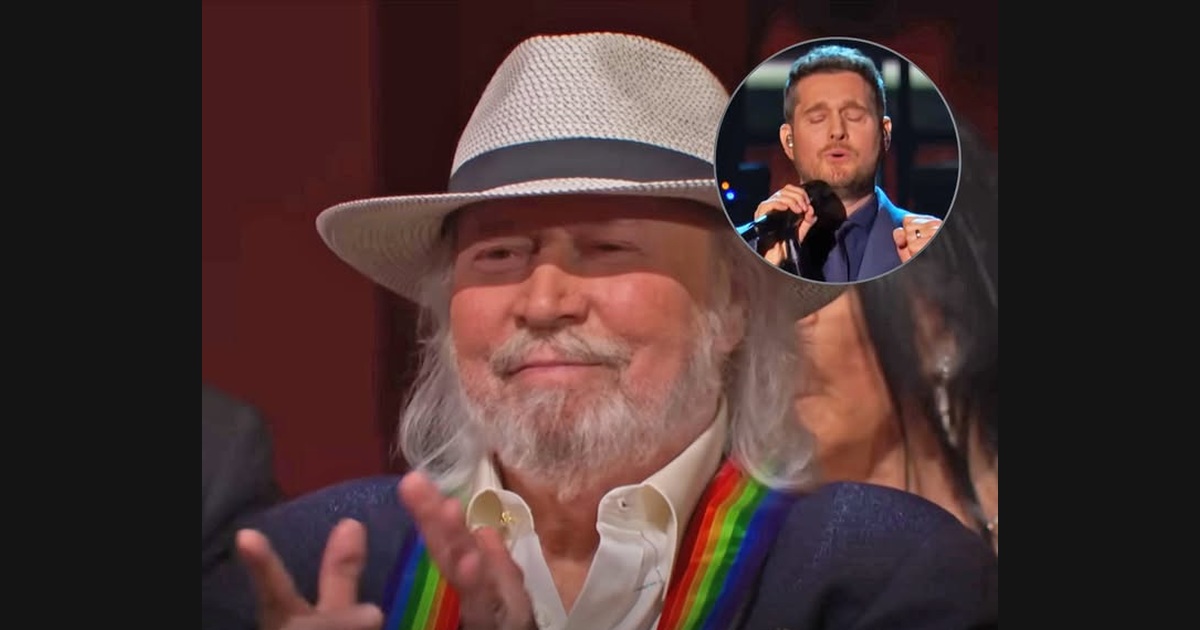
The title “How Can You Mend a Broken Heart” asks for something the song cannot simply deliver. That unresolved request is the ballad’s dramatic starting point. Michael Bublé’s tribute to Barry Gibb at the 46 th Kennedy Center Honors places that vulnerable songwriting in the center of a public celebration.
The Kennedy Center identifies the performance as part of its 2023 honor for Gibb. The ceremony took place on December 3 at the Kennedy Center Opera House, with the television premiere on December 27. Its purpose was to recognize lifetime artistic contributions, so this was a performance drawn from a much larger career rather than a new Bee Gees release.
Watch on YouTube ↗
Why this song is a revealing selection
The Bee Gees’ own history identifies “How Can You Mend a Broken Heart” as their first American number-one single in 1971. That places it before the later disco-era recordings that dominate many casual introductions to the group. A tribute built around this ballad therefore widens the picture of their repertoire.
The choice also gives another singer a clear interpretive task. A question can be addressed outward to someone else, inward as reflection or more generally to an audience. Those possibilities do not require different words. Phrasing, pacing and the relationship with the accompaniment can change how the address feels.
Hear a request rather than a victory speech
A ceremonial occasion encourages applause and recognition. A ballad about uncertainty works on another scale. Its musical destination does not need to sound like the occasion’s triumphant conclusion. This tension gives an honors performance a useful dual purpose: celebrating the songwriter while allowing the song’s speaker to remain unresolved.
For a focused listen, attend to the ends of complete thoughts. Does the phrase seem to settle, leave something suspended or lead directly into the next question? A longer note is not automatically a resolution. Its effect depends on what the melody and accompaniment do around it.
This is also why an interpreter need not reproduce the original vocal identity. The task is to make the question intelligible within a new performance, not to become the person most closely associated with its first recording. Distinguishing composition from vocal signature makes tribute singing easier to appreciate.
The Bee Gees as the reference point
The Bee Gees recording below provides a direct comparison. Begin with the song’s movement between recollection and appeal, then consider how the changing arrangement affects those functions. A listener can recognize the same dramatic situation through more than one vocal approach.
Watch on YouTube ↗
The reference is particularly useful because it keeps the catalog in perspective. The Bee Gees were not solely a dance group whose songs occasionally became ballads. This composition belongs to an earlier part of their recording history and gives Gibb’s celebration an important additional dimension.
Bublé in a different dramatic posture
“Feeling Good,” in Bublé’s official video, offers a contrast in the singer’s repertoire. Its central posture is declarative rather than the open request at the center of “How Can You Mend a Broken Heart.”
Watch on YouTube ↗
Comparing those two kinds of address is more useful than assuming that one vocal personality suits only one emotional register. A confident declaration and a vulnerable question ask different things of the same performer. The Kennedy Center selection lets the latter quality carry a public act of appreciation, while preserving the uncertainty that makes the ballad distinctive.