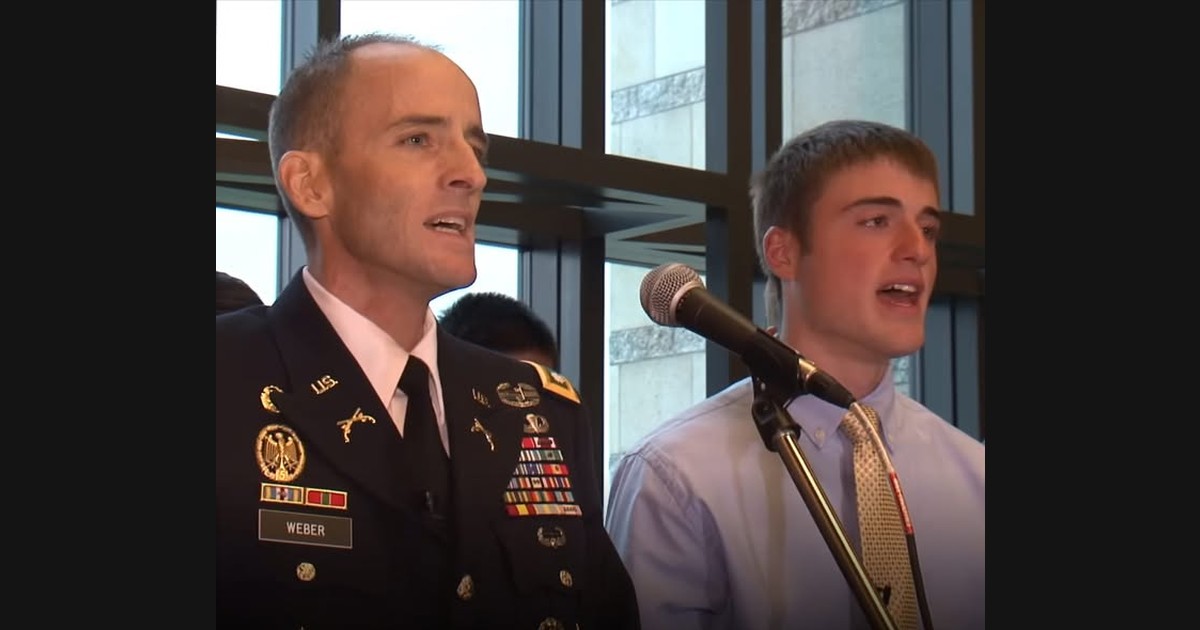
Mark Weber and his son Matthew’s “Tell My Father” carries two relationships at once. The composition gives a soldier a message for his father; the recorded performance places a real father and son together. Those connections are meaningful without making the song’s character identical to either person singing it.
The Minnesota National Guard produced the recording and identifies the occasion at the Minnesota History Center in Saint Paul on June 14, following Weber’s Army Birthday address. The institution also documents that he was living with cancer and died in June 2013. This is a historical recording, rather than a current appeal or a newly unfolding medical story.
Watch on YouTube ↗
The song is modern musical theater
“Tell My Father” belongs to The Civil War, the musical whose original Broadway version dates to 1999. Music Theatre International lists it in the show’s score and identifies Frank Wildhorn as composer. It is not a song preserved unchanged from the nineteenth-century war.
That distinction corrects an easy confusion between setting and composition date. A musical can depict historical experience through later writing. The song’s soldier is a dramatic voice created for that work, while subsequent singers bring it into new public circumstances.
A father and son change the listening context
When a family performs this particular song, the audience can recognize a relationship outside the composition alongside the relationship within it. The title’s address gains another resonance because a father is physically present in the duet.
This does not require a claim that every line becomes literal autobiography. Interpretation allows the performers to inhabit the written situation while their own occasion gives listeners another frame. Preserving both levels makes the recording more specific than describing it only as an emotional song.
Follow the complete statement
The song asks a listener to follow a message from beginning to end. A useful listening focus is how one thought leads toward the next, rather than isolating the most sustained vocal moment. In a duet, another voice can reinforce the statement or change who appears to carry it.
The recording’s institutional context matters, but the music still needs continuity. Shared timing and the direction of a phrase allow two singers to contribute without making the performance sound like separate fragments joined together.
Matthew in another setting
The second upload identifies Matthew Weber performing “Tell My Father” with Rosemount Choir and dates the occasion to May 26, 2011. It provides another presentation of the song, distinct from the National Guard’s father-and-son recording.
Watch on YouTube ↗
Compare how the meaning of an address changes with its public frame. A composition remains the same work even as different performances make different relationships visible around it.
A theater singer’s recording
John Owen-Jones’s artist recording supplies a further interpretation. Its label credits identify Wildhorn’s composition and Jack Murphy’s lyrics, reinforcing the song’s modern theater identity.
Watch on YouTube ↗
The three versions make context an audible part of interpretation without replacing authorship. Mark and Matthew’s partnership is distinctive because their family relationship meets a song about a family message. The written character and the real occasion remain separate, and the connection between them gives the recording its particular weight.


