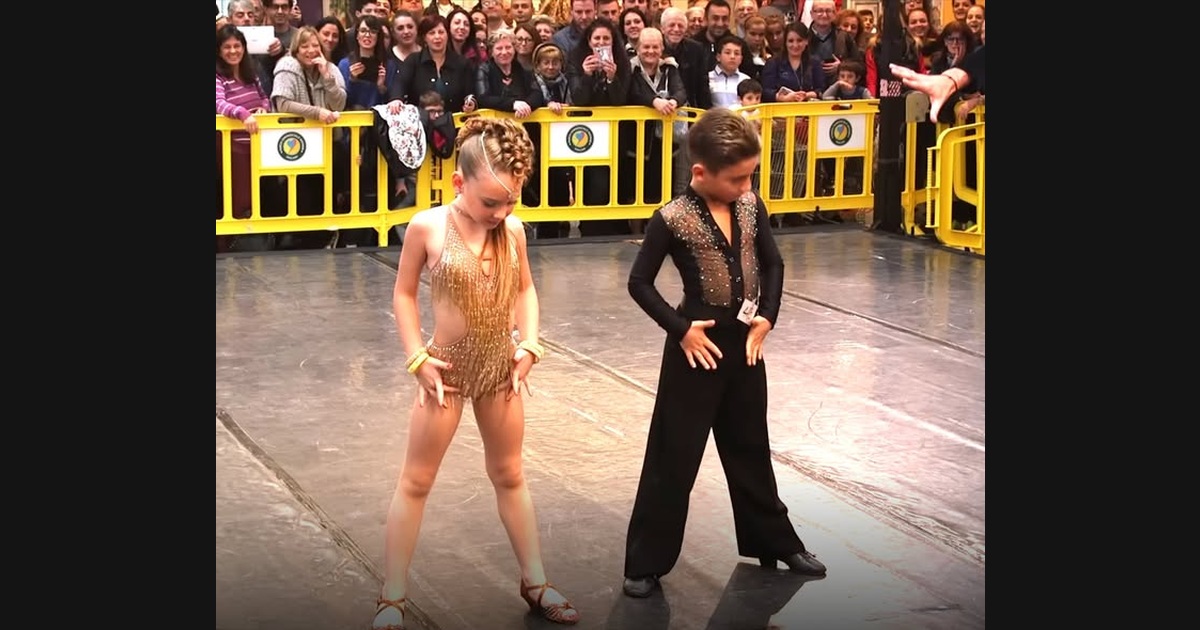
A touring dance appearance, a competition recording and a demonstration can show related skills while serving different public purposes. Maria Rosaria and Antonio’s Ballando on the Road selection from Giugliano provides a useful place to begin that distinction. The host’s upload identifies the pair and location; the wider format supplies another part of the context.
Rai’s biography of Milly Carlucci dates her creation of Ballando on the Road to 2015 and describes it as a live Italian tour seeking dance talent. That is a program identity, rather than a competition result or a complete biography of every participant.
The touring-program selection
Watch on YouTube ↗
A partnership can be followed through shared timing and the use of space. The dancers do not have to perform identical actions to remain connected. One can establish a reference while the other changes position, adds detail or prepares the next exchange.
Watch a complete sequence rather than an isolated figure. Its preparation and the return to a shared pattern help explain how it fits. A conspicuous turn or decoration becomes more intelligible when the movements around it remain attached.
Three frames for public dance
| Frame | What it emphasizes |
|---|---|
| Touring talent format | A participant’s presentation within a program. |
| Competition recording | A performance identified through a competitive event. |
| Demonstration | A dance partnership presented as something to watch and recognize. |
The boundaries can overlap. A television-related appearance can include competitive elements, and a competition routine can also entertain an audience. The point is to keep the documented frame clear rather than assume every dance clip has identical judging criteria.
A viewer can therefore make a useful comparison without assigning a technical score. Follow how the pair establishes a common pulse, changes its relationship and makes the next movement possible. Those are visible relationships rather than guessed names for every figure.
A separately labeled competition selection
Watch on YouTube ↗
The related upload identifies a 2017 Grand Nationals swing result. It changes the participants and public frame. Compare the clarity of transitions rather than treating the title as evidence that its style and rules are identical to the Giugliano appearance.
A performance can make a difficult-looking action appear continuous by preparing space for it. The supporting work of the partner remains important even when one person’s movement attracts the immediate attention.
A Carolina shag demonstration
Watch on YouTube ↗
Charlie Womble and Jackie McGee provide another partnership reference. Carolina shag has its own recognized context and vocabulary; it should not be used as an automatic label for the first clip. The comparison can remain focused on a broader shared task, such as maintaining orientation through an exchange.
Changing the recording angle can also change what is easy to see. If an action becomes obscured, the larger path and relationship may remain more informative than a guessed footwork detail.
The three selections work best as examples of partnerships within different occasions. The program title identifies where Maria Rosaria and Antonio’s appearance belongs, while the connected movement gives viewers something concrete to follow inside that frame. Keeping both in view makes the dance more than a collection of isolated visual highlights.


