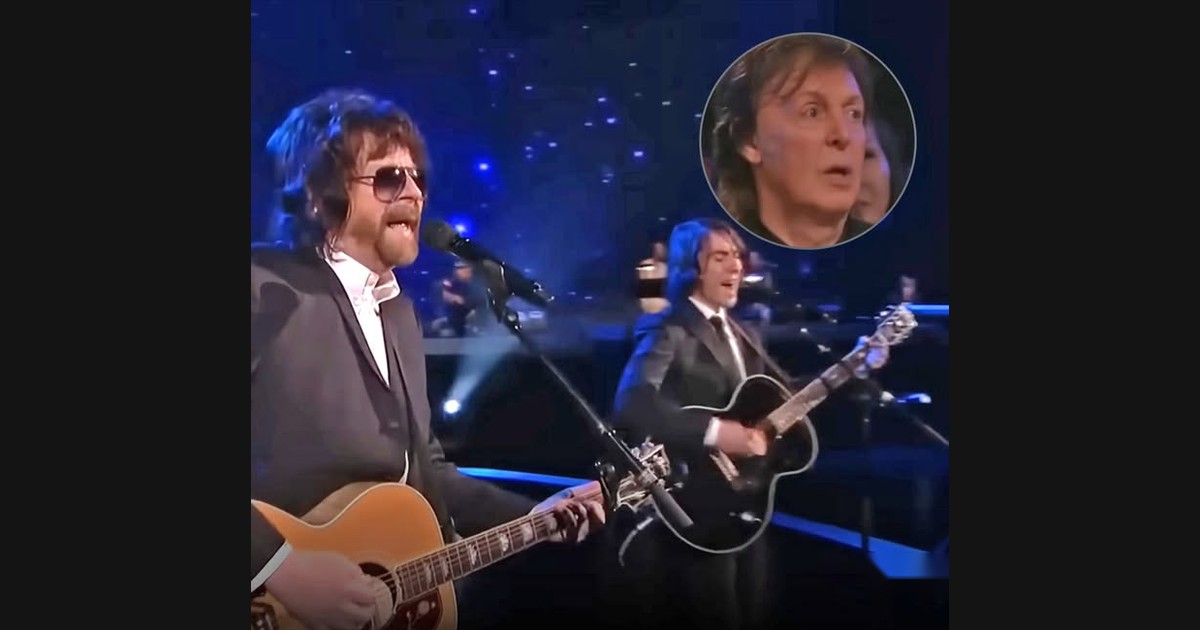
Jeff Lynne, Dhani Harrison and Joe Walsh’s “Something” belongs to a larger television occasion: The Night That Changed America — A GRAMMY Salute to the Beatles. The Recording Academy’s official program lists the trio for the song, giving the circulating performance a direct institutional reference.
The special marked the fiftieth anniversary of the Beatles’ first Ed Sullivan Show appearance and aired in February 2014. “Something” was one selection within that broader songbook, rather than a standalone concert devoted only to George Harrison.
Watch on YouTube ↗
A Harrison composition represents part of the band’s story
The Beatles’ own catalog credits Harrison as the writer of “Something” and places it on Abbey Road in 1969. Including it in the salute gives his songwriting a defined place beside material associated with Lennon and McCartney.
This is an important distinction in a group tribute. A band’s identity can contain several writers and performing personalities. Selecting repertoire is one way to make those contributions visible without reducing the history to a single voice.
The featured trio is part of a larger musical team
The official program names a house band including musicians such as Kenny Aronoff, Peter Frampton, Steve Lukather and Don Was, who also served as musical director. The three names attached to “Something” consequently identify featured participants, not every person contributing to the event’s sound.
A tribute arrangement needs relationships among those layers. A vocal line supplies the immediate statement; a guitar can become another foreground voice; the wider ensemble provides continuity. The musical director’s role belongs to the coordination of the full presentation.
Another upload does not create another tribute
The second video presents the same trio’s “Something” through another channel. Its title labels the 2014 Beatles tribute, but the official program remains the stronger reference for the event and featured artists.
Watch on YouTube ↗
For a focused listen, follow one complete musical thought. Ask how the melody remains identifiable when another instrument occupies the foreground. A song can retain direction even while attention passes from singing to an instrumental response.
This approach appreciates the ensemble without claiming an exact note-for-note reproduction of the Beatles recording. A tribute can acknowledge a composition through its own performance relationships.
A third presentation returns to the same material
The final upload again identifies Lynne, Walsh and Harrison. Its resolution labels do not establish a separate performance date or a different group of musicians.
Watch on YouTube ↗
Multiple online presentations can help a performance remain accessible, but they should not be counted as several distinct historical occasions. The three clips here lead back to one featured number in a documented television program.
Placed in that program, “Something” does two kinds of work. It gives viewers an interpretation by the featured trio, and it supplies a Harrison-written part of the Beatles repertoire within a wider anniversary celebration. The official credits connect both levels, letting the song be appreciated as a composition, an ensemble performance and a selected piece of a larger musical history.


