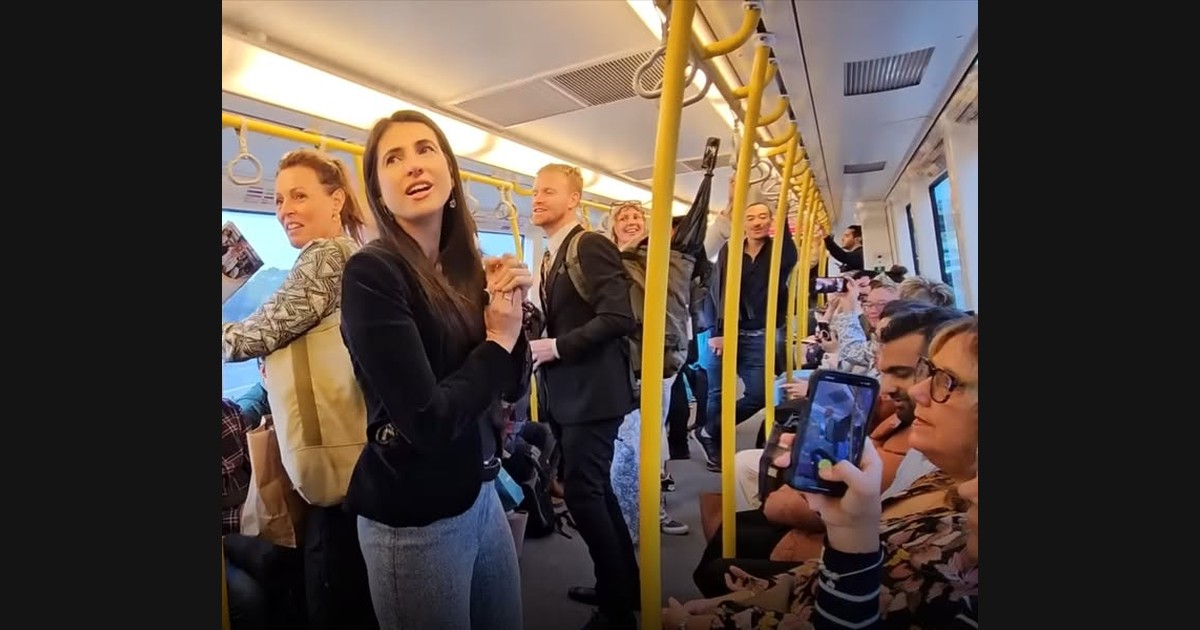
A song performed on a train can become known first through the setting and the people nearby. “Loosen” has a specific writer behind that public scene. The Liberators’ own description identifies Simone Alexander and fellow singers while crediting Aly Halpert as the composer.
That connection is worth preserving. The train performance is another interpretation of an existing work, not proof that the person most prominent in the clip wrote it. Halpert’s own recording supplies a direct route back to the song’s musical source.
Watch on YouTube ↗
Repetition gives a group common ground
A recurring musical idea can make shared singing approachable. Someone joining later has a chance to recognize the pattern as it returns, while existing participants can maintain continuity. Repetition creates another opportunity to enter the song rather than simply saying the same thing without purpose.
The text’s central invitation concerns releasing a burden. That is the song’s expressive address, not a medical promise about what singing it will do to someone’s body or mental health. A musical invitation can carry meaning without being treated as a guaranteed intervention.
The train is a particular public frame
A carriage brings performers and other passengers into the same confined environment. The recording can show a shared musical activity, but it does not establish that everyone chose to sing or had the same response. Listening, joining and remaining occupied with another task are different positions within the setting.
The creator’s emotional title should therefore not replace the music with a universal claim about strangers. The supported musical event is a group presenting “Loosen” in a public-transport space.
Halpert’s recording identifies the work directly
The original artist video credits music and lyrics to Halpert. It names Joey Weisenberg and Halpert for music direction and production, and identifies recording at Philadelphia’s Germantown Jewish Centre in November 2021.
Watch on YouTube ↗
The album was released through the Rising Song project in 2022. Halpert’s own description places the work within music for community and prayer. Those details provide a concrete creative context without requiring every later performance to reproduce the same setting.
Compare how the recurring idea functions in the two recordings. A public sing-along and a recorded ensemble presentation can share the composition while using different performing resources. The song remains the stable reference.
A second train selection uses another work
The Liberators’ “Over the Rainbow” recording supplies another public-transport performance. It is a separate song and occasion, not an additional section of “Loosen.”
Watch on YouTube ↗
The consistent setting makes the difference in repertoire useful to follow. A familiar composition can offer recognition; a repeated original song can establish its own landmarks during the performance. Both can give several people a shared musical task.
The opening video becomes more substantial when the songwriter stays in the account. Alexander and the other singers give “Loosen” another public life, while Halpert’s credited recording preserves the work’s origin and creative community. The train adds an occasion; it does not replace the people who made the song available to be shared.


