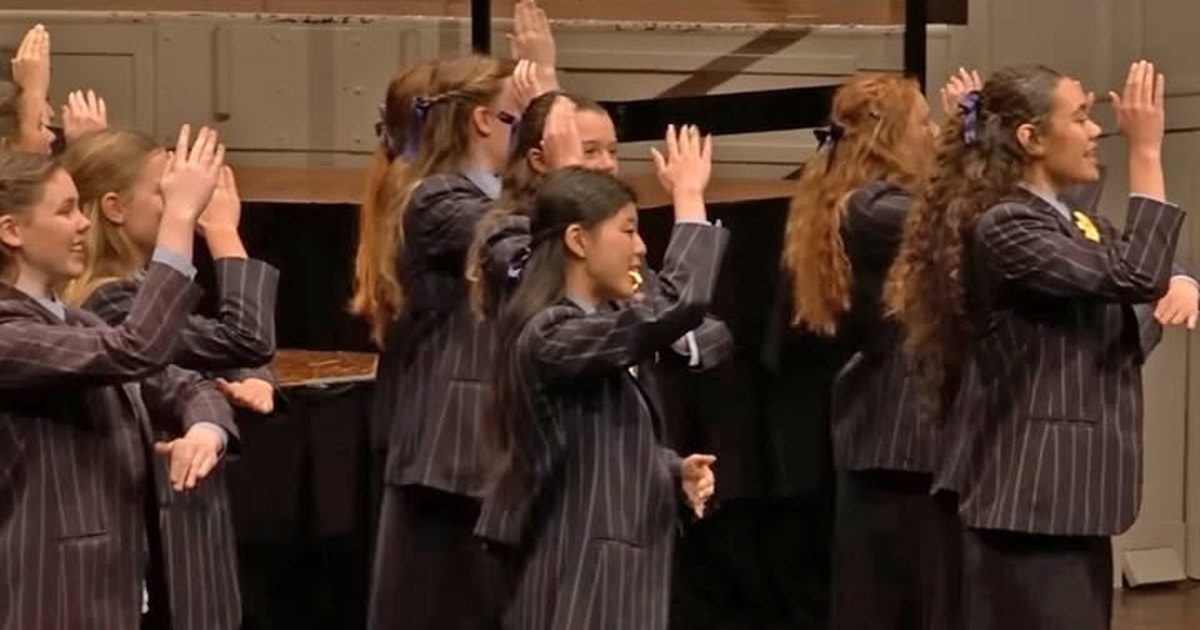
Before describing Takapuna Grammar School’s Leonessa performance as a general display of choral energy, begin with the information attached to the work. The New Zealand Choral Federation identifies the ensemble, names “Te Iwi E,” and credits Wehi Whanau in its official upload. Those details give the performance a more specific identity than a description based on gesture alone.
The federation’s separate 2025 awards record also lists Leonessa’s “Te iwi e” under its award for performance in te reo Māori. That supplies a documented language context. It should not, by itself, be used to assign the embedded video a recording date.
Watch on YouTube ↗
Language belongs inside musical attention
A listener who does not understand every word can still hear articulation, the shape of a phrase, and the relationship between syllables and a recurring pulse. Recognizing those features does not require pretending to translate the text. It does require leaving room for meaning that a first hearing may not reveal.
One practical approach is to follow a short repeated passage. Notice how its beginning is made clear and how the end gives way to the next musical event. Treat the words as part of the ensemble’s coordination, rather than an indistinct surface placed on top of the notes.
Credit also prevents an easy mistake: assuming that an unfamiliar choral work must be anonymous or simply “traditional.” The supplied identification names a work and a credit. A complete account should preserve that specificity rather than replace it with a broad cultural label.
Movement needs a musical reference
When watching the performance, connect any visible action to a musical event you can identify. A gesture may coincide with the start of a phrase, a change in emphasis, or a shared ending. Describing that relationship is more informative than treating all coordinated movement as the same kind of performance practice.
Nor does an ensemble’s movement authorize a listener to assign a ceremonial purpose or historical meaning without further evidence. It is possible to appreciate a performance’s physical communication while keeping those larger interpretations open.
A translated repertoire comparison
Ndlovu Youth Choir’s official isiZulu version of “Bohemian Rhapsody” supplies a different language-and-repertoire relationship. Here the title identifies a familiar composition presented in a specified language version, rather than another rendition of “Te Iwi E.”
Watch on YouTube ↗
The useful comparison is how recognition works. Someone who knows the earlier “Bohemian Rhapsody” may recognize a musical destination before understanding the new verbal presentation. Someone encountering “Te Iwi E” for the first time may instead learn its recurring landmarks within this performance. Familiarity changes the listening task.
A title is not a shared origin
Angel City Chorale’s “Africa” is the final selection. It offers another large ensemble and another named song, but its title should not flatten the different languages, composers, and contexts in this set into one category.
Watch on YouTube ↗
Across the three videos, preserve three separate questions: who is performing, what work is being performed, and what the presentation asks the ensemble to coordinate. Answering one does not automatically answer the others.
Leonessa’s performance benefits from that care. It remains a particular choir presenting a named work, with language and musical structure both worthy of attention. Its value does not depend on a generalized cultural description or an unverified account of the occasion.