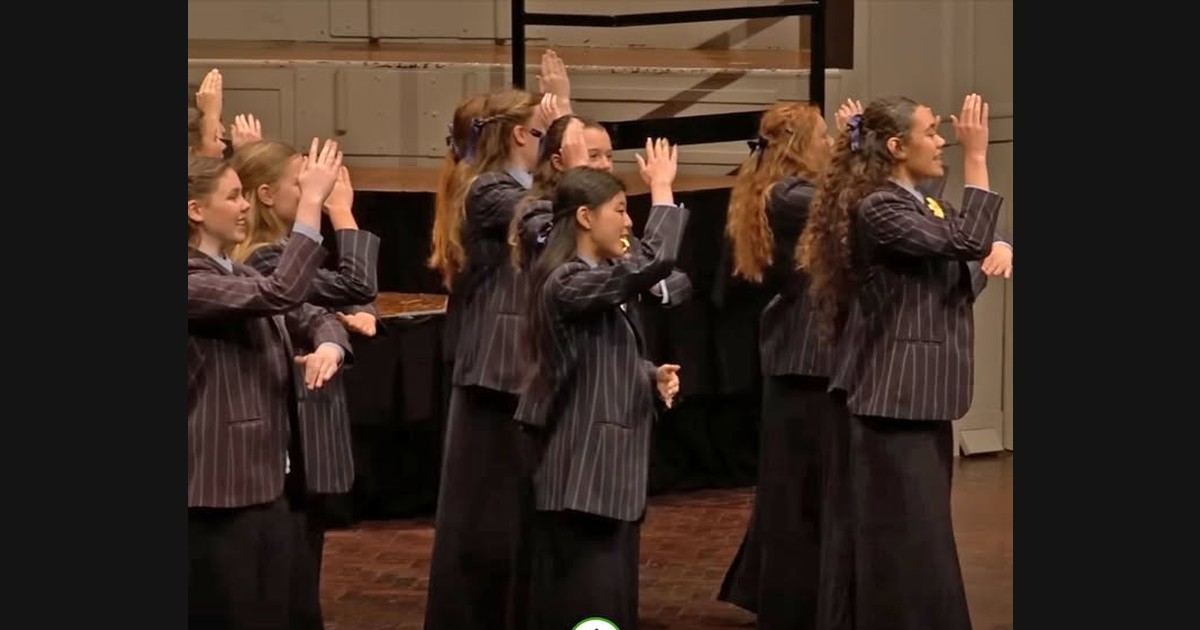
The loudest point in a choral performance is not always the most informative place to listen. The edges of a phrase can reveal a different kind of coordination: how several singers establish a beginning, complete a final syllable, and make room for what follows. Leonessa’s “Te Iwi E” provides a focused occasion for that kind of attention.
The New Zealand Choral Federation’s official upload identifies Takapuna Grammar School’s Leonessa and credits Wehi Whanau with the named work. The listening exercise here starts from that particular performance, then carries the same subject into two contrasting choir selections.
Watch on YouTube ↗
Listen for a boundary rather than a big moment
Choose a short phrase whose end you can recognize. On the first pass, follow the principal melodic direction. On the next, pay attention only to how the phrase finishes. A final sung sound, a consonant, and the moment of release can contribute different kinds of definition.
This does not require identifying individual singers or reading a score. It asks the listener to notice whether a musical unit feels complete and what creates that impression. The ending may feel decisive, suspended, or connected to the next idea, depending on the relationship between its parts.
A choral phrase also exists in a room. Sound can continue after an action appears to end, so visible and audible boundaries need not seem perfectly identical in a recording. Avoid treating every lingering sound as proof of a singer’s mistake. The useful subject is how the presentation makes the musical structure legible.
Follow the space after the phrase
After identifying the ending, keep listening instead of jumping immediately to the next entrance. The interval between phrases can create expectation. It can make a return feel prepared, a change feel abrupt, or a new section seem to begin from a different scale of attention.
There is a practical difference between silence as an absence and a pause experienced as part of an ongoing musical thought. The recording lets you investigate that difference without needing to assign a private intention to the conductor or the singers.
Another language version changes familiarity
Ndlovu Youth Choir’s official isiZulu version of “Bohemian Rhapsody” gives the exercise a new composition and ensemble. If you already know the song in another version, remembered landmarks may help you anticipate a transition.
Watch on YouTube ↗
Use that familiarity carefully. Anticipation is your reference point, rather than proof that this arrangement must follow every expectation. Notice where a phrase actually completes itself in the supplied performance. Then compare that experience with learning the phrase boundaries of “Te Iwi E” as you go.
Scale the exercise to a third ensemble
Angel City Chorale’s “Africa” provides another setting for following beginnings and endings. Keep the task small: choose one musical unit and listen through its complete course.
Watch on YouTube ↗
A larger impression of choral unity is built from many local relationships. Listening to a phrase boundary can make one of those relationships easier to grasp without reducing the performance to a technical checklist.
The three selections need not be ranked for precision from compressed online recordings. Their value here is comparative attention. Returning to Leonessa afterward may shift what stands out: a familiar title or visible movement can lead the first encounter, while the shaping of a phrase gives a subsequent listen a different and more specific purpose.


