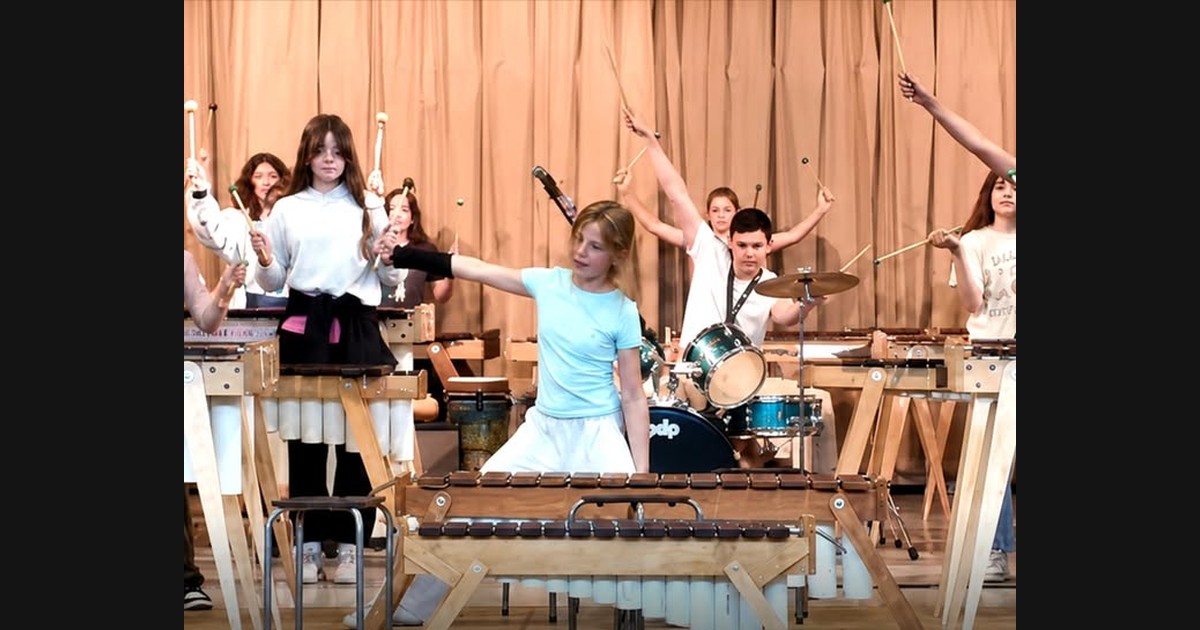
A familiar song can make ensemble work easier to notice. In Lava Ridge’s The Lion Sleeps Tonight, recognition gives the listener a melodic landmark; the interest then moves to how several players support and coordinate it. The performance is a group task, not merely a tune played on different instruments.
LavaRidgeMusic identifies the performers as the Lava Ridge Mallet Masters, a fifth-grade honors ensemble directed by Matthew Crawmer. Its description credits Walt Hampton’s arrangement and explicitly frames the piece as a test of time, feel and ensemble listening.
Watch on YouTube ↗
The arrangement distributes attention
A marimba ensemble can divide musical labor between melody, bass movement, repeating figures and harmonic support. Those parts do not need to be equally busy to be equally necessary. A repeated pattern can make another player’s entrance possible, while a lower line can establish where a phrase is heading.
This is the useful challenge of a recognized song. Knowing the melody does not automatically tell a player how to accompany it. The arrangement turns one shared reference into several responsibilities that must remain compatible.
For the listener, try following a supporting part across more than one phrase. Resist returning to the tune as soon as it becomes recognizable. The repeating material may be doing the work that allows the most noticeable line to remain clear.
Time and feel are connected, but different
Keeping time means maintaining a dependable relationship to the pulse. Feel concerns how notes sit within that relationship: their emphasis, length and connection. A mechanically regular sequence can still lack a convincing sense of phrase.
Ensemble listening adds another requirement. A player has to relate their own sound to the other parts, rather than treating the performance as a set of simultaneous private exercises. The director’s stated learning goals make that a more useful focus than measuring the children against professional virtuosos.
A simple listening exercise is to mark the pulse silently while following a repeating figure. Then redirect attention to the melody without changing that pulse. The task reveals how a stable background and a changing foreground can be heard at once.
Watch on YouTube ↗
The boys’ choir provides a different instrument
The Dagilėlis companion recording presents The Lion Sleeps Tonight through voices, with Remigijus Adomaitis credited as artistic director and conductor. A vocal ensemble has words, breath and consonants to coordinate; a mallet ensemble organizes attacks and ringing instrumental tones.
Both need shared timing, but the practical obstacles differ. A choir’s word ending can act like a collective release. A struck instrument’s note begins with an impact and then decays. Comparing those sound shapes explains more than describing one version as bigger or more energetic.
Watch on YouTube ↗
Recognition is the beginning of the comparison
The Tokens’ audio supplies the familiar recorded song in another setting. It is a useful reference for distinguishing the composition’s recognizable identity from the sound of any one arrangement.
Lava Ridge’s version gives that identity a classroom ensemble purpose. The credited arrangement and the director’s learning goals direct attention toward coordination, not novelty alone. The strongest achievement to follow is a group maintaining its shared musical ground while different parts do different work.


