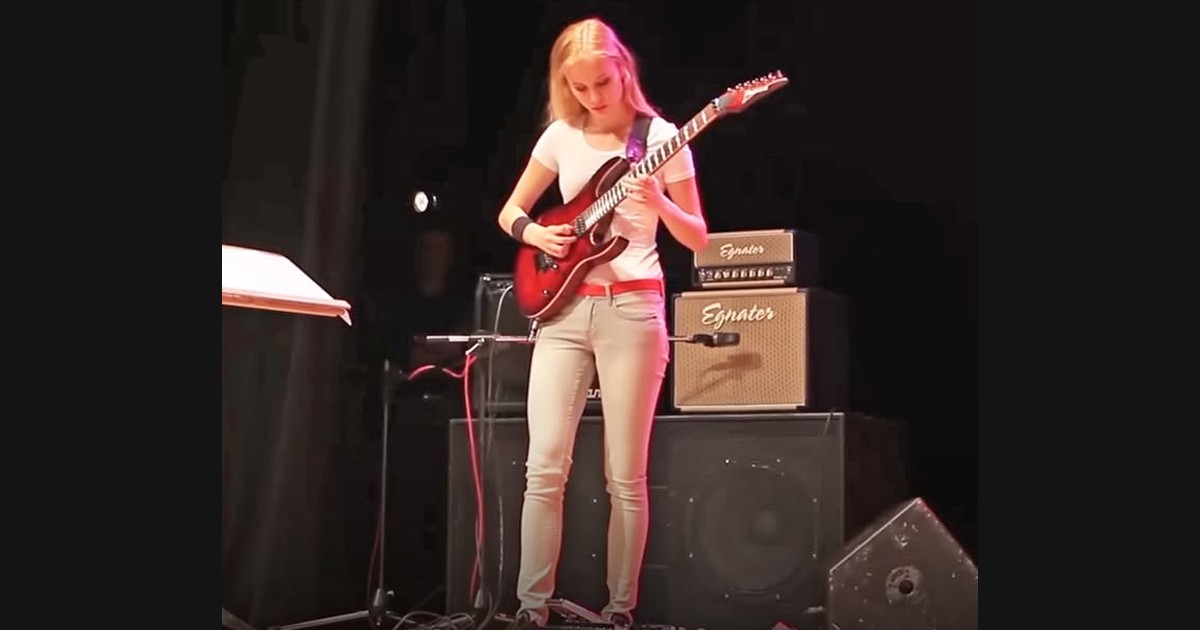
“Canon Rock” points in two directions at once: toward Pachelbel’s familiar source work and toward JerryC’s guitar arrangement. Laura Lāce’s cover is a useful entrance to a musical distinction that the familiar title can obscure. Repeating a foundation and repeating a melody in overlapping voices are different processes.
Pachelbel’s Canon in D is published for three violins and basso continuo. Its design combines a recurring bass foundation with imitation among the upper parts. A rock arrangement can draw on the source without reproducing that original distribution of instruments and voices.
Watch on YouTube ↗
A loop and a canon answer different questions
An ostinato is a returning musical pattern. Its repetition gives the listener a stable reference while other material develops around it. A canon instead concerns a relationship between parts: one voice begins material that another takes up after a delay.
Imagine a short melody labeled A. In a simple illustration, the first voice begins A; after a gap, the second starts A while the first continues onward. The overlap creates a musical relationship that would not exist if everyone merely repeated A together. This is an illustration of the principle, not a transcription of Lāce’s video.
A recurring bass can support that imitation, but the two devices are not identical. Hearing a familiar chord cycle does not, by itself, prove that every lead phrase is being treated as a strict canon.
What changes in a guitar arrangement
The supplied performance explicitly credits JerryC’s “Canon Rock” as the arranged work being covered. That gives the listener permission to hear a transformation rather than demand a literal recreation of the original chamber scoring.
Choose a short stretch and divide your attention between what returns underneath and what changes above it. The lead line may become more active while the foundation remains familiar. Such a relationship can create direction through contrast: the listener recognizes a place while hearing a new route through it.
Instrumental display is only one part of that experience. Repeated material can make a change legible, and a sustained idea can give a dense passage a reference point. The question is how the arrangement organizes those relationships over time.
Vivaldi brings a different source design
Lāce’s “Summer Presto” cover changes the source work. It should not be assumed to employ the same formal plan merely because both selections translate older repertoire to electric guitar.
Watch on YouTube ↗
Instead, carry over the distinction between recurring and developing material. Listen for an idea that returns and consider what makes its return recognizable. Its role can differ from the persistent foundation associated with the Pachelbel source.
A performance setting adds another layer
The final “Summer” upload is identified as a live version. It offers another presentation of the Vivaldi-related material, allowing the comparison to move from source design to performance context.
Watch on YouTube ↗
Keep the vocabulary modest: repetition, imitation, return, and contrast describe different relationships. There is no need to assign every visible gesture a technical name.
Lāce’s “Canon Rock” is more informative when those distinctions remain available. The familiar source supplies a point of connection, JerryC’s arrangement supplies another set of decisions, and the guitarist’s performance makes those decisions unfold in time.