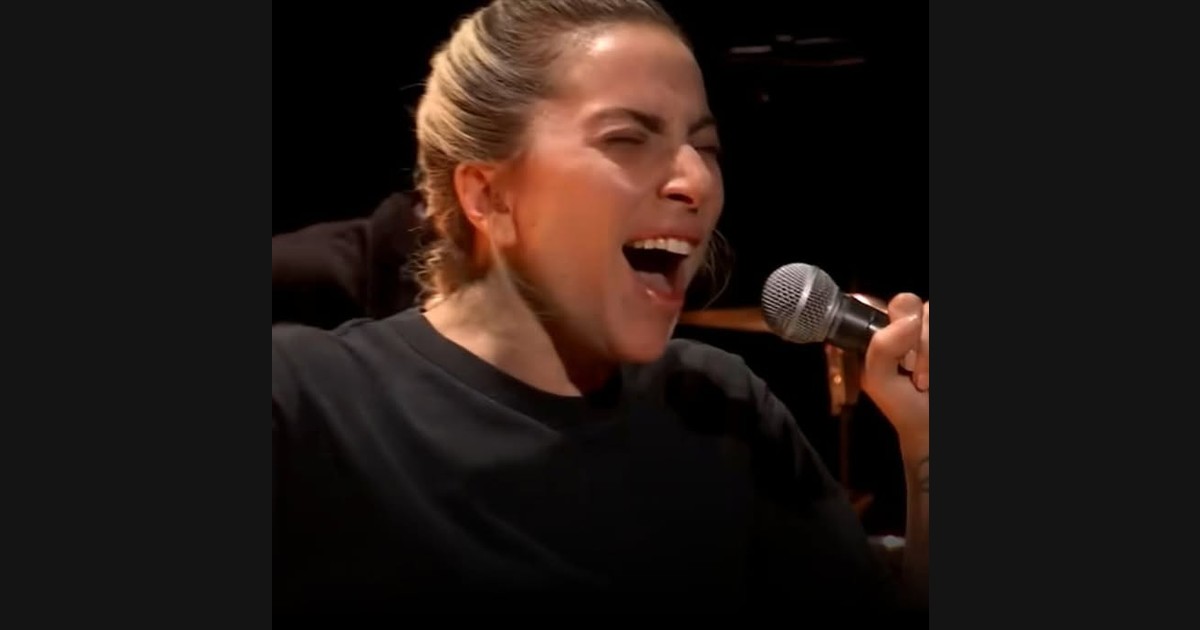
Lady Gaga’s official “Hold My Hand” Oscars video can be viewed beside two other television appearances: “Happy Mistake” on Jimmy Kimmel Live! and “Million Reasons” at the Royal Variety Performance. The three selections have a shared featured artist, but they belong to programs with different purposes.
That difference offers a more useful comparison than searching for one performance that supposedly reveals the real person behind every other presentation. Television performance is shaped work. A close visual frame or a restrained musical setting can be a deliberate artistic choice without becoming proof that preparation has vanished.
Watch on YouTube ↗
The awards-show segment
“Hold My Hand” enters the 2023 Oscars through its association with Top Gun: Maverick and its Original Song nomination. It occupies one part of a larger ceremony concerned with film. The performance has to establish a musical identity within a program whose surrounding segments may be quite different.
For the viewer, the song becomes a complete unit of attention inside that larger sequence. A live arrangement can give it a beginning and ending that work for the occasion, even when the listener knows the composition from another setting.
The camera changes apparent distance
A television image can make a large venue feel close by concentrating on a face, a voice, or a small part of the performing space. That closeness is a feature of presentation. It does not tell us that the physical audience, the production team, or the supporting musicians have ceased to matter.
Compare what the image encourages you to notice with what the music requires you to follow. The frame may feature one person while accompaniment continues to carry timing and harmonic movement. Keeping both in mind prevents a visually spare presentation from being mistaken for a performance without collaboration.
A song inside a talk show
The official “Happy Mistake” clip changes the program context to Jimmy Kimmel Live!. A featured musical appearance in a talk show has a different relationship to its surrounding material from a film-awards selection. The title and program name help identify that relationship without requiring a claim that the song was written specifically for the broadcast.
Watch on YouTube ↗
Listen for how quickly the performance establishes its own pace. A song arriving among conversation and other television segments still needs a coherent arc. Its arrangement can draw the viewer into that temporary musical space through the proportions of phrases and returns.
A place within a variety program
“Million Reasons” supplies the third context. The Royal Variety Charity’s archive places Gaga in its 2016 Hammersmith program. A variety bill brings several kinds of performance together, so an individual song has to be recognizable as a distinct contribution while fitting the occasion’s broader flow.
Watch on YouTube ↗
Keep the comparison tied to those actual settings. The three clips do not establish that one audience was more moved, that one performance used less technology, or that an artist’s visual choices reveal a private emotional hierarchy.
What they do provide is a route through three forms of televised music: a film-awards showcase, a talk-show appearance, and a variety contribution. Following how a song establishes its own scale within each form makes Gaga’s recurring performance identity more interesting than a simple contrast between spectacle and intimacy.


