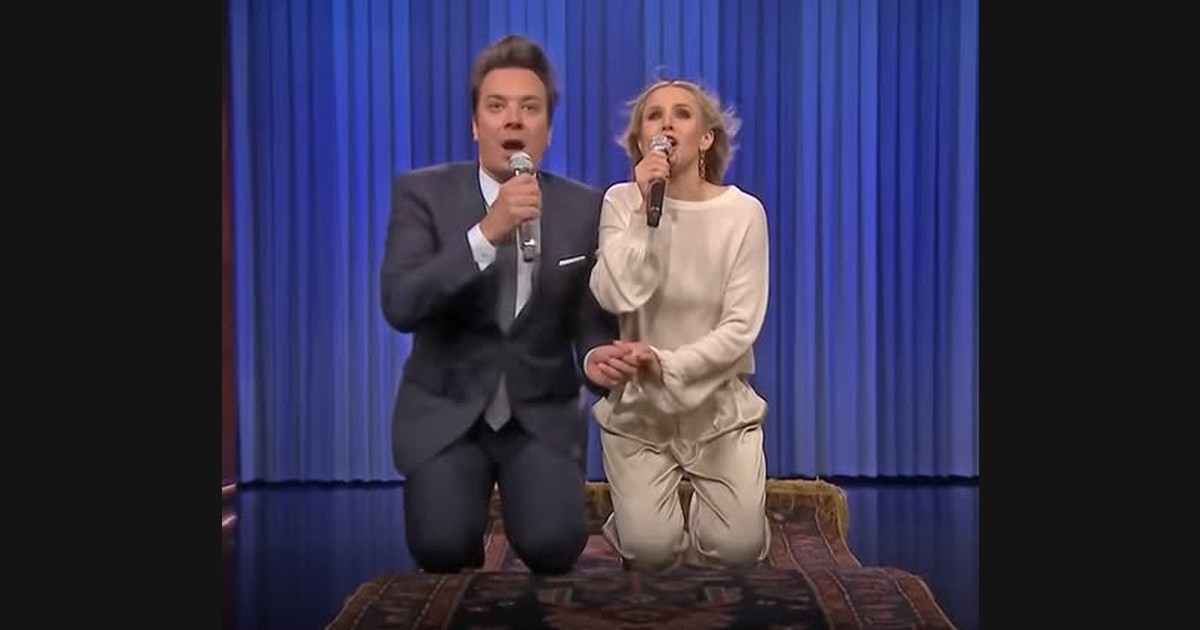
Kristen Bell can sing a Disney selection on television without becoming the original voice of every character associated with it. That distinction is useful when watching her “History of Disney Songs” medley with Jimmy Fallon. The segment moves through a catalog, while Bell’s own film credits describe a more specific set of roles.
Disney identifies Bell as Anna in Frozen and Idina Menzel as Anna’s sister Elsa. Santino Fontana voices Hans. The two related selections give those credits a practical listening context, separating a performer’s identity from the fictional person a song presents.
Watch on YouTube ↗
Three names can belong to one musical moment
There is the name of the performer singing now, the name of the character associated with the song, and the name of the performer credited in the original film. Those names sometimes coincide in a concert appearance, but a medley does not require them to.
The distinction prevents a familiar shortcut: recognizing Bell from Frozen and then attributing all of the film’s singing to her. A shared film contains several voices and musical situations. The public personality who introduces a television segment is not a substitute for the film’s individual credits.
It also leaves a cover free to function as a cover. A performer can interpret material outside an established character without pretending to have originated that role. Part of a medley’s appeal is the freedom to move among those associations.
A character’s position belongs to a story
Within a musical film, a song occurs at a particular point in the narrative. The audience knows something about who is singing and what that person understands at the time. A television excerpt may retain the melody while leaving much of that surrounding information behind.
When a fragment feels immediately familiar, distinguish memory of its tune from memory of its dramatic situation. Both can shape the response, but they are different sources of recognition. Someone new to the film may hear the same excerpt without supplying the missing story.
Bell and Fontana in a named selection
Disney’s “Love Is an Open Door” performance explicitly names Bell and Fontana. It offers a more concentrated comparison than the medley: two credited singers carry one work associated with their film characters.
Watch on YouTube ↗
Follow the exchange as musical dialogue. A response can make a statement sound agreed upon, challenged, or completed. Understanding that structure does not require treating either actor’s fictional position as a report about their own relationships.
Menzel supplies another credited voice
The official sing-along selection identifies Menzel with “Let It Go.” It gives a specific reference for a song that may be recalled more quickly than the separate names behind its film presentation.
Watch on YouTube ↗
The credits allow both performers to retain their own contributions. Bell’s participation in the medley and Menzel’s identification with this selection can be appreciated together, without forcing one to replace the other.
Watching with that distinction in mind adds clarity to the familiar material. The medley is a present-day performance of selected songs, the related videos identify particular singers, and Frozen supplies characters whose musical moments belong to a larger story. Each layer offers something different to follow.