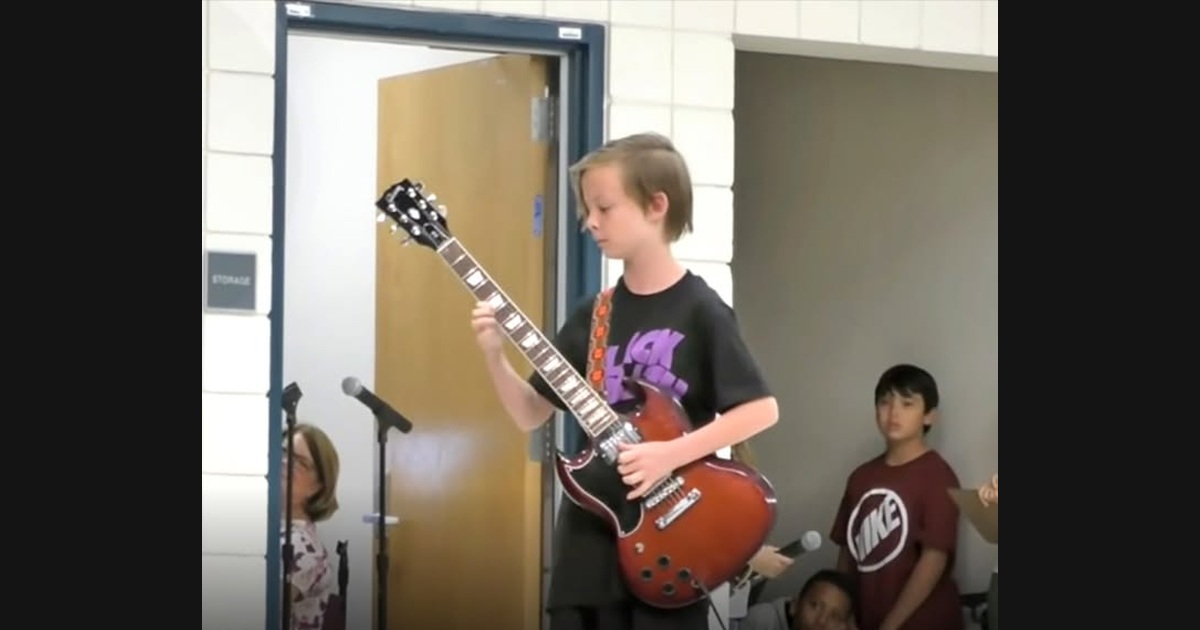
Julian’s “Thunderstruck” talent-show recording is more interesting when it is understood as a learning moment rather than a claim of finished perfection. The original uploader explains that he was still working on the song with his guitar teacher when he chose to bring it onto the stage.
The same account says Julian had originally planned to perform the bass part from Metallica’s “Orion,” then changed to guitar. That is a concrete musical decision: instead of presenting one instrument’s role inside one composition, he selected a different instrument and a song with an immediately recognizable guitar identity.
Watch on YouTube ↗
The familiar figure provides an entry point
AC/DC’s official catalog places “Thunderstruck” at the opening of the 1990 album The Razors Edge. Its recurring guitar figure gives listeners something to recognize before a singer needs to explain the song. That makes it an understandable choice for an instrumental school appearance.
Recognition is only a beginning, however. A repeated figure still needs continuity: the next group of notes must relate to the previous one, and the performer needs a sense of where the music is going. A familiar opening does not remove the practical task of sustaining a performance.
An audience changes the experience
The uploader describes a moment when early cheering left Julian unsure how to respond and a teacher signaled for him to continue. Presented as the uploader’s account, this gives the recording a useful human context without turning every reaction in the room into a dramatic claim.
Practice normally allows a musician to stop and return to a difficult passage. A public appearance introduces another task: maintaining the sequence while other things happen around it. That does not mean a learner must ignore the audience. It means playing and responding to the room become related parts of the experience.
The teacher’s encouragement belongs to that context. It makes the appearance a supported activity, rather than a tale of an isolated child suddenly revealing an unexplained ability. Instruction, practice and a decision to try the song all precede the performance.
AC/DC supplies the full-band reference
The official “Thunderstruck” video places the guitar idea within the established band’s sound. Compare how the recurring figure relates to the larger arrangement once other parts enter the musical picture.
Watch on YouTube ↗
This is a helpful distinction for viewers as well as players. Recognizing a riff means identifying one important musical idea; following a song means understanding its place among other sections and responsibilities. A learner’s stage recording and a professional band release answer different kinds of questions.
Another young guitarist in a different situation
The final recording presents a young guest performing “Enter Sandman” with Foo Fighters. Here the player joins an established live band rather than occupying a school talent-show slot.
Watch on YouTube ↗
The settings differ, but both invite attention to participation in a complete musical sequence. Neither recording needs to predict a child’s future career to be worthwhile. Julian’s appearance already preserves something specific: a song being learned, a choice to attempt it publicly and the support that helped the performance continue.