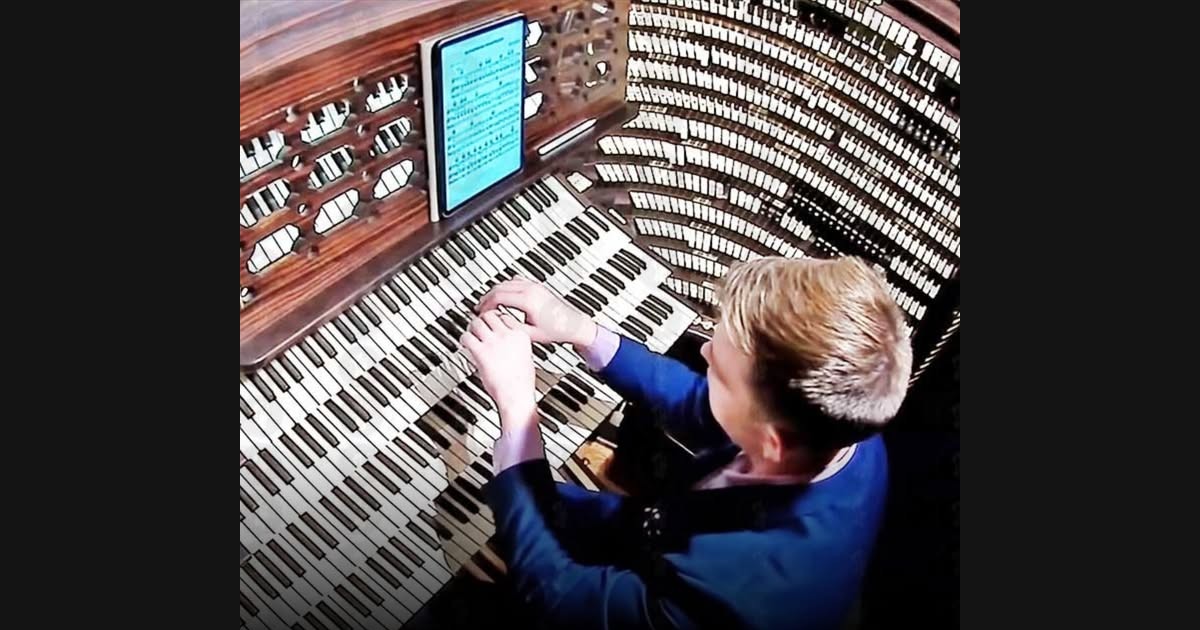
An organ-console video can look like a musician operating an entire room. The controls around Josh Stafford’s Bohemian Rhapsody performance are easier to understand when they are separated into different jobs. A keyboard, a tonal selection and a foot control do not all contribute in the same way.
The Historic Organ Restoration Committee identifies the instrument as the Midmer-Losh at Boardwalk Hall in Atlantic City. Its official description lists seven manuals, the keyboards played by the hands, alongside several categories of controls. The console is an interface to a much larger instrument, not a stack of seven independent pianos.
The Stafford performance
Watch on YouTube ↗
The song provides a familiar route through a complex-looking presentation. Recognition lets the listener keep track of the music while gradually understanding the visible actions. There is no need to identify every control before enjoying the arrangement.
Three distinctions that make the console less mysterious
- Playing notes
- A manual gives the performer a keyboard through which to articulate musical material.
- Selecting sounds
- Organ registration concerns the combination of available sounds used for a passage.
- Controlling expression
- Some controls affect how the instrument’s resources are presented rather than supplying another melody.
The specific console has its own design, which the restoration committee documents in detail. A general distinction is enough for viewing: not every movement introduces a new note, and not every audible change must correspond to an obvious move from one keyboard to another.
A camera angle can hide the action that produces a change. It is better to describe a change in musical color than to assign it an exact stop combination without evidence. The published specification explains the instrument’s resources; it does not identify every setting used in this particular performance.
Watch one layer, then hear the whole
Choose a short section and follow the recurring musical foundation. On another pass, attend to the melody. These layers may depend on different combinations of actions, but their musical relationship matters more than the apparent complexity of the movement.
For example, a stable lower part can make a changing upper line easier to follow. A different tonal color can separate a new section without requiring every underlying part to stop. The console gives the performer ways to organize those relationships.
A band distributes the controls among people
Watch on YouTube ↗
Queen’s official Live Aid selection provides a contrast in organization. A band divides musical responsibilities among performers and instruments. An organ arrangement brings more of those responsibilities to one interface, even though it does not need to copy every original instrumental sound.
Compare a transition between sections. Notice how the music signals a new character in each setting, then distinguish that musical result from the physical actions used to create it.
A featured guitar inside an ensemble
Watch on YouTube ↗
The Rock Hall’s While My Guitar Gently Weeps selection adds another relationship: a featured instrumental part within a continuing group. Follow what the ensemble sustains while the foreground changes.
Returning to Stafford’s console with those comparisons makes the visible coordination more intelligible. The controls serve musical decisions about foreground, support and contrast. Understanding their different jobs turns the console from an impressive collection of switches into a way of presenting a coherent arrangement.


