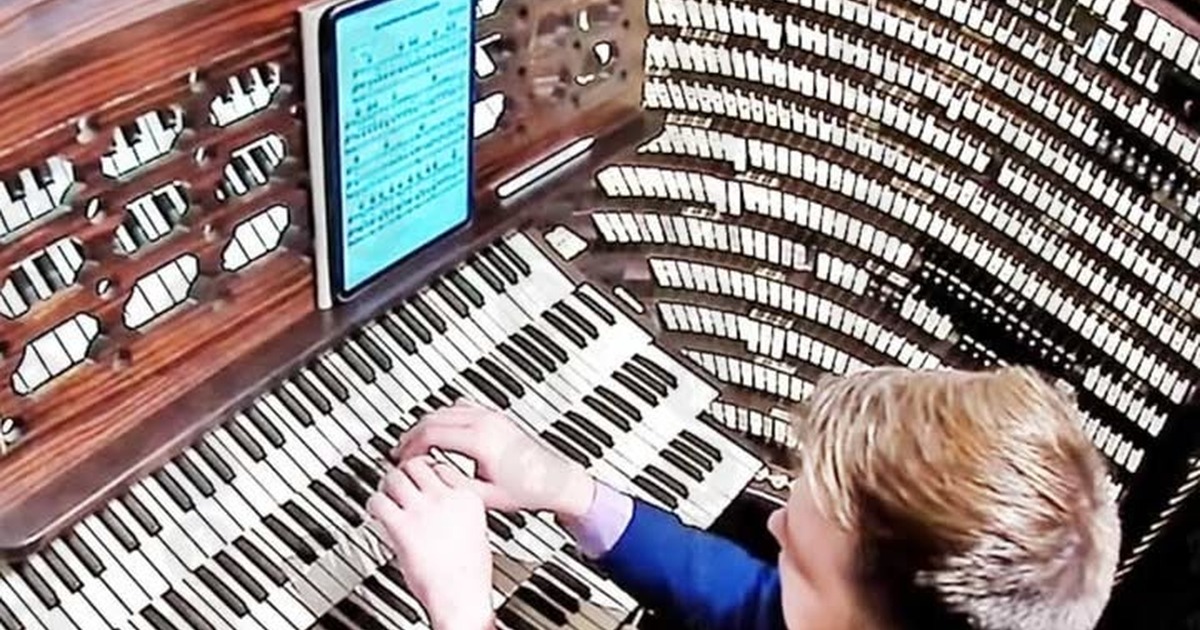
Moving Bohemian Rhapsody to a pipe organ is an arranging problem before it is a spectacle. A rock recording divides its work among voices and instruments. Josh Stafford’s Boardwalk Hall performance invites a listener to consider how those jobs can be reassigned when one performer controls a different musical system.
The Historic Organ Restoration Committee presents the recording among its own performance videos. The instrument is the Midmer-Losh organ at Boardwalk Hall in Atlantic City. Its main console has seven manuals, or hand keyboards, but the number of keyboards is only the beginning of the story. An arrangement still has to make musical relationships clear.
Translate the job, not just the sound
Watch on YouTube ↗
A melody is not valuable only because of the particular sound that first carried it. It can remain recognizable when played on a different instrument. The same principle applies to a bass line or a repeated rhythmic figure: an arranger can preserve what the part does while changing the sound through which it does it.
Consider a hypothetical band passage with a sung melody, a bass foundation and short accompanying chords. An organ version does not need to imitate a singer, bass guitar and rhythm guitar literally. It needs the listener to distinguish a foreground line, a foundation and a supporting pattern. That is a more useful test of the arrangement than counting how many original sounds it resembles.
Contrasting sections need audible boundaries
The composition’s changes of character make it a particularly revealing subject. When material shifts, an arranger can change register, density, articulation or the combination of organ sounds. Register refers to pitch area; density concerns how many musical elements seem active together. Either can signal a new section without changing the underlying tune.
Follow one transition as a complete event. Include the end of the earlier material, the change itself and the beginning of what follows. A dramatic new sound may attract attention, but the connection around it determines whether the whole piece still feels coherent.
What the concert-band reference contributes
Watch on YouTube ↗
The related Queen selection is labeled as Bohemian Rhapsody / Radio Ga Ga at Live Aid in 1985. Its program and performance frame differ from Stafford’s organ arrangement. It therefore supplies a reference for band roles rather than a requirement that the organ version reproduce the same sequence exactly.
Listen to a musical task that both settings need to solve, such as keeping a central line intelligible while other activity surrounds it. On organ, a change of sound can create separation; in a band, different players and instruments already offer distinct identities. Both approaches require decisions about balance.
A featured instrument still belongs to a larger design
Watch on YouTube ↗
The Rock Hall’s While My Guitar Gently Weeps tribute adds another contrast: a group can make space for a featured instrumental voice while retaining an ensemble underneath it. Stafford’s task brings more of those responsibilities to one console. This is a difference in organization, not a reason to rank one format above the other.
After the comparisons, return to the organ performance with a simple distinction in mind. Recognition tells you which song you are hearing; arrangement explains how this version lets you follow it. The instrument’s scale is striking, but the musical interest lies in choices that keep foreground, support and contrast working together.


