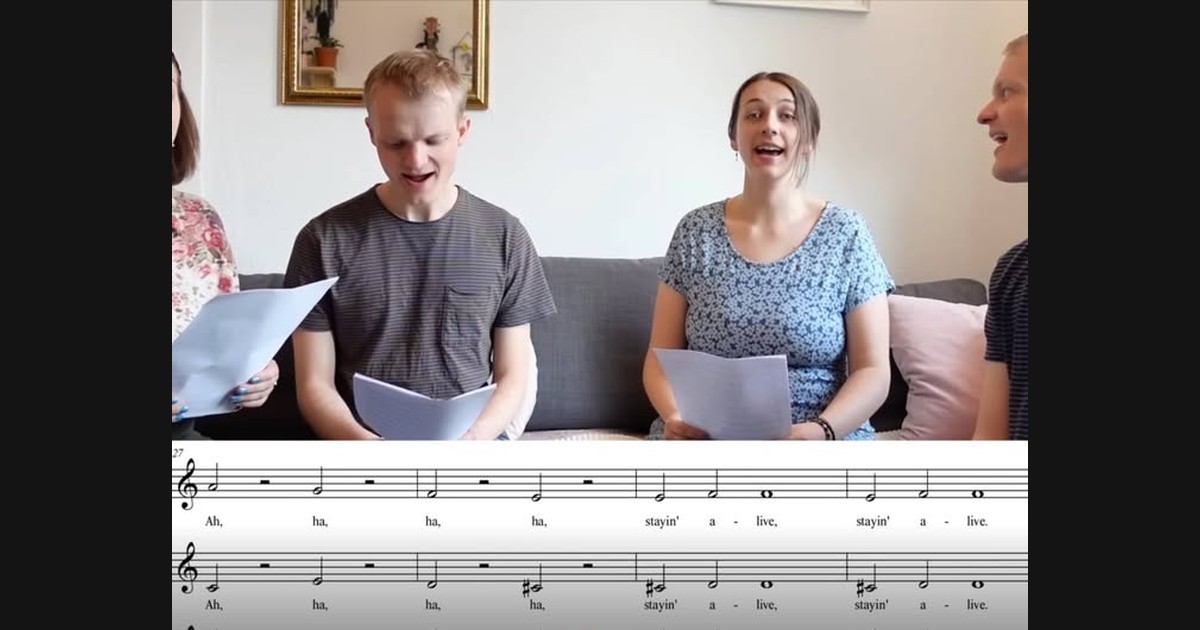
Jonasquin’s “Stayin’ Alive” asks how a familiar pop song might sound in the style of a sixteenth-century madrigal. Its published arrangement supplies a concrete musical detail behind that premise: the scoring is SATB choir.
SATB identifies soprano, alto, tenor, and bass parts. It describes a distribution of vocal lines, not automatically four visible people or four unedited recording takes. That distinction gives the listener something more useful than the costume or historical joke alone.
Watch on YouTube ↗
A part can be followed through time
When several voices sound together, attention often settles on the highest or most familiar line. A score organized into parts offers another way of listening: follow one line as it continues, rests, enters, or changes direction.
Then listen to how it relates to another part. Two lines may move together for a passage or contribute different activity at the same moment. Their relationship can create motion even when the underlying song remains recognizable.
For example, imagine one part sustaining a note while another continues with shorter movement. The combined sound changes through the active line, while the held note provides continuity. This is a general model for hearing layered voices, not a transcription of a particular bar in Jonasquin’s arrangement.
Hear horizontally and vertically
A horizontal pass follows a single line over time. A vertical pass attends to the combination sounding at one moment. A rest belongs to a part’s design too; silence can leave another line audible. The two approaches reveal different relationships: a part’s direction and the sonority created when parts meet.
Try one of each rather than attempting to follow all four parts equally from the beginning. First choose an identifiable line. Then return to a shared arrival and listen to the combined voices. Even without reading notation, the change of focus can make the arrangement less like one undifferentiated block of singing.
The publication has specific limits
The marketplace listing identifies Jonasquin as arranger, gives SATB scoring, and credits the underlying song to Barry, Maurice, and Robin Gibb. It dates that song to 1977. The sixteenth-century premise is therefore a stylistic reimagining, not a newly discovered historical composition.
Likewise, the published score does not document every layer of the released video’s production. It identifies musical parts. Avoid translating the four-part designation into an unsupported account of how many people or recording passes produced the soundtrack.
Another arrangement changes the song
Watch on YouTube ↗
“Bridge over Troubled Water,” credited with Tabea Bös, keeps Jonasquin’s historical-style project in view while changing the composition and featured partnership. Follow a line or a shared arrival using the same method, without assuming every piece must use identical scoring.
Watch on YouTube ↗
“Let It Be,” credited with Anna Petrtylová, supplies another arrangement. Its relevance is a third opportunity to distinguish the familiar song from the organization of its new vocal parts.
The most useful outcome is a small musical map: one line’s direction, another part’s contribution, and a moment when they arrive together. That gives the historical-style premise audible substance while preserving the modern song’s writing credit and the arranger’s separate work.