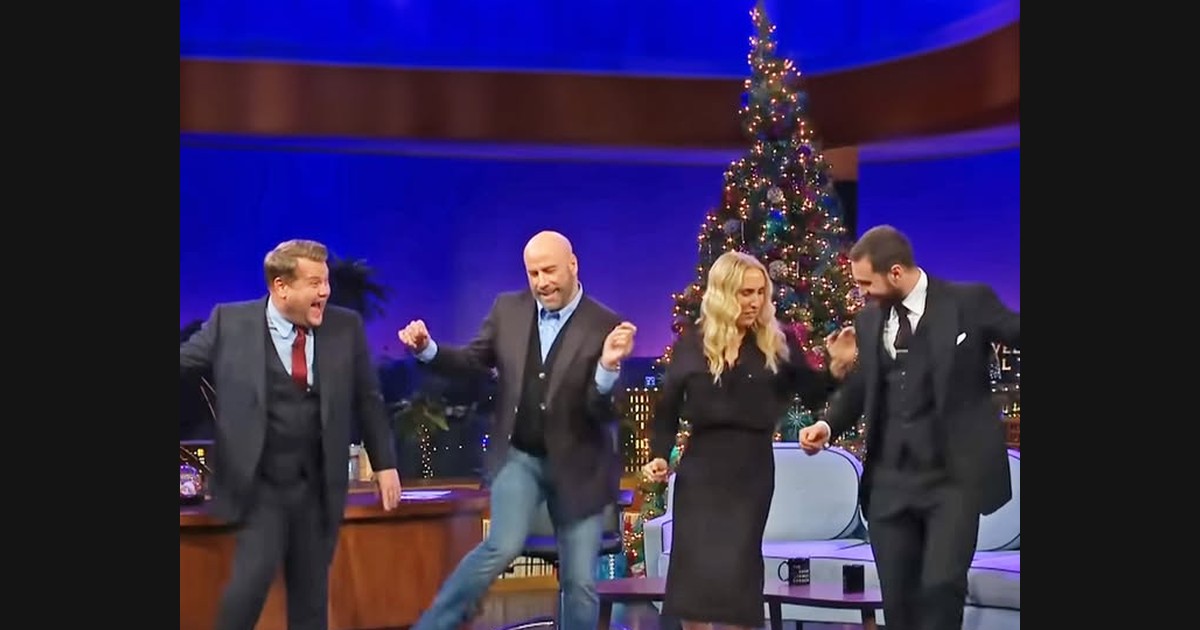
John Travolta’s screen history can supply both a demonstration and a game. On James Corden’s programme, a conversation about Pulp Fiction leads into dance. On Jimmy Fallon’s, roles associated with Travolta become prompts for a comic contest. The shared reference is a performer; the rules of the encounters are different.
The Corden clip begins from Aaron Taylor-Johnson and Sam Taylor-Johnson recalling costumes based on Travolta and Uma Thurman’s film characters. Travolta then discusses developing the dance with Quentin Tarantino. A screen role has already moved into another public activity before the demonstration begins.
Watch on YouTube ↗
A recognizable character can be reduced to a few cues
Costumes, posture and movement can make a character identifiable without reproducing an entire scene. This is how a film role can circulate at a party, in a television conversation or in a brief imitation.
Selection is essential. An imitation cannot include everything a performance contains; it needs a few details that let an audience locate the reference. Recognition then does some of the work, filling in a broader association from a limited cue.
That process is different from developing a character inside a film. A dramatic scene has relationships and consequences around it. A later imitation can borrow its recognizable surface for a much smaller task.
The original performer does not have to control every version
A familiar role can become shared cultural material. People remember it, dress as it and compare their attempts to enact it. The actor’s participation in a television game acknowledges that continuing life without making every imitation an exact copy.
The useful question is what the new format asks participants to do. A demonstration can provide a model for others to follow. A game can make the distance between a model and an attempt part of the entertainment.
Watch on YouTube ↗
Fallon’s Travolt-Off makes the rule explicit
The Tonight Show describes a challenge in which Fallon and Travolta take turns selecting randomly generated roles and acting them out. Its comic premise asks who can be the better John Travolta, putting the original performer inside a contest built around his own screen identities.
The rule supplies a clear sequence: receive a reference, choose how to represent it and make the attempt recognizable. The performers are not being asked to recreate an entire film. They are responding to a compact prompt in a present-tense exchange.
That also explains why a broad gesture can work. In a recognition game, immediate readability may matter more than subtle dramatic development. The same gesture would have a different responsibility inside a full scene.
Watch on YouTube ↗
The film gives the reference its larger world
The Pulp Fiction dance excerpt returns the movement to its screen setting and to the pairing of Travolta and Thurman. It supplies context for the later references while remaining a separate work from either television segment.
Across the clips, the interesting transformation is from role to reusable cue. Corden’s conversation explores how a remembered scene can be demonstrated; Fallon’s contest explores how quickly an associated role can be recognized. The actor’s history provides the material, while each programme gives that material a different public job.


