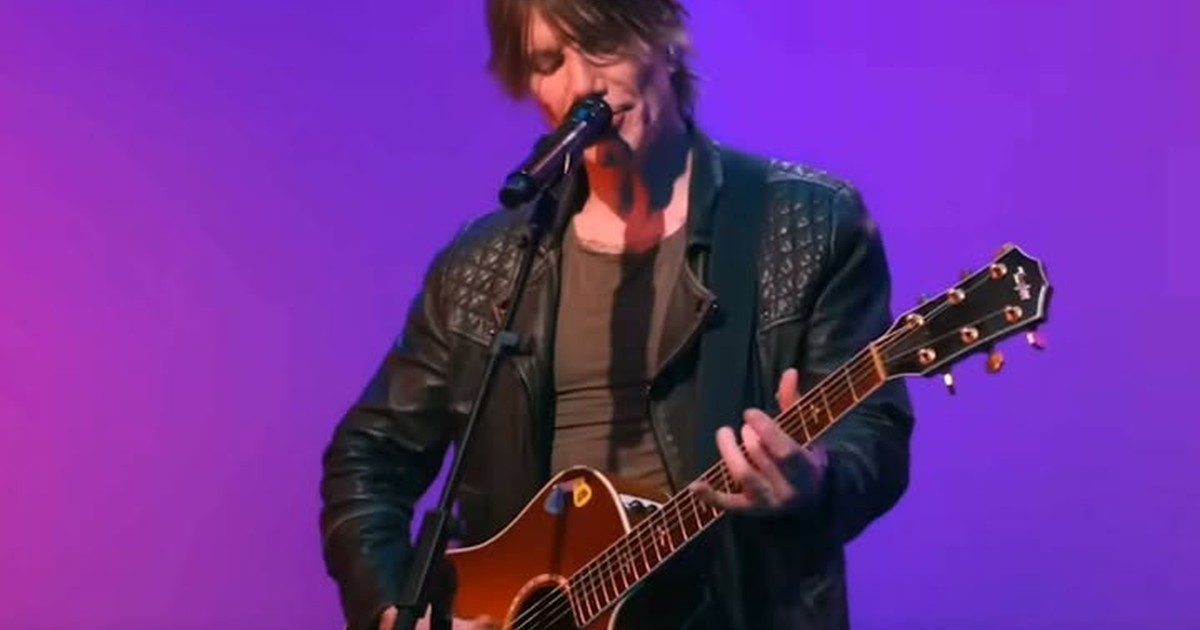
John Rzeznik’s Apple Music Studios performance of “Iris” offers a concentrated starting point for a song that also belongs to much larger concert settings. With voice and guitar at the center, the presentation invites attention to the musical framework underneath the familiar Goo Goo Dolls recording.
The band shared the performance on its official website in February 2026, identifying Rzeznik’s visit to Apple Music Studios. Apple’s original description places the session in Los Angeles. These direct sources connect the studio appearance with the band and its continuing repertoire, rather than presenting it as an unidentified acoustic clip.
Watch on YouTube ↗
A smaller arrangement redistributes responsibility
In a voice-and-guitar setting, one instrument may need to preserve several functions: harmonic movement, a sense of pulse and the connection between vocal phrases. It cannot simply reproduce every part of a larger band recording simultaneously. The arrangement works through selection.
That makes a useful listening question: which elements are essential to recognizing the song? The main melody is one answer, but recurring harmonic motion and the approach to a returning section can be equally important. A familiar work can survive a substantial change in scale because its identity rests on relationships, not one fixed quantity of sound.
The central address remains personal
“Iris” places the wish to be understood against a reluctance to be exposed to the wider world. That dramatic relationship remains available whether one person sings in a studio or a large audience participates in a concert. Public performance and private address can exist together inside the same composition.
The performer need not be recounting a new literal event each time the song returns. A continuing repertoire work gives a singer material to interpret repeatedly. That distinction allows a listener to engage with the words’ situation without inventing a fresh personal story behind every recording.
Buffalo changes the public scale
The band’s official video identifies the second performance as Buffalo on July 4, 2004. It supplies a live-concert reference for the same composition, with a different relationship between the stage and the people attending.
Watch on YouTube ↗
Compare how a recurring section is prepared in the two settings. A close studio presentation may make a small change of emphasis easy to follow; a concert arrangement can draw on a wider ensemble. Neither needs to reproduce the other’s exact balance to make the destination recognizable.
It is also worth separating an audience’s familiarity from the song’s narrator. People can share a refrain publicly while the composition continues to express a singular address. That coexistence is one reason intimate songs can function at a large scale.
A shared vocal presentation
The official Rzeznik and Taylor Swift performance introduces another variable: a different singer joins the song’s established performer. The musical material becomes something two recognizable voices can share.
Watch on YouTube ↗
Follow which parts of the song remain stable across all three recordings. Then consider what the changing setting makes more noticeable: accompaniment, collective recognition or vocal partnership. “Iris” is a useful example because the composition does not need to be remade completely to give each performance a distinct center of attention.


