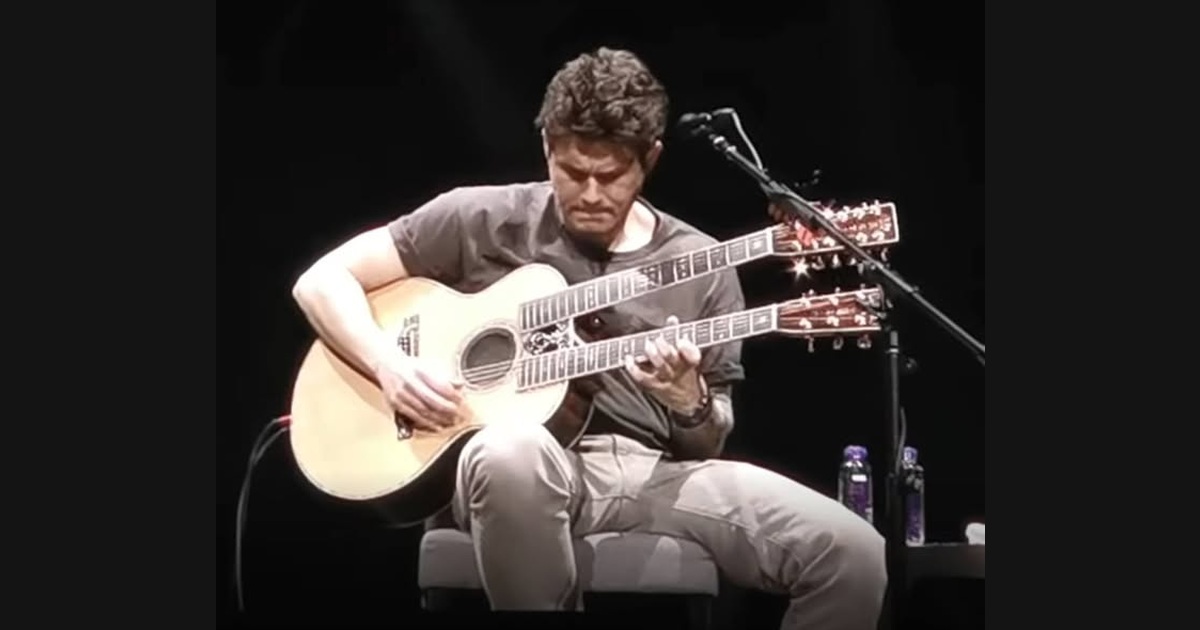
A solo arrangement is not simply a band recording with several musicians removed. The remaining performer has to decide which musical jobs to carry, which to suggest, and which to leave open. John Mayer’s “Edge of Desire” offers a useful way to think about that division of labor.
Mayer’s official 2023 tour announcements described a solo format leaning heavily on acoustic guitar, with piano and electric-guitar appearances as well. That establishes the broader project. The fan-uploaded clip here should not be used to infer an exact tuning, string configuration, or equipment method that its title does not establish.
Watch on YouTube ↗
Separate the musical jobs
Start with four functions: the vocal melody, the harmonic movement underneath it, the recurring sense of pulse, and any instrumental figure that helps identify the song. A band can distribute those jobs among several people. A solo performer has to make some of them coexist in the same pair of hands.
This does not mean every part must remain continuously present. A brief instrumental figure may identify a passage so clearly that it can then give way to the vocal. A simpler accompaniment can preserve a section’s direction while allowing the sung phrase more room.
When listening to “Edge of Desire,” choose one transition rather than trying to track everything. Follow how the accompaniment carries the listener from the end of one vocal thought into the beginning of the next. The connection may explain more about the arrangement than a conspicuous instrument by itself.
What omission can accomplish
Missing a familiar part is not automatically evidence of an incomplete rendition. A reduction can shift the listener’s attention toward a relationship that was previously one element among many. It may make a recurring accompaniment feel more central or expose how a melody creates momentum across it.
The test is whether the performance establishes a coherent route through the song, not whether it recreates every sound associated with a recording. That distinction makes arrangement a constructive choice rather than a contest in imitation.
Change the song and the setting
The second selection, “Slow Dancing in a Burning Room” from Live on Letterman, changes both composition and presentation. It provides a broader reference for Mayer’s repertoire without serving as a direct before-and-after version of “Edge of Desire.”
Watch on YouTube ↗
Keep the musical-job framework in place. Identify what introduces the song’s identity, what supports the singing, and what becomes prominent between vocal statements. Compare the division of attention rather than assuming every guitar passage has the same role.
A featured instrumental moment and an accompaniment can involve the same instrument while performing quite different tasks. Naming that distinction makes it easier to hear when a player is supporting a phrase and when the instrument itself becomes the principal statement.
A third reference prevents a single-song rule
“Gravity,” presented through Mayer’s official GRAMMYs on CBS upload, supplies another composition. It is useful precisely because an arrangement that suits one song is not automatically the best model for every other song.
Watch on YouTube ↗
Across the set, follow the exchange between vocal and instrumental responsibility. The solo “Edge of Desire” performance raises the clearest practical question: what must remain for the song to retain its shape? The related recordings broaden the answer by showing that a performer’s repertoire can ask for different balances, rather than one fixed display of technique.


