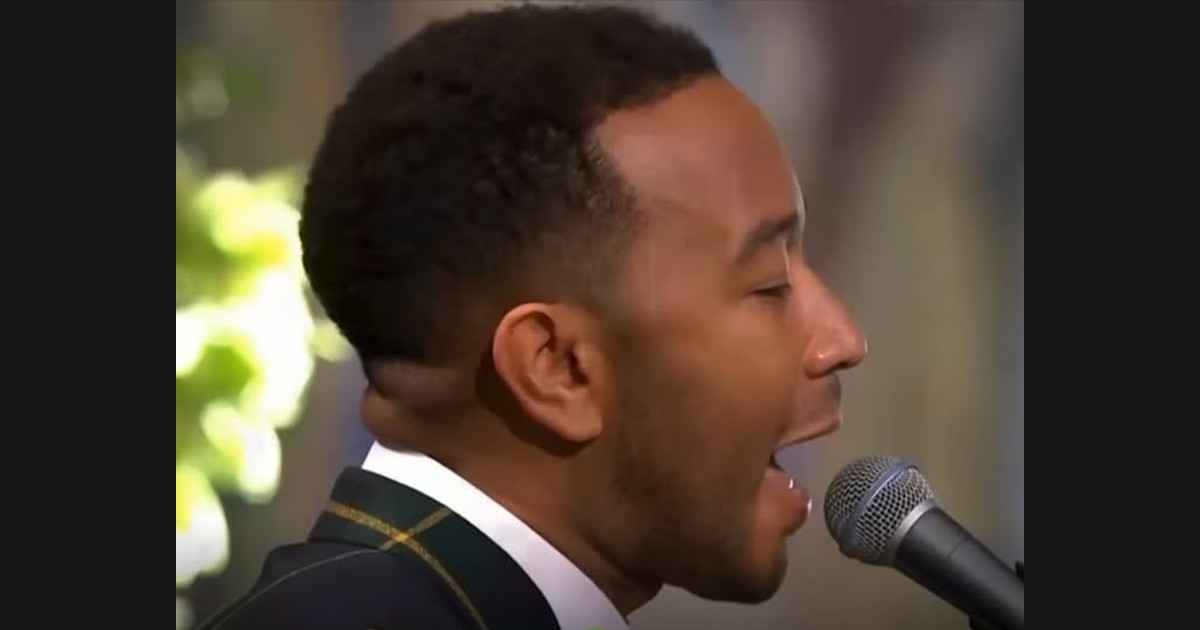
John Legend’s “Redemption Song” at the 2017 Nobel Peace Prize ceremony has a precise place in a formal program. It is not simply an unidentified performance near a Nobel event. The published order places Legend’s vocal-and-piano contribution after the diploma and medal presentation and before the Nobel lecture.
That sequence offers a useful way to understand ceremonial music. A song can stand as a complete performance while also forming a transition between other parts of an occasion. Knowing where it appears helps a viewer hear it as part of a program rather than as a detached concert excerpt.
The official program supplies the frame
The Nobel document identifies December 10, 2017, Oslo City Hall, and Bob Marley’s “Redemption Song,” performed by Legend on vocal and grand piano. The 2017 Peace Prize recipient was the International Campaign to Abolish Nuclear Weapons, known as ICAN. Legend’s role was musical; he was not the laureate.
Watch on YouTube ↗
The distinction between participant and recipient matters whenever a famous performer appears at an award ceremony. A video may give the performer the visual foreground, but the occasion’s institutional purpose remains separate from the artist’s appearance. The program gives each contribution its proper place without requiring guesses about why every individual in the room responded as they did.
What the order tells us
- Presentation: the diploma and medal are awarded.
- Music: Legend performs the Marley song.
- Lecture: ICAN representatives Beatrice Fihn and Setsuko Thurlow deliver the Nobel lecture.
This order establishes a structural relationship, not a private account of the selection process. It does not prove which person proposed the song or which particular line mattered most to an organizer. The public facts are sufficient: the composition, performer, instrumentation, occasion, and position in the sequence.
A ceremony and a concert are different events
The accompanying “All of Me” clip is identified by the Nobel Peace Prize Concert channel as a highlight from its 2017 concert. The shared Nobel association and the same performer do not make it another segment of the City Hall ceremony. It also changes the repertoire from a Marley composition to a song associated with Legend’s own catalog.
Watch on YouTube ↗
This is a useful comparison of program function. A formal ceremony distributes time among speeches, presentations, and music. A concert organizes its attention more directly around musical acts. A song can be meaningful in either setting without the two occasions becoming interchangeable.
The benefit performance changes the context again
The final video comes from Public Counsel and identifies Legend performing “Redemption Song” and “All of Me” at its 2016 dinner. It places both selections within another organization’s event, earlier than the Nobel performances.
Watch on YouTube ↗
Here, the comparison keeps the performer constant while varying the institutional frame. One item belongs to an award ceremony, another to a concert, and another to a benefit dinner. Repeated repertoire can move across these settings without establishing that every event had the same purpose or audience.
Hear the contribution at its actual scale
For the principal recording, follow a complete phrase alongside the piano rather than treating the clip only as background to a famous occasion. The official program credits both voice and instrument to Legend, so the relationship is also one of a performer accompanying his own singing.
The documentary context and the music reinforce one another. The program explains where the song sits; the recording lets the viewer encounter that contribution on its own terms. Neither needs an invented account of the audience’s emotions to make the performance significant.


