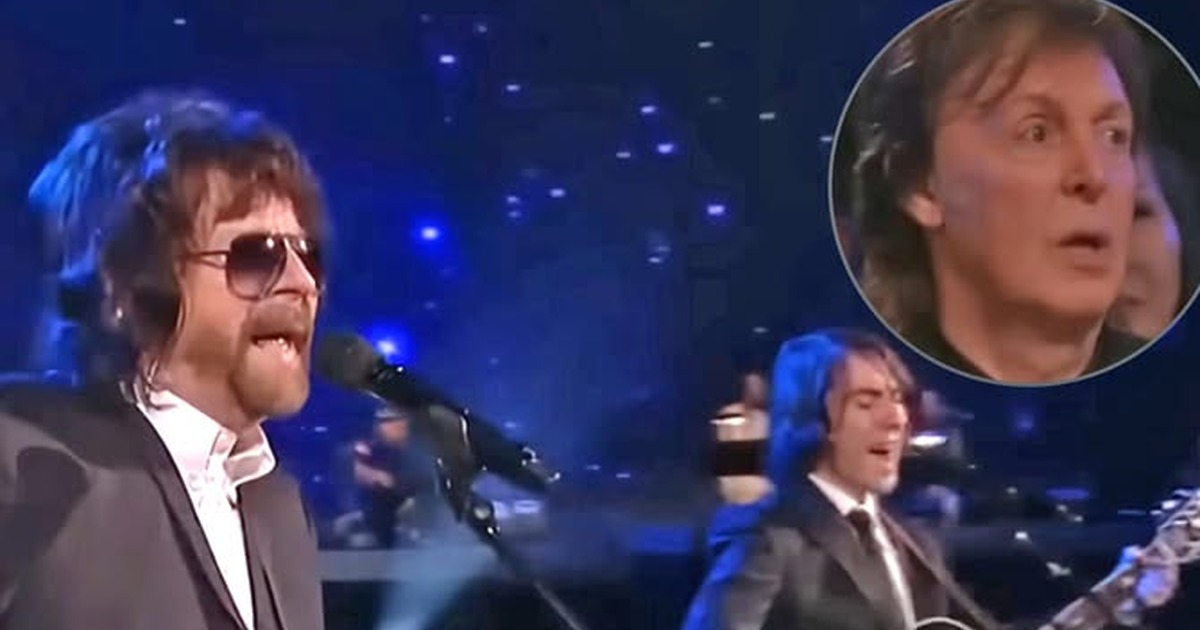
A tribute performance has two jobs: make a song work in the present and acknowledge the person whose music brought the performers together. Jeff Lynne, Dhani Harrison and Joe Walsh’s Something is a useful place to examine that balance. Three recognizable musicians share a composition that remains unmistakably associated with George Harrison.
The Beatles’ official account places the trio together at The Night That Changed America: A GRAMMY Salute to the Beatles, taped in January 2014. That occasion differs from the Concert for George performance included below. Keeping the events distinct prevents a common confusion: musicians can honor the same songwriter at separate concerts without the clips belonging to the same evening.
The song is the center of the triangle
Watch on YouTube ↗
Something is Harrison’s composition from Abbey Road. That gives the performance a stable reference point, but it does not mean every participant has to reproduce a particular recording role. A tribute arrangement can distribute melody, accompaniment and instrumental response among musicians who bring different associations to the stage.
Think of the trio as a triangle around the song rather than a queue of guest stars. One corner carries the words, another supports the harmony, and another can draw attention through an instrumental line. Those jobs may move. Following the movement makes the performance easier to understand than tracking only whichever face the camera shows.
Separate a musical role from a family connection
Dhani Harrison’s presence understandably attracts attention because George Harrison was his father. That biographical fact provides context, but it does not explain every musical choice. The audible work still involves entrances, phrasing, balance and the relationship between instruments and voices.
A useful description might identify a supporting part that makes a melody clearer. A less useful one would assume a participant’s exact feelings from a close-up. The first directs another viewer toward something they can evaluate; the second turns a tribute into an imagined private conversation.
A second ‘Something,’ a different occasion
Watch on YouTube ↗
The official George Harrison channel’s Paul McCartney and Eric Clapton selection supplies a direct comparison because the composition stays constant. Use the beginning of a vocal phrase as the reference point, then compare what surrounds it. Does an instrumental idea function as an introduction, an answer or a transition? Does the arrangement place attention on continuity or on a change of featured performer?
This comparison does not require a verdict on which version is more sincere. Two versions can convey respect through different means. One can emphasize an ensemble identity while another highlights the meeting of particular musicians.
What changes when the tribute chooses another song?
Watch on YouTube ↗
The Rock Hall’s 2004 While My Guitar Gently Weeps selection changes the composition as well as the lineup. It is therefore a broader comparison, not a matching test. Listen for the place given to a featured instrumental contribution within a group performance. A memorable solo still needs the surrounding ensemble to give it context.
Across the three clips, keep a small mental distinction: the songwriter being honored, the song being performed and the people doing the work are related but separate. A tribute becomes musically interesting when those elements cooperate. The familiar title may bring a viewer to the video; the arrangement determines what there is to notice once it begins.


