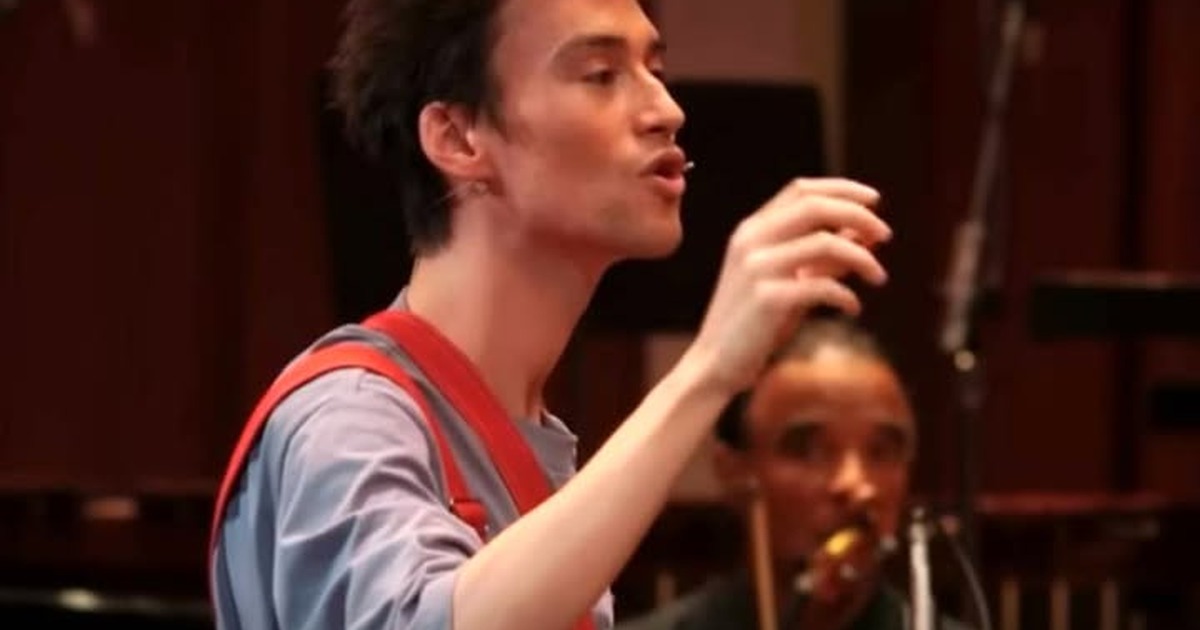
In an orchestra experiment, an instruction can become part of what the audience follows. Jacob Collier’s National Symphony Orchestra recording is introduced by the artist as a challenge without a prepared plan, sheet music, rehearsal or prior discussion. That is Collier’s account of the starting conditions, not an assumption based on a spontaneous-looking image.
The premise changes the presentation’s subject. Listeners receive not only a resulting piece but also a process through which the ensemble is asked to make something together.
The Kennedy Center experiment
Watch on YouTube ↗
A usable instruction reduces the problem
An entire composition is a large task to communicate at once. A short instruction gives a group a smaller, repeatable action. Once that action is understood, another part can be introduced in relation to it.
This does not mean the musicians are interchangeable. Different players bring different resources. A useful instruction connects those resources with a task that can be carried out and recognized within the developing piece.
The challenge is also temporal. Someone may need to continue an established part while attention moves elsewhere. The leader’s next request must preserve enough shared information for earlier and later contributions to belong together.
Creation includes listening to a response
An instruction is not a complete result. The responding sound provides information about whether the intended relationship has become clear. A leader can then continue, clarify or revise rather than treating the first request as beyond adjustment.
That feedback is part of the performance. A change of plan need not be an interruption of creativity; it can be the mechanism through which the developing music acquires a workable form. The musicians’ understanding matters as much as the leader’s initial idea.
This frame gives viewers something concrete to follow without claiming to transcribe the main recording. Notice the relationship among request, response and continuation. The process becomes intelligible through those connections, rather than through an unexplained claim of musical magic.
Another orchestra experiment
The second official Collier upload identifies a San Francisco performance. It supplies another named setting for the same broad kind of activity while preserving a separate event identity.
Watch on YouTube ↗
The comparison should not assume identical players or an identical resulting piece. A recurring method can produce a different presentation because the ensemble and the requests belong to another occasion.
A transcript supplies a concrete example
The TED companion names the VSO School of Music Orchestra. Its published transcript records Collier assigning short descending patterns to cello and flute, then asking that they repeat. Later instructions specify when parts return within a verse-and-chorus structure.
Watch on YouTube ↗
That example shows two distinct levels of communication. One request gives a player material; another explains where the material belongs in the larger sequence. A collection of successful small parts still needs relationships among them to become a piece.
The three recordings therefore offer more than a story about one unusually capable leader. They expose a practical collaboration: instructions must be understandable, responses must be heard and the developing sequence must remain available to the group. The visible process gives the audience another way to understand how an ensemble makes music together.


