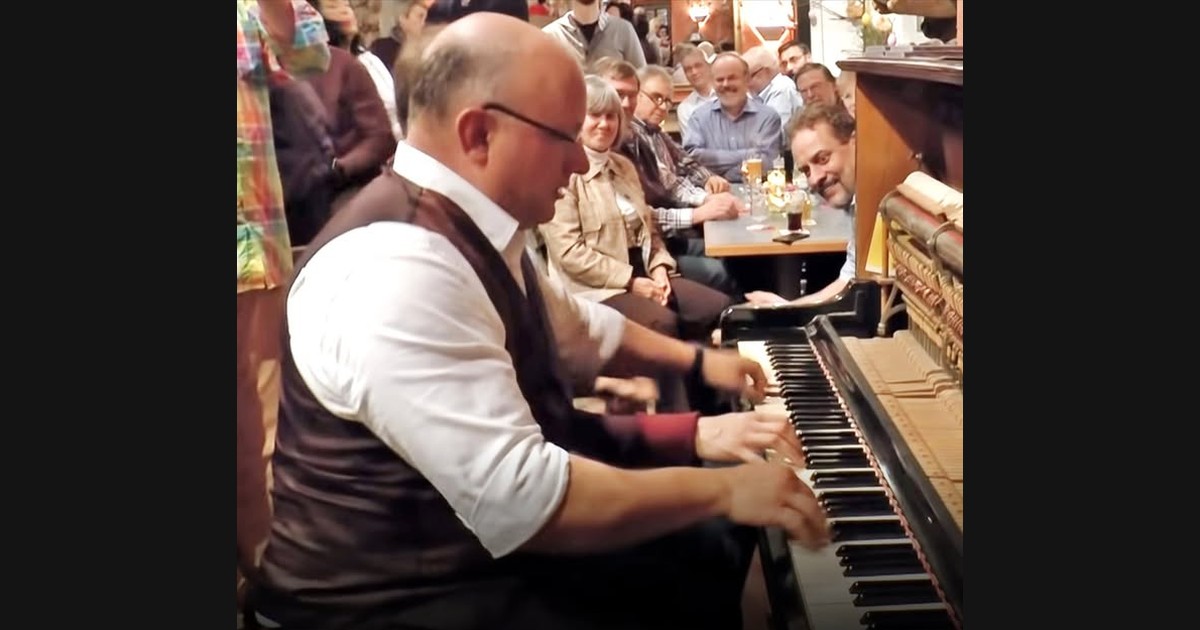
Jörg Hegemann and Stefan Ulbricht’s “Sixth Avenue Express” has a visible constraint: two pianists share one keyboard. They need a musical relationship and a workable division of physical space. The resulting partnership can be heard through those two responsibilities together.
The original uploader places the encounter at Sonja’s in Bonn and describes Ulbricht joining Hegemann there. Hegemann’s own site identifies his continuing work in boogie-woogie, a style in which recurring rhythmic patterns and changing melodic activity can create a particularly clear division of musical jobs.
Watch on YouTube ↗
The lower part is a continuing task
A repeating foundation gives another line something stable to move against. The interest is not only that a pianist can play many notes. It is that one kind of activity preserves the pace while another creates variety.
When two people share the instrument, those jobs can be distributed between them. The exact division may change, but the musical need remains: a new idea has to relate to the pattern already underway. More hands do not remove the need for a common timeline.
Keyboard territory affects the arrangement
A piano has a single continuous range. Two performers using it together need to consider where each part belongs and how physical movement relates to the sound. Register can consequently become a practical organizing resource as well as a musical color.
For a focused viewing, follow one player’s activity for a complete phrase, then widen attention to the shared instrument. Ask what lets the two contributions remain distinguishable. The useful answer may concern range, rhythm or the timing of an exchange rather than speed alone.
This is a way to read the collaboration, not a claim that every action was improvised without prior knowledge. The uploader describes the encounter, but the recording does not reveal every musical reference the players already shared.
A medley changes the repertoire boundary
The next Hegemann–Ulbricht recording is labeled a boogie-woogie medley. A sequence of selections introduces another kind of coordination: the pair needs to make changes of material understandable while retaining continuity.
Watch on YouTube ↗
Listen for what remains stable when a new section arrives. A recurring pulse or the relationship between lower and higher activity can help the performers connect different ideas without making each one feel like a completely separate act.
Two pianos create another spatial possibility
Ulbricht’s own “Boogie Show on 2 Pianos” identifies Hegemann and Moritz Schlömer in a jam session at the Siegburger Brauhaus. That is another occasion, with an additional pianist and another instrument arrangement.
Watch on YouTube ↗
More keyboard space changes the physical constraint. It does not automatically determine how musical responsibility should be shared. The performers still need to decide when to support, answer or occupy the foreground.
The three recordings are rewarding because they keep that partnership visible. A single piano makes the division of space immediate; a medley adds transitions; the two-piano session expands the resources. In each setting, the central achievement is a readable relationship between continuing pattern and new musical activity, created by people listening and coordinating around the same musical direction.


