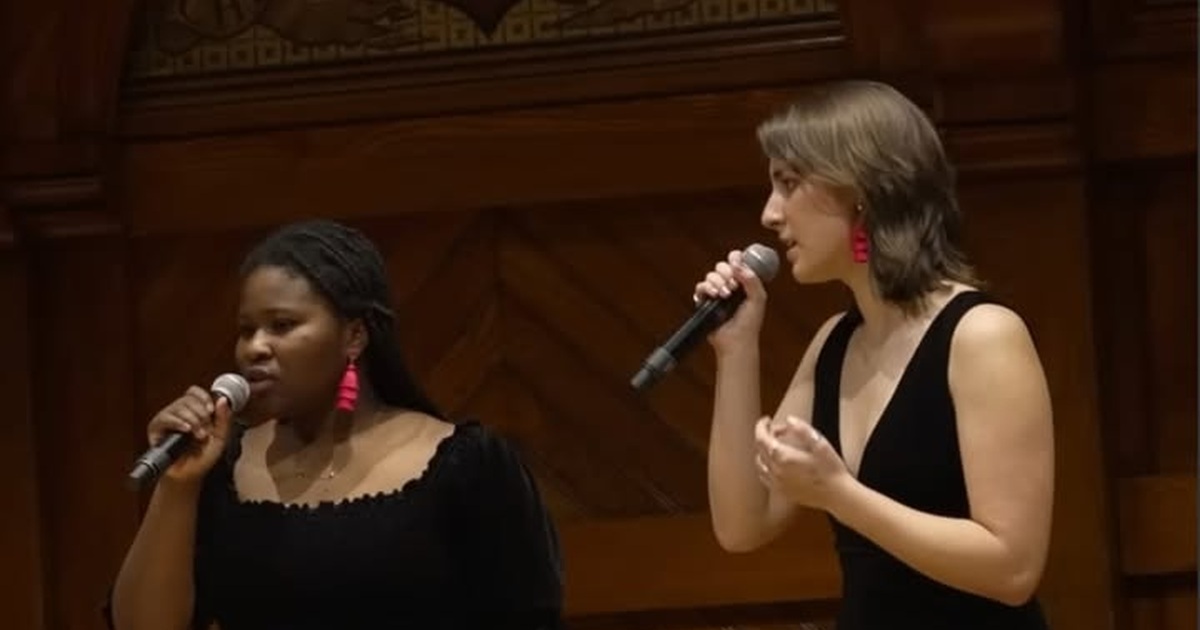
A cappella is sometimes described as a singer performing without accompaniment. A vocal ensemble shows why that description can be incomplete: the accompaniment may be supplied by other singers. The Harvard Opportunes’ Blackbird offers a useful way to follow those supporting responsibilities instead of hearing only the most exposed line.
Harvard’s student-organization account identifies the Opportunes as an all-gender a cappella group known for student arrangements. The ensemble’s own audition information distinguishes solo singing from the supporting vocal block behind a soloist. That practical distinction is a good starting point for understanding an arrangement as shared work.
The ensemble’s cover
Watch on YouTube ↗
A featured voice can carry the tune while other parts establish harmony, pulse or continuity. The supporting singers are not simply a quieter copy of the soloist. Their musical responsibilities can differ in pace, pitch range and the amount of verbal material they carry.
Listen once for the line that makes the song recognizable, then return with attention on the surrounding voices. Keep following one supporting part through a complete phrase. Its importance may become clearer when it is heard as a continuing line rather than as an indistinct background sound.
A role map for an a cappella arrangement
| Role | What to distinguish |
|---|---|
| Featured line | The melody or statement drawing main attention. |
| Harmonic support | Other pitches that create a setting around it. |
| Rhythmic reference | Recurring attacks or patterns that maintain motion. |
| Transition | Material connecting one phrase or section with another. |
A single vocal part can take more than one role, and the distribution can change. A line that begins as support may briefly become central; another singer may maintain continuity while the featured voice leaves space.
For example, a slower-moving supporting part can give a changing melody a stable foundation. The difference in activity makes the two jobs easier to separate. An arrangement does not need every voice to be equally elaborate in order to make the ensemble valuable.
The Beatles recording provides the composition reference
Watch on YouTube ↗
The Beatles’ recording keeps the song identity clear while changing the performance resources. Compare what provides support around the central line, rather than expecting singers to imitate an instrument literally.
This is a useful distinction in any vocal cover. A group can translate a musical function into another medium: continuity can remain continuity even when the sound that supplies it changes. Recognition depends partly on relationships, not only on familiar instrumental colors.
Another vocal interpretation broadens the comparison
Watch on YouTube ↗
The Crosby, Stills and Nash selection supplies another ensemble reference. Its inclusion is not a claim that the arrangements or circumstances are identical. Follow the same role map and notice which parts seem most independent and which work together closely.
The result can be a precise description rather than a ranking. One passage may make a shared line especially clear; another may draw attention through contrasting parts.
Returning to the Opportunes makes the supporting work easier to hear. The featured line supplies an immediate route into Blackbird, while the other voices construct the musical space in which it can unfold. Their contribution is part of the arrangement’s identity, rather than the absence of an instrumental backing.


