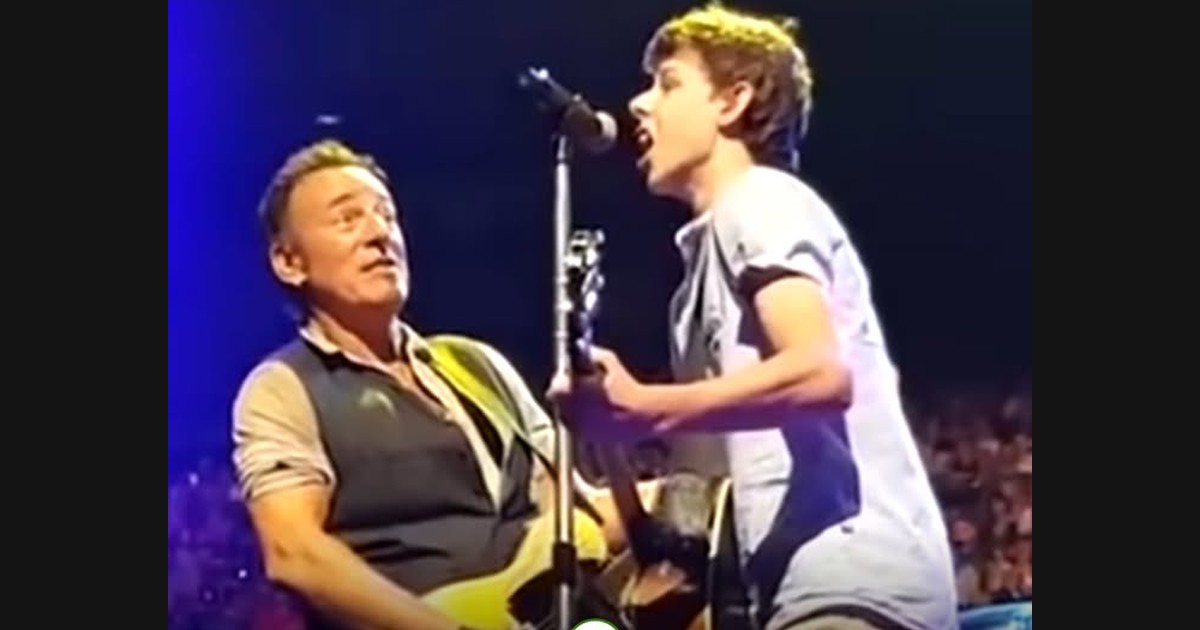
“Growin’ Up” was already established Springsteen repertoire long before Nathan Testa joined him in Brisbane. Springsteen’s official catalog places the track on Greetings from Asbury Park, N.J., released on January 5, 1973.
The guest appearance therefore brings a younger participant into an older composition’s continuing concert life. The title creates an immediate association with youth, but it does not mean the song was written for this encounter or that every line describes either performer literally.
Watch on YouTube ↗
The narrator and the performer remain distinct
A first-person song gives a singer a voice to inhabit. That voice can exaggerate, imagine, remember, or combine experiences within a piece. It should not automatically be read as a factual account of the person currently performing it.
This matters when a familiar title seems to fit a guest’s age. The association can make the selection appealing without supplying a complete biography. The song has its own language and musical shape; the concert adds a particular occasion.
For example, an established performer and a younger guest can share an account of growing up while bringing different personal histories to it. Their participation does not require those histories to be identical to one another or to the narrator’s.
A composition can outlast one performance frame
The official track page lists “Growin’ Up” across studio and live releases, including Live 1975–85, In Concert/MTV Plugged, and Live in Dublin. That catalog history makes its recurrence concrete rather than merely calling it a timeless song.
A recurring title is not a single frozen performance. Different ensembles and occasions can change how its material is carried. The composition supplies continuity while the arrangement and public setting remain open to reconsideration.
The Sessions Band provides another setting
Watch on YouTube ↗
The official Dublin selection names Springsteen with the Sessions Band. Keep that ensemble credit attached to it instead of assuming every live release uses the same band configuration as the Brisbane encounter.
Choose a matching section and follow how the musical responsibilities are distributed. Which part carries the statement, and what supports the transition onward? A shared song makes those questions comparable even when the performing combination changes.
The comparison need not prove that one setting reveals the composition’s only authentic identity. Each release can make a different use of familiar material while preserving a recognizable connection.
Another view of the guest encounter
Watch on YouTube ↗
The final upload explicitly labels Nathan and the February 16, 2017, Brisbane appearance. It supplies another source for the same guest context, rather than a newly written continuation of the 1973 song.
Use the event identification to keep the recording clear. Springsteen’s official tour history confirms that Brisbane concert date, while the fan footage identifies the specific encounter being presented.
The useful story is a repertoire relationship: an early composition remains available for a later concert, another ensemble interpretation, and a shared performance with a younger guest. Its title can resonate with the occasion without becoming evidence that the song predicts or documents somebody’s life. The continuity belongs to the music and its continued use.


