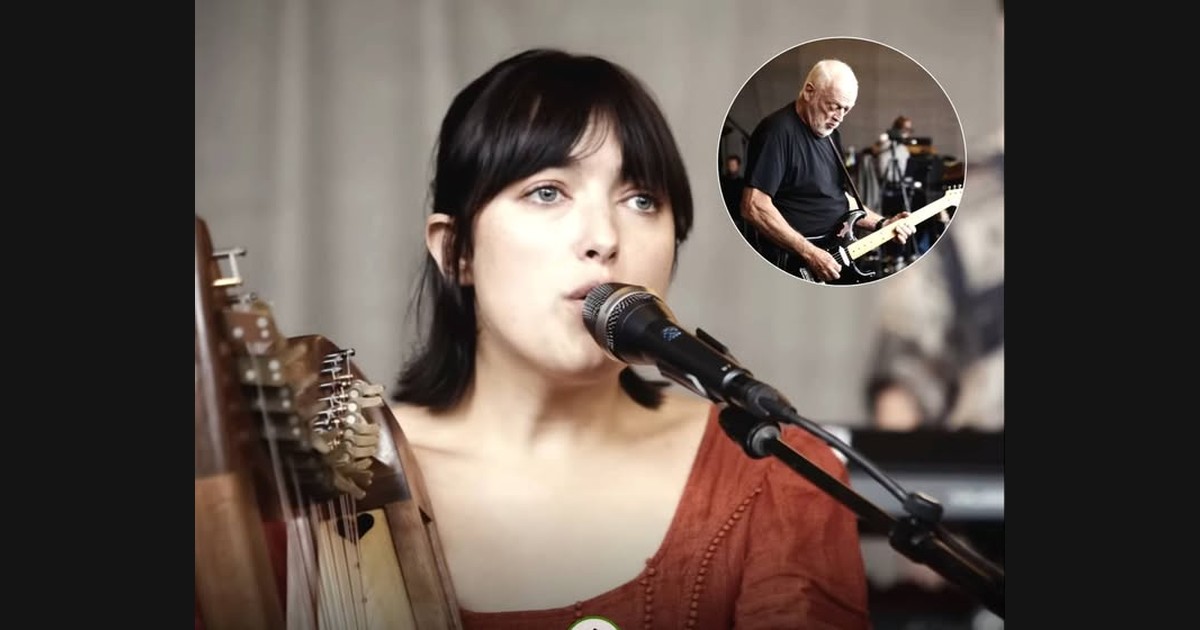
A recording labeled “Tour Rehearsal” can suggest access to work in progress, but it is also a performance selected for public release. David Gilmour’s “Between Two Points” with Romany Gilmour is useful to approach through both facts: rehearsal describes the setting, while publication gives the recording an audience of its own.
Gilmour’s official catalog separates filmed tour-rehearsal material from concert footage, documentaries, and music videos. That distinction matters. A rehearsal selection is not automatically an excerpt from the concert film, and it does not tell us everything that happened while the musicians prepared the tour.
Watch on YouTube ↗
Listen for a shared arrangement
Romany’s lead vocal and harp are specifically credited in the song’s official release information. Rather than treating her presence as a biographical surprise, begin with those musical responsibilities. Follow how the lead line is supported and how instrumental material connects one vocal passage with another.
A rehearsal-oriented comparison can concentrate on coordination: the beginning of a section, the space left for a vocal entrance, or the handover into an instrumental passage. These are concrete features a released performance can show without requiring speculation about instructions exchanged before filming.
For example, an accompaniment can prepare an entrance by maintaining a clear pulse, reducing its density, or finishing a connecting phrase. Determine which description fits the passage you hear. The useful observation explains how the parts fit, rather than declaring the recording “effortless” and leaving the work unexplained.
Rehearsal does not mean unprocessed evidence
The label does not prove that this is the first run-through, a complete unedited session, or a recording without production choices. It also does not identify a mistake simply because something differs from the album.
A performance prepared for a tour can make different practical decisions from a studio recording. The released material lets a listener compare those results; it does not supply a full account of how or why every choice was made.
Bring in the album version deliberately
Watch on YouTube ↗
The “Between Two Points” audio release provides a useful counterpart. Choose a matching section and compare just one feature, such as the amount of instrumental activity around the lead voice. Keep the section comparable rather than jumping from the beginning of one recording to the ending of the other.
| Comparison | A useful note |
|---|---|
| Entrance | How the accompaniment prepares the lead |
| Texture | Which parts remain audible together |
| Transition | What connects two sections |
| Ending | How the musical activity comes to rest |
If a difference is unclear, say so. Playback volume and the visual presence of an instrument can affect what receives attention. An instrument visible on screen is a prompt to listen for it, not proof that it is the loudest part.
A guitar-led recording changes the reference point
Watch on YouTube ↗
Jeff Beck’s live “A Day in the Life” offers a different song and a different relationship between melody and instrument. Compare the job of an instrumental lead with the accompaniment surrounding a sung lead. The contrast is about musical function, rather than a claim that both recordings use the same method.
This gives the rehearsal a clear value: a particular arrangement can be considered alongside its album counterpart, with attention to coordination and responsibility. It is a focused performance document, not a promise of unrestricted access to a private creative process.