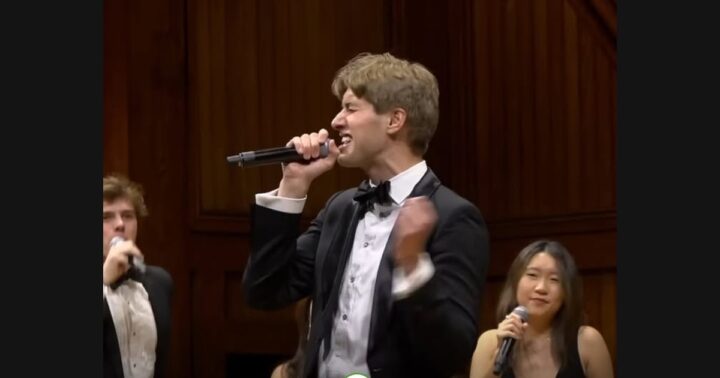
“Foster & Allen featuring Martin Finn” is a useful description because it identifies a collaboration rather than treating three names as an interchangeable group. The duo’s established artist identity and Finn’s featured contribution belong together, but they describe different roles in this release.
Foster & Allen’s official releases page places “Flying Without Wings” on 50 at 50, their 2025 anniversary collection. It describes the track as a collaboration with Finn and identifies an accompanying studio-filmed video. That gives the recording a specific catalog context beyond an isolated online clip.
Watch on YouTube ↗
Three credits answer three questions
An artist credit tells you who is presented as the performer. A featured-artist credit makes a guest contribution visible within that presentation. A songwriter credit identifies authorship. None of these labels automatically substitutes for another.
For this selection, start with the names supplied by the release: Foster & Allen and Martin Finn. Then separate the song’s earlier recording history from this collaboration’s identity. The point is not to award ownership to the most familiar singer, but to understand which recording you are hearing.
| Information | Useful question |
|---|---|
| Artist and feature | Who is credited on this release? |
| Album placement | Which collection includes it? |
| Earlier recording | What reference might listeners already know? |
| Video format | How is the musical collaboration presented? |
The official page’s studio context helps with the final question. It does not, by itself, prove that a released soundtrack is an untouched single take. A studio-filmed music video and a technical record of every recording decision are different documents.
Hear the guest as a musical participant
Choose a returning passage and follow who carries the melody, who supports it, and when more than one voice is present. This turns a featured credit into something you can investigate in the arrangement. The important detail is the musical responsibility, rather than simply the number of people pictured.
For example, a featured singer can establish a passage alone before other voices join. Alternatively, the collaboration can make its point through a shared line. Determine which description fits the recording instead of assuming that “featuring” always means one fixed kind of duet.
Westlife provides an earlier reference
Watch on YouTube ↗
Westlife’s official video offers another recording of the same song. Official Charts documents the Westlife single’s UK chart entry in October 1999, well before Foster & Allen’s anniversary collection. That supplies a verified point of comparison without making the later collaboration a mere copy.
Compare one passage for continuity of melody and difference of presentation. A recognizable tune can survive changes in vocal combination, accompaniment, and visual setting. Those changes are the useful subjects of comparison; a contest about which version is “the real song” obscures them.
A different collaboration, rather than another version
Watch on YouTube ↗
Josh Groban and Andrea Bocelli’s “We Will Meet Once Again” changes both the song and the artist combination. Use it to compare the division of lead responsibility in a separately credited collaboration, not to extend the recording history of “Flying Without Wings.”
The resulting map is straightforward: a particular song, an earlier Westlife recording, and a later Foster & Allen release with a named guest. Keeping that map clear allows the music to carry the comparison without turning the performers’ personal lives into an explanation of every phrase.