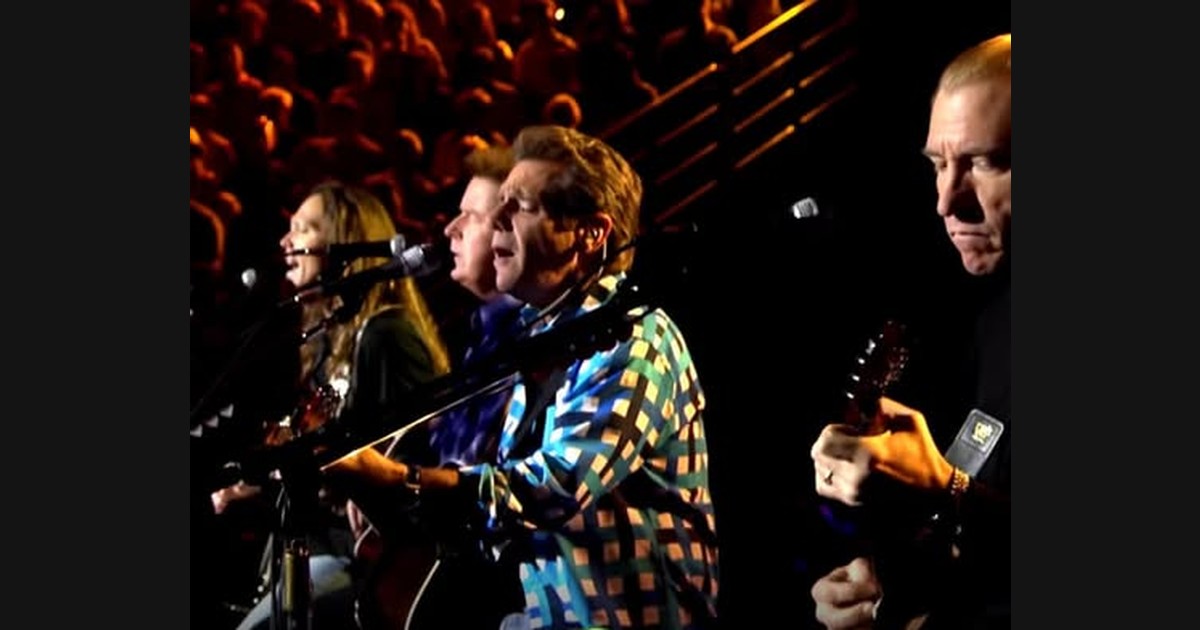
A recently presented concert video can contain a much older song and an earlier performance. The Eagles’ “Tequila Sunrise” is a useful example because its album history and Melbourne setting occupy distinct points in time. The official video offers access to the music; its present resolution label does not make the concert newly performed.
The Eagles’ own store places “Tequila Sunrise” on Desperado, their 1973 album. Rhino’s archive identifies the Melbourne Farewell I footage with November 2004 concerts. Keeping those references separate clarifies what a listener is comparing.
Watch on YouTube ↗
Album material becomes concert repertoire
An album gives a song a fixed sequence of neighbors. A concert can place that song alongside material from other stages of a band’s catalog. The composition remains recognizable while its surrounding context changes.
In Melbourne, consider the song as part of an ensemble’s working repertoire rather than as a reenactment of the original album session. A live presentation can preserve familiar musical relationships while making its own decisions about pacing, balance, and the connection between sections.
Follow the beginning and the ending. What establishes the song quickly, and how does its conclusion feel prepared? Those boundaries matter when a familiar album track has to occupy a place within a larger concert rather than play automatically into the next track on a record.
Restore the Desperado neighborhood
Watch on YouTube ↗
The official audio returns attention to the song itself. The published Desperado sequence places it after “Out of Control” and before the title track. That is an exact catalog relationship, though it does not prove a single hidden explanation for the ordering.
If you listen to the album in sequence, notice what changes as one track gives way to the next. Pace, density, and musical character can create contrast even when the songs are not chapters of a literal continuous story. Then hear “Tequila Sunrise” alone and consider which impressions came partly from its neighbors.
This distinction is useful for any familiar song encountered through a standalone video. A clip can become a listener’s main reference while leaving the original album context largely outside the frame.
Watch on YouTube ↗
Another song broadens the concert reference
The Melbourne “I Can’t Tell You Why” companion introduces another part of the Eagles’ catalog. The band’s official store places that composition on The Long Run, released in 1979. The two songs therefore do not originate on the same album even when concert recordings bring them into a related viewing selection.
Compare how each song establishes its foreground line and accompaniment. A band’s identity can remain recognizable while the individual song requires another balance of musical functions. There is no need to assume that every catalog selection receives an identical treatment.
A farewell title is still a title
Farewell I identifies the concert release; it should not be expanded automatically into a claim that every song shown was the band’s final performance of it. The record documents a particular program, not every later event.
A useful final description names three things: the 1973 album source, the later Melbourne concert, and the video presentation being watched. That keeps the archive intelligible and leaves the musical comparison focused on what an established song gains when it is heard in another setting.


