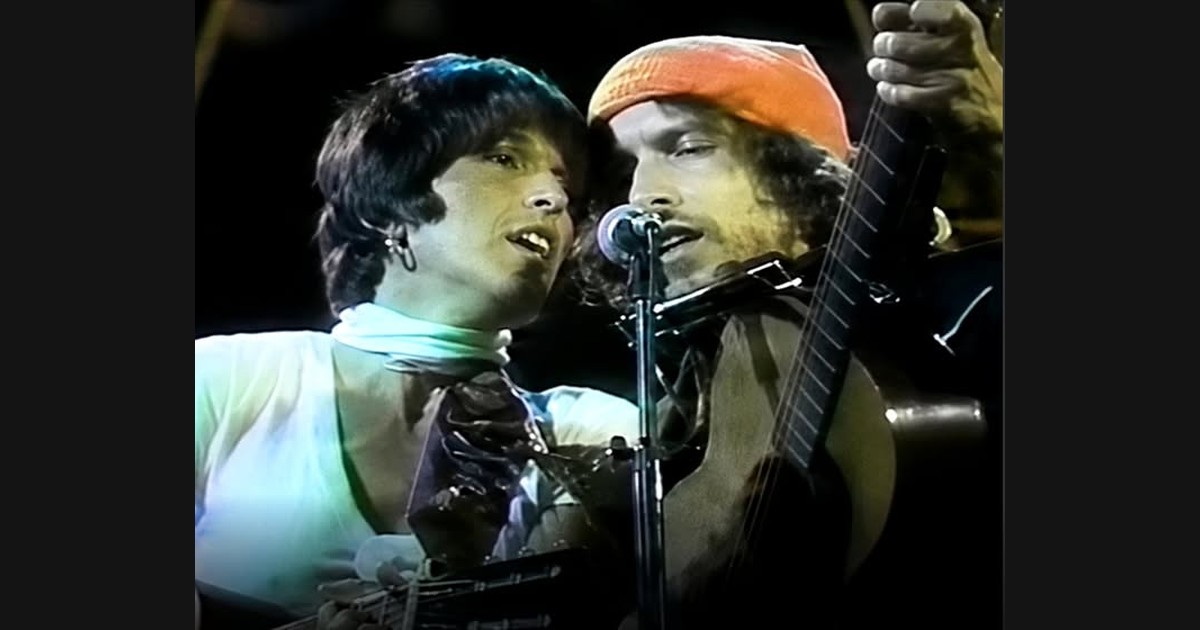
“Blowin’ in the Wind” offers a distinctive kind of shared singing: its structure raises questions and returns to a recurring response rather than developing a conventional scene between two characters. Bob Dylan and Joan Baez performing it together gives that repeated structure another vocal relationship without changing the song into a literal conversation about their private lives.
Dylan’s official catalog identifies the composition with The Freewheelin’ Bob Dylan and credits its writing to him. Baez’s role in the duet is interpretive. The presence of two singers should not be mistaken for a two-person songwriting credit.
Questions can organize a song’s movement
A question directs attention outward: it asks a listener to consider something rather than merely receive a completed account. Repetition can connect several questions through a common melodic and verbal pattern. The returning response then gives those changing questions a recurring point of arrival.
Watch on YouTube ↗
That structure matters musically as well as rhetorically. A familiar return lets the listener recognize where a section is heading, even while the intervening material changes. The song can build continuity without needing a plot in which characters complete a sequence of actions.
Two voices do not have to become two characters
A duet can supply contrasting vocal colors or supporting lines while both performers address the same material. The arrangement need not assign one person the questions and the other a literal role as the answer.
| Relationship | What it helps a listener follow |
|---|---|
| Changing questions | The successive ideas within the song. |
| Returning response | A recognizable point of arrival. |
| Shared performance | Two interpreters contributing to the same musical statement. |
The singers’ public association can add context, but it does not make the words autobiography. A composition can be performed convincingly by people who are not describing their own immediate circumstances.
The second duet upload is another source
The next item again identifies Dylan and Baez with the song. Its brief title does not independently establish an exact concert date, a tour, or a complete lineup. Keep those details unspecified rather than borrowing a date from a different related clip.
Watch on YouTube ↗
For a useful comparison, follow a corresponding return and the phrase leading into it. Notice how the vocal support relates to the principal tune. That is more concrete than assigning a generalized story about the performers’ relationship to every line.
The Newport label belongs to the final clip
The third upload identifies Dylan with guests at Newport Folk Festival in 1963. That is its stated context, not proof that the first two duet uploads show the same occasion. Its restoration label describes a later presentation of older material.
Watch on YouTube ↗
A larger group changes the scale of a repeated response. Material organized around recognizable returns can provide shared entry points for several participants. The exact identity of every person in an incompletely credited upload should not be invented to explain that possibility.
A public song can remain open-ended
The Morgan Library’s Dylan exhibition places “Blowin’ in the Wind” within the early-1960s folk and civil-rights context. That history gives the song public significance without requiring one narrow meaning for every later performance.
The useful listening thread is the relationship between changing questions and recurring material. Dylan and Baez’s shared interpretation can bring another voice into that structure while leaving its questions available to the listener.


