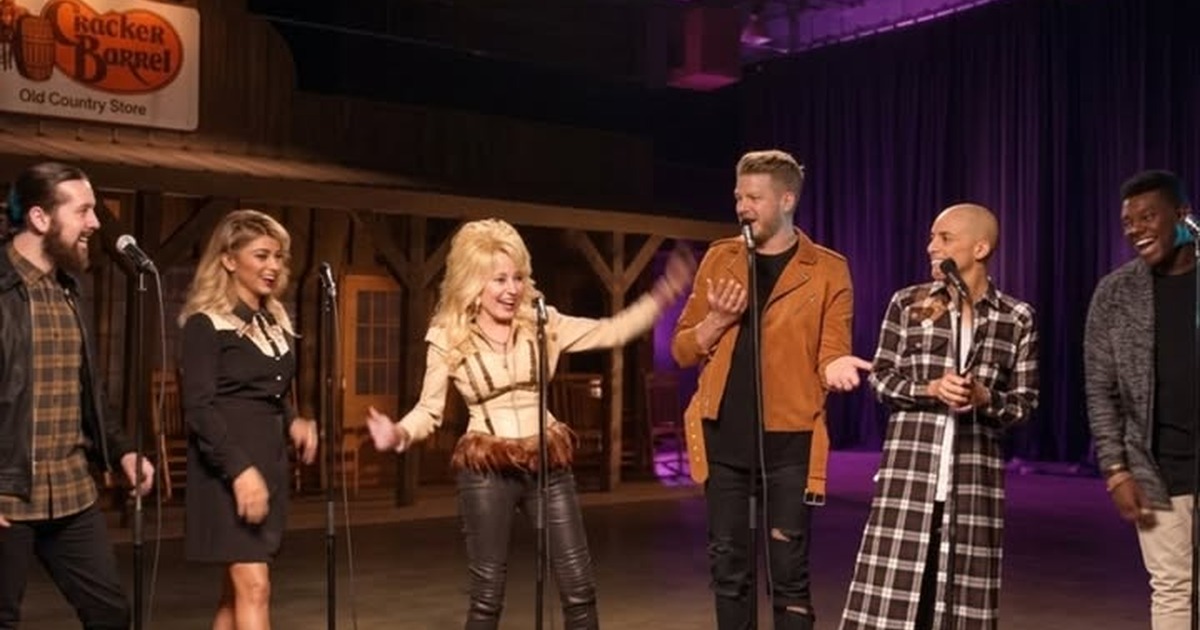
Many covers are made at a distance from a song’s writer. Pentatonix’s “Jolene” collaboration had Dolly Parton in the room, participating in a version of her own composition. That makes the project particularly revealing: familiarity did not remove the need to rehearse a new arrangement.
The single was released in September 2016 and won Best Country Duo/Group Performance at the 2017 Grammy Awards. Those are different milestones. The award year does not identify the recording as a newly created 2017 performance.
Watch on YouTube ↗
What Hoying’s account adds
In a firsthand account published by the Recording Academy, Scott Hoying describes Pentatonix preparing the arrangement together before meeting Parton. They worked through harmonies and rhythms, including changes to the song’s measures. He also recalls that Parton suggested allowing the group to take part of the lead rather than singing the whole piece herself.
These details explain the collaboration more usefully than a general claim that the singers simply blended perfectly. An altered structure has to be learned, even by someone who knows the composition extremely well. Sharing the lead is also a decision about the song’s presentation, not merely a change in background texture.
Three different kinds of familiarity
A songwriter knows the composition through writing and performing it. An ensemble approaching a cover knows both that composition and the public recording associated with it. A listener may know only a few especially recognizable moments. A collaboration has to work across all three kinds of familiarity.
That is why a small change in length can matter. Adding or removing a measure may be easy to describe on paper, yet it changes when a singer expects a phrase to arrive. Rehearsal converts a new plan into a shared sequence of events.
This is a useful way to listen to the finished version. Follow a returning section and the point at which responsibility changes. The question is not just who carries the tune, but what allows the next voice to enter as part of the same unfolding piece.
Voices can have several jobs
An a cappella arrangement distributes musical responsibilities among people: a lead line, harmonic support, lower foundations, and rhythmic movement. Those functions can coexist without every singer remaining in the same role throughout. More layers are not automatically better; clarity depends on what each contributes at a given point.
The collaboration with Parton also preserves the identity of the guest. A vocal group need not absorb a featured singer until she becomes indistinguishable from its existing sound. The interest can lie in a recognizable writer’s voice meeting an established ensemble’s method.
Two directions for comparison
The next video pairs Parton with Miley Cyrus on “Jolene.” Keeping the composition and Parton present makes it a comparison of partnerships. The change of featured partner gives familiar material a different set of vocal relationships.
Watch on YouTube ↗
The final selection is Pentatonix performing “Hallelujah” live. This changes the song while retaining the ensemble, inviting attention to which arrangement functions remain useful across different repertoire.
Watch on YouTube ↗
Hoying’s account gives the first collaboration a documented working process. The related clips then broaden it into two clear questions: how does Parton share a familiar song with different partners, and how does Pentatonix organize different songs through voices? Together, they connect the documented working process with the finished collaboration and its place in a wider repertoire.