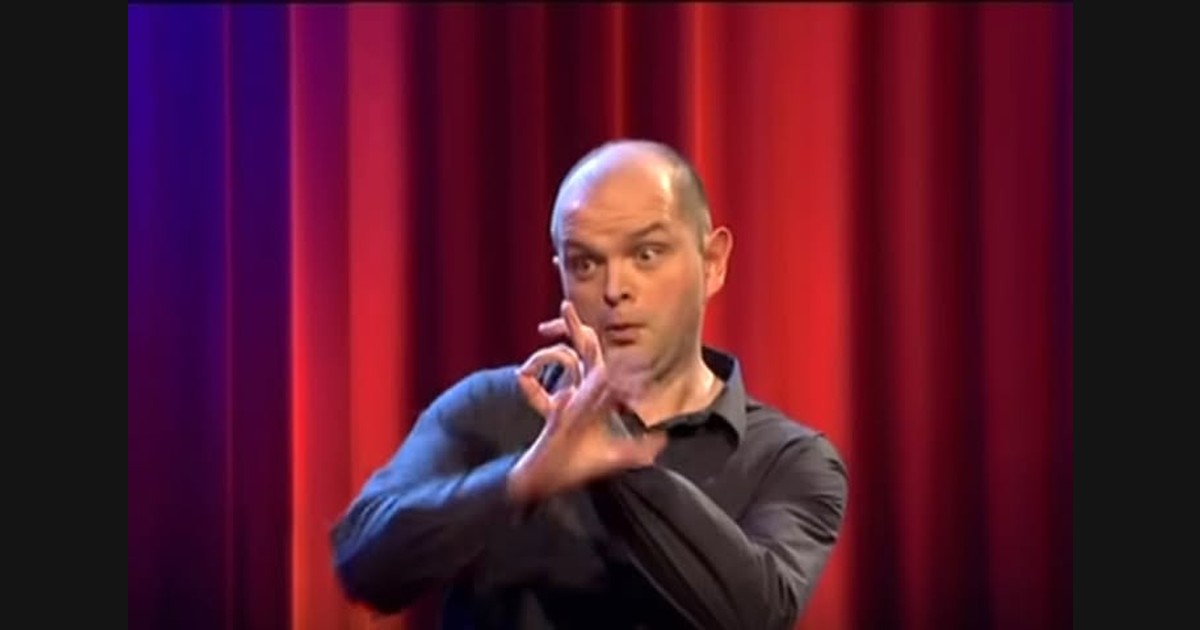
David Armand’s “Don’t Stop Me Now” mime has a musical deadline: the recorded song keeps moving while his body supplies visual information. The BBC’s Fast and Loose clip places that work inside a guessing game, but the performance also offers a practical introduction to how mime creates a readable world without a set of physical props.
The BBC identifies Hugh Dennis as host, with Pippa and Ruth trying to recognize the song. Armand must provide useful visual material within that format. The interest is not only whether the title is guessed; it is how actions become understandable quickly enough to function as clues.
Watch on YouTube ↗
A gesture needs a clear shape
In everyday movement, several intentions can overlap. A staged gesture benefits from a more readable beginning, direction and ending. That does not mean every action must be large. It means the viewer needs enough information to distinguish one idea from the next.
Facial presentation can help supply attitude around an action. The same broad movement might suggest confidence, uncertainty or surprise depending on how it is framed. A mime can therefore communicate both an event and a response without adding dialogue.
Imaginary space needs consistency
If a performer establishes an imaginary object or location, returning to a consistent place helps the audience accept it. A hypothetical door, for example, becomes harder to understand if its handle changes position whenever the performer reaches for it. This illustrates a general mime principle, not a claim about a particular gesture in Armand’s routine.
That kind of spatial clarity is especially useful when the music limits the time available. The performer cannot pause the soundtrack to explain the object. An action needs to be readable through its own relationship with the body and the surrounding imagined space.
Compare another song in the same format
The second official BBC clip presents Armand interpreting Britney Spears for Fast and Loose. The broadcaster identifies Laura Solon and Humphrey Ker as the guessers on that occasion.
Watch on YouTube ↗
Keeping the game format consistent makes the new musical material the main variable. Different words and images create another set of visual problems. A performer may need to suggest a concrete action, a relationship or an attitude, rather than relying on one universal gesture for every phrase.
The exercise is not the same as a complete translation into a language. These are comic clues shaped for a particular performance game. Their purpose is to make recognition possible, often through playful interpretation rather than a literal representation of everything being sung.
Queen supplies a different visual performance
The band’s official “Don’t Stop Me Now” video returns the music to Queen’s own presentation. The singer and band are performing the song, while Armand’s act uses another layer of visible actions to make its language into clues.
Watch on YouTube ↗
Comparing the two shows how different kinds of performance can occupy the same musical time. One foregrounds the musicians; the other builds a temporary visual world around the recording. Armand’s clarity depends on giving that world recognizable shapes and relationships, allowing the audience to follow an idea before the next musical moment has already arrived.