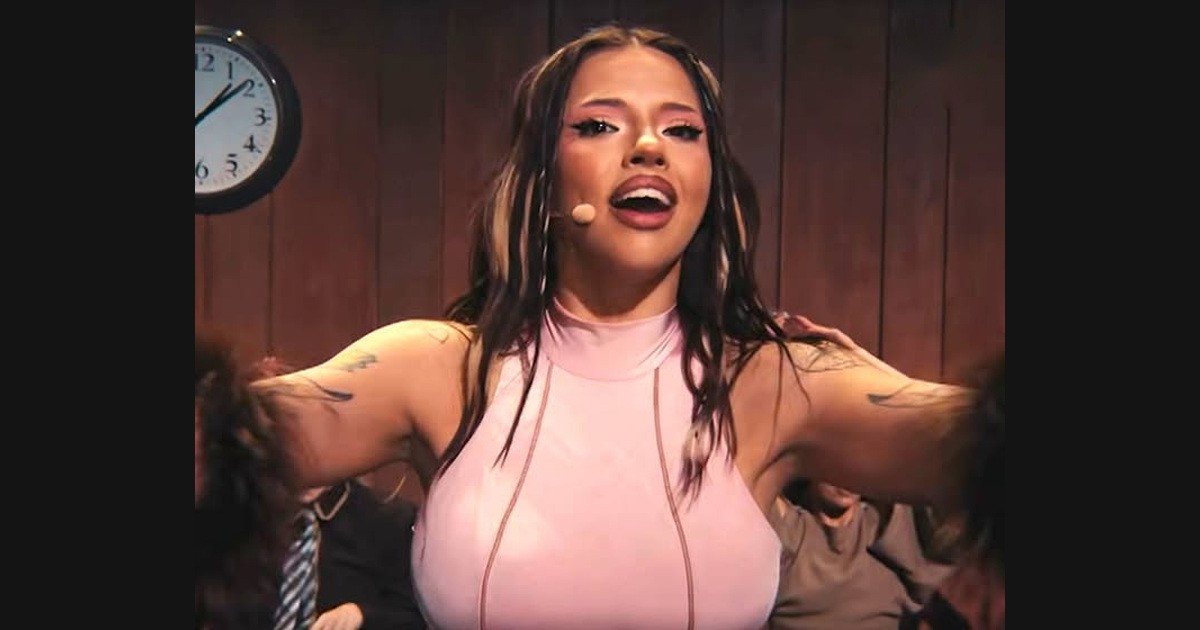
DARA’s “Bangaranga” won the 2026 Eurovision Song Contest for Bulgaria. The organizer’s result records 516 points and the country’s first victory. That establishes the competition outcome, but it does not explain every musical or screen choice that makes the entry worth revisiting.
The three selections here provide a more focused route: the grand-final performance, the official music video, and a national-final presentation of the same song. Holding the composition steady allows the different formats to become the subject of comparison.
Watch on YouTube ↗
Begin with the final performance as a whole
A televised competition entry has to establish its identity inside a larger sequence of songs. The final recording presents “Bangaranga” in that setting. Before isolating a moment, follow the complete performance and notice where its main recurring idea first becomes clear to you.
Then identify one point where the sense of momentum changes. It might involve a transition between sections, a shift in musical emphasis, or a change in the way attention is directed on screen. Describe the particular relationship you can identify, rather than assuming a winning result proves that every choice worked identically for every viewer.
Credits matter alongside the featured artist. Eurovision lists the song’s writers as Anne Judith Stokke Wik, Darina Yotova, Dimitris Kontopoulos, and Monoir. Naming that collaborative authorship keeps the composition visible within a presentation strongly identified with one performer.
A music video offers another kind of continuity
The official video changes the frame from a competition stage to a standalone screen presentation. It can organize attention through its own sequence of images, rather than through the practical boundaries of a particular live-show slot.
Watch on YouTube ↗
Choose the same musical passage you noticed in the final performance. Compare what prepares its arrival in each version. An image or change of setting can become associated with a musical return, but that visual association is part of the video’s construction, not an additional section of the composition.
This distinction helps separate the song’s identity from the memory of one presentation. A familiar visual moment may lead recognition for a repeat viewer even when another format communicates the same musical passage differently.
Look back to the national-final frame
The final selection is identified by Eurovision as a national-final performance. It offers another public presentation of the entry, rather than a private rehearsal or an unedited account of its development.
Watch on YouTube ↗
Compare a section boundary across all three versions. Keep the question narrow: how is the listener led into the next part? That provides a concrete point of contact without inventing a behind-the-scenes account of why an element changed.
A difference does not automatically mean that one version corrected a failure in another. Different venues and screen formats can call for different ways of making the same musical structure legible.
The result and the performance answer different questions
The verified Eurovision result tells us where “Bangaranga” finished. The videos allow attention to the work through which the entry was presented. Both forms of information are useful, but one should not replace the other.
Moving through the set in this way gives a winning song more than a victory label. It becomes a composition with several screen lives, each offering a different relationship between recurring musical material, the featured performer, and the viewer’s attention.


