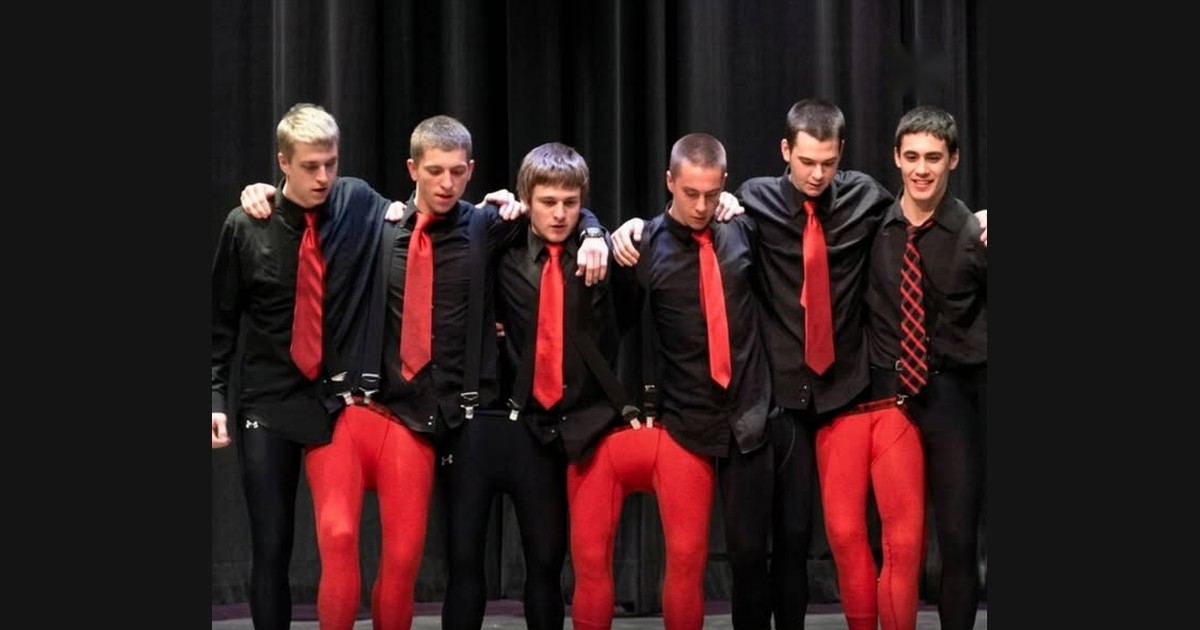
A costume can change how a viewer groups the movements on a stage. Dan Beck’s Linganore illusion dance uses that possibility as its premise: contrasting panels and coordinated performers create a line whose moving parts can be difficult to assign at first glance. The effect depends on relationships across the group, not a claim that one person has acquired extra limbs.
Lancer Media’s own upload identifies the routine with the Mr. Linganore 2014 talent presentation. That school-source context is more specific than treating it as an unidentified contemporary internet challenge.
Watch on YouTube ↗
Color can suggest a connection before movement confirms it
When similar colors sit beside one another, a viewer may initially treat them as a continuous shape. Movement can then challenge that grouping. A leg that seemed to belong to one outline may appear connected to another when the pattern changes.
The useful viewing task is to distinguish the visible pattern from the individual people producing it. Start with one performer if you can follow them confidently, then widen attention toward the whole line. The two views may provide different impressions without either requiring a hidden mechanical explanation.
This is a description of the stage effect, not a diagnosis of a viewer’s perception or a scientific claim about a particular brain mechanism. The contrast between what a costume suggests and what the performers are doing is enough to explain the routine’s central joke.
Timing turns a design into choreography
A still photograph can show the costume arrangement, but it cannot preserve the complete sequence of changes. The dance develops through actions in time. A repeated motion gives the viewer a reference, while a change in the pattern can make the earlier grouping seem unstable.
Follow an approach, a repeated action, and a departure from it. What becomes easier to read through repetition, and what becomes surprising when it changes? Those questions connect the optical premise with choreography rather than treating the costume as a finished trick on its own.
A pause can also matter. Giving a shape time to register may prepare the next change more clearly than constant movement would. The effect belongs to the relationship between design, duration, and coordinated action.
Watch on YouTube ↗
The school recording supplies an event reference
The Lancer Media presentation identifies the same named talent-show routine through another source. Compare the framing before assuming that a different upload shows another performance. A wider view can clarify the overall line, while a closer frame may make individual movement easier to follow.
There is no need to extend the school context into an unsupported account of the participants’ later careers or the contest result. The routine has enough construction to discuss on its own terms.
Watch on YouTube ↗
A musical reference uses another kind of illusion
The Steve Miller Band’s “Abracadabra” video provides a separate screen presentation associated with a song whose title invokes magic. Its editing and imagery should remain distinct from the practical costume-and-movement premise of the Linganore act.
After watching, describe one change that made the group harder or easier to read. Naming the relationship between a visible pattern and coordinated action explains the performance more clearly than calling it an impossible dance or inventing a secret apparatus behind the effect.


