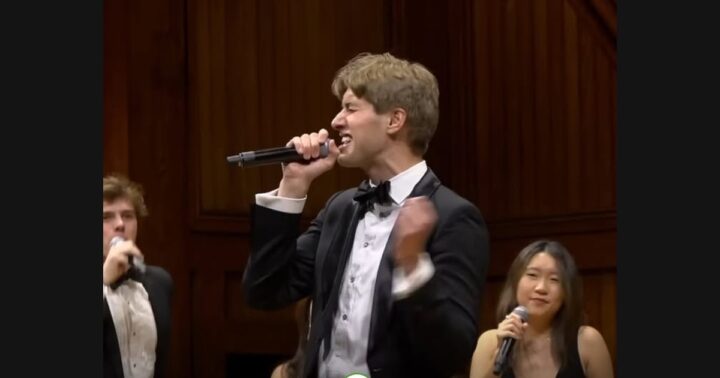
A performance title can identify a song accurately while telling only part of its history. Dagilėlis’s own upload of “The Lion Sleeps Tonight” names George David Weiss. That credit belongs within a longer sequence of musical adaptation whose starting point is Solomon Linda’s “Mbube.”
Knowing the sequence changes how a familiar chorus can be heard. Instead of treating the song as a melody that simply appeared with its best-known English title, a listener can recognize that the piece has passed through different performers, words, and musical settings.
Watch on YouTube ↗
Three names mark three stages
Linda recorded “Mbube” in South Africa in 1939. The recording later reached Pete Seeger, and the adaptation known as “Wimoweh” emerged in the early 1950s. A further version associated with Weiss, Hugo Peretti, and Luigi Creatore became “The Lion Sleeps Tonight.” These stages are described in the firsthand historical account published by the World Intellectual Property Organization.
The names are therefore useful distinctions, rather than interchangeable spellings for one unchanged recording. A history of the melody and a credit on a particular version answer related but different questions. Keeping Linda’s role visible need not prevent attention to what a later arranger or choir does with the material.
This is also a reason to avoid calling a familiar piece anonymous merely because it has circulated widely. Repetition can make a composition feel as though it belongs to general memory, while identifiable people and recordings remain part of its history.
What a choir brings into focus
With Dagilėlis, make the relationship between individual lines and the ensemble your point of attention. Follow the material that seems to carry the main melodic idea, then notice the work surrounding it. A choir can distribute musical functions among singers, so the apparent simplicity of a familiar refrain need not describe the complexity of coordinating it.
Do not assume that every sound represents a particular animal or that an imaginative effect is a literal illustration of the song’s origin. Those are interpretations to test against the performance, not historical facts supplied by the title.
The Tokens as a recording reference
The second selection is The Tokens’ official audio. It gives the English-titled version a specific recorded reference, allowing comparison with the choir without pretending that the later pop recording invented every element of the work.
Watch on YouTube ↗
Hold one recurring idea in mind across the two versions. Consider whether your attention stays with the melody or shifts toward a surrounding pattern. Naming that change is more useful than deciding that one presentation is simply the authentic one and the other a decorative copy.
A second choral piece changes the test
Angel City Chorale’s “Africa” closes the set. It is a different song, so it does not belong in the Linda-to-“Lion Sleeps” adaptation chain. Its usefulness lies in changing the repertoire while returning to a large vocal ensemble.
Watch on YouTube ↗
That distinction makes the comparison clearer: the first two selections share a song lineage; the first and third invite attention to choral presentation. A similar musical function across two choirs would not make the works interchangeable.
Credits, repertoire, and performance can all remain in view at once. Following them separately gives this familiar title a more substantial context than an account built only around recognition or a generalized picture of a jungle.