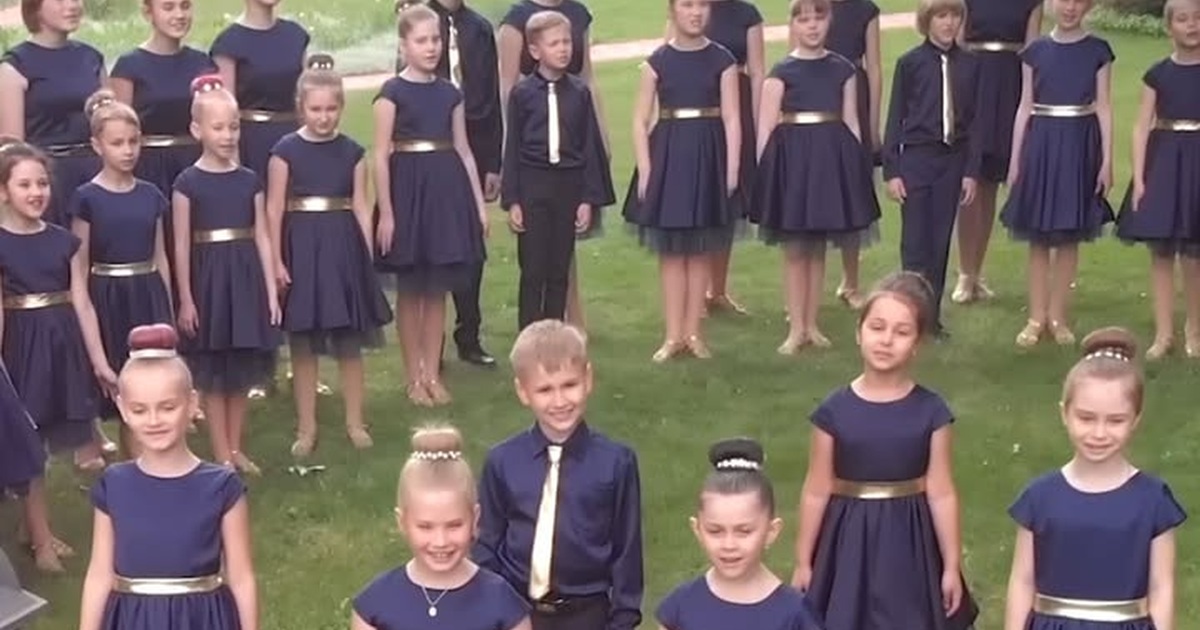
A recording can take on a new significance without belonging to the event that later brings it to people’s attention. That distinction is essential to COLOR MUSIC Children’s Choir’s version of You Raise Me Up. The Ukrainian ensemble published the main video in September 2019, well before Russia’s full-scale invasion of Ukraine in 2022. Its message of receiving strength from another person can resonate with later events, but the earlier film should be understood in its own chronology.
The choir’s upload identifies the performers as COLOR MUSIC from Dnipro, Ukraine. It credits Rolf Løvland and Brendan Graham as the songwriters and Olexandr Petrykov with arranging, recording and producing the music. Those credits place the emphasis on an ensemble interpretation: a familiar song is being shaped for these singers, rather than presented as an unmediated glimpse into their lives.
The earlier recording
Watch on YouTube ↗
The central idea is unusually well suited to a choir. The song’s speaker acknowledges a limit and finds the possibility of going further through another person’s presence. A solo voice can make that exchange feel like a private address. A group of singers offers a different possibility: a personal statement can be carried by many people at once.
That is an interpretation of the song’s design, rather than a reason to prescribe one response to the children performing it. Their participation does not establish what any individual was experiencing when the video was made. It is enough to recognize the expressive choice: a piece associated with reassurance becomes an ensemble’s shared material.
Three details worth following
Start with the relationship between the verse and the returning refrain. The verse gives the central statement a context; the refrain brings the listener back to the idea of support. Instead of treating each repetition as merely another attempt at a bigger climax, consider what the intervening verse has added to the meaning of that return.
Next, follow the melody through changes in the surrounding texture. Can you still trace the same musical thought when more voices or accompaniment occupy your attention? This gives you a specific way to compare a choral version with a familiar solo recording, without assuming that greater size automatically produces greater feeling.
Finally, notice the ends of phrases. Choir singing involves shared decisions about when a word begins, how long a vowel continues and where a phrase releases. Listening for those joins redirects attention from a general label such as moving or uplifting toward the practical work of making a group sound connected.
A later appearance with Charlotte Perrelli
The second video belongs to a separate occasion. COLOR MUSIC’s own description identifies a performance with Charlotte Perrelli at the United With Ukraine charity concert in Stockholm on January 18, 2023. Here, support for Ukraine is part of the documented event itself. Keeping the recordings distinct lets the later concert carry that public purpose without rewriting the earlier film’s origin.
Watch on YouTube ↗
The useful comparison is between settings, not a contest to decide which version contains more emotion. Ask who appears to be addressing whom. In one case, the choir presents its interpretation to a video audience; in the other, it participates with a guest singer in a concert organized around a shared cause. The song supplies continuity while the occasion changes its frame.
Hear the ensemble beyond one signature cover
The third video, published by Suspilne Dnipro, presents COLOR MUSIC singing Shchedryk. Moving to a different piece helps keep the ensemble from being defined entirely by the associations of one widely circulated cover.
Watch on YouTube ↗
Carry one listening question across the change of repertoire: how do individual entries contribute to the larger group? You do not need to rank the pieces or force them into the same emotional category. Comparing the tasks each song gives its singers is more revealing than expecting the choir to recreate the same effect every time. The collection offers three encounters with an ensemble, with enough context to let each remain its own performance.