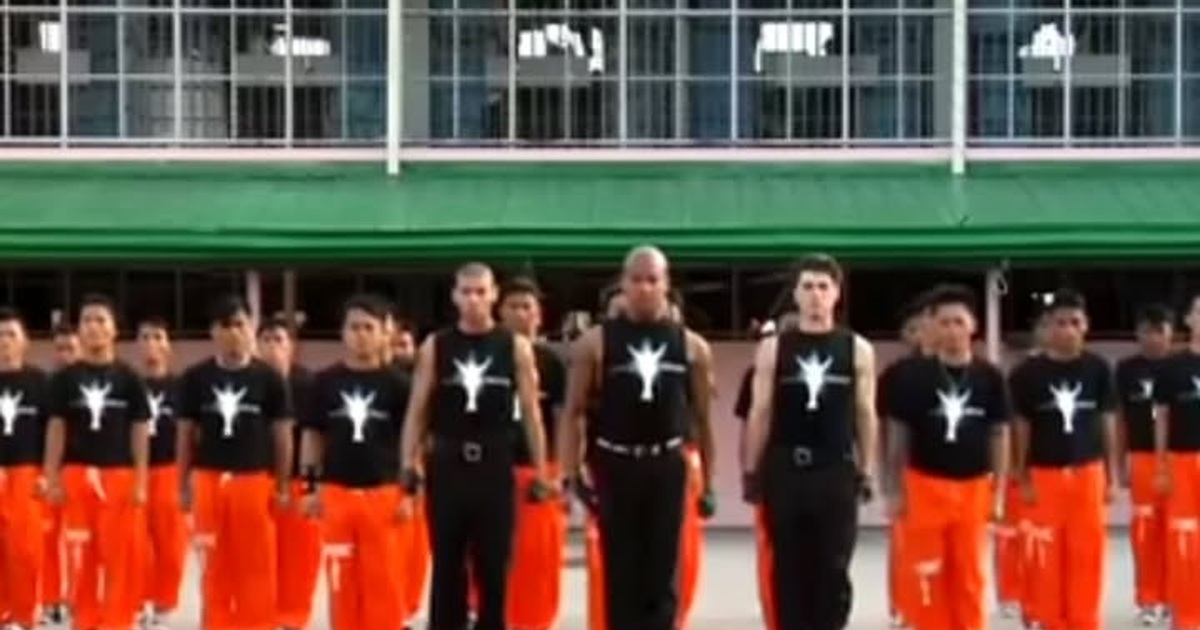
A large dance ensemble creates a different viewing problem from a close-up of one performer. The eye can follow a person, a row, or the outline of the whole group, but it cannot give every movement equal attention at once. Sony’s recording of the Cebu dancing inmates performing to “They Don’t Care About Us” offers a clear setting for considering that difference of scale.
The publisher connects the video with Michael Jackson’s This Is It. That identifies a presentation context, not a claim that Jackson personally appears in the yard recording. His music provides the connection while these participants remain the performers on screen.
Watch on YouTube ↗
Read a formation as a musical idea
A formation gives the viewer a broad shape to recognize. Repeated movement can then make a change readable across that shape. The result is not simply a larger version of a solo: the relationship between neighboring performers becomes part of the visual material.
For one passage, follow the group’s overall outline rather than individual faces. On another viewing, choose one small area. The change of focus reveals how collective choreography offers several scales of information at the same time.
Spacing helps movement communicate
When many people perform together, the space between them matters alongside the movement itself. An idea that is clear in a close view may require broader coordination to remain legible across a yard. The audience’s distance changes which details can carry the presentation.
Timing has a similar role. A shared point of arrival can make a phrase visible across a group, while a deliberately staggered sequence would create another kind of effect. These are useful categories to look for without assigning an exact count or a technical label to every passage.
Keep the people within the scale
The institutional setting is part of the recording’s identity, but it should not turn participants into a statistic or a proof of a social outcome. A dance video does not by itself establish the conditions of participation, an individual’s history, or the effectiveness of a prison program.
It can still be considered as a performance. Attend to the work of coordination and the way the group is presented, while leaving broader claims to evidence capable of supporting them. Musical appreciation and a careful account of what the image establishes can coexist.
The song’s own screen presentation
Michael Jackson’s official “They Don’t Care About Us” video supplies the next comparison. It changes the featured performer and screen work while retaining the song. That allows attention to move from group organization in the Cebu recording toward another visual presentation of the same musical material.
Watch on YouTube ↗
The relationship should not be simplified into a claim that one video is a complete replica of the other. A new group, place, and recording purpose create different conditions for movement and filming.
A separate short-film world
“Thriller” changes the composition and adds the distinct frame of Jackson’s short film. Its movement belongs to a screen narrative rather than the same institutional event as the Cebu recording.
Watch on YouTube ↗
The three selections provide different scales of attention: a large collective presentation, the song’s associated artist in an official video, and a separate choreographed film world. Following those differences gives the Cebu performance a concrete visual subject beyond the novelty of its setting.