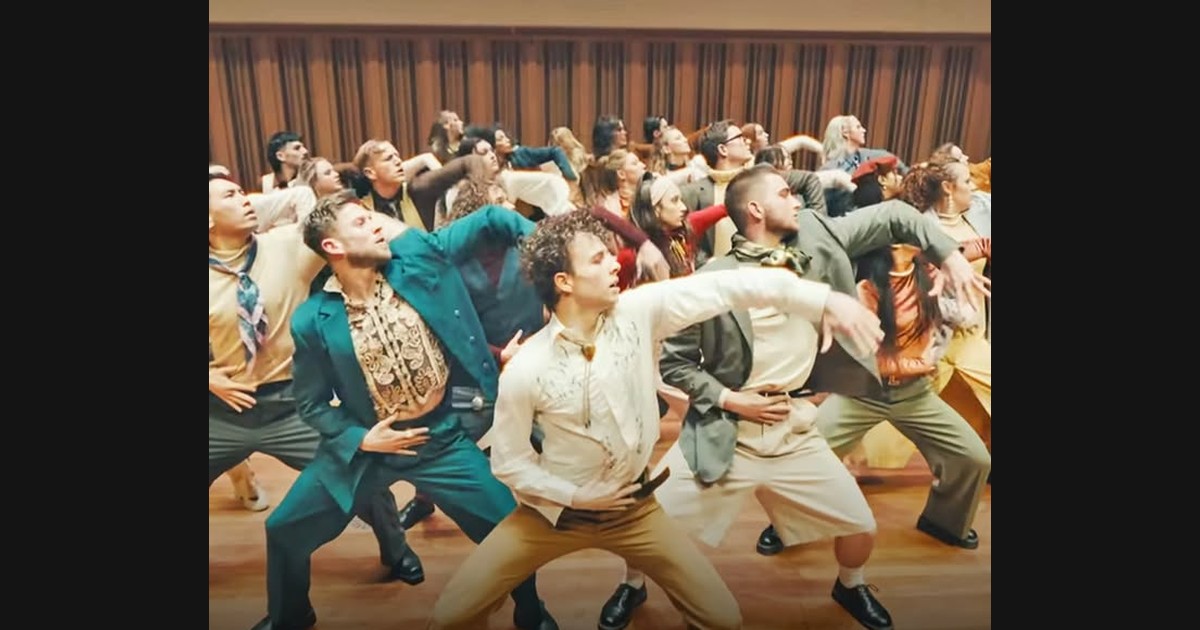
CDK’s “Somebody That I Used to Know” is presented through a company identity and an individual uploader, but neither label alone is a complete creative credit. The San Francisco Dance Film Festival names Sergio Santos Reis, Jowha van de Laak, and Mauro van de Kerkhof as choreographers. CDK’s own website describes a wider creative collective.
That distinction makes a useful starting point for understanding dance film as collaborative work. The people credited for a particular piece, the team associated with a company, and the person publishing a video can overlap without being identical lists.
Choreography is one part of the screen result
Choreography organizes movement and relationships between performers. A screen presentation also has to determine what the viewer sees: the frame, the visual sequence, and the relationship between one shot and the next. Appearance and styling add another layer to the work’s public identity.
Watch on YouTube ↗
These functions can be undertaken by overlapping collaborators, but the existence of the functions does not identify who performed each one. Use the actual credits when assigning names. A familiar uploader should not automatically receive sole authorship of every creative decision.
The festival provides specific choreography credits
| Source | What its list identifies |
|---|---|
| Festival film entry | Three named choreographers for this particular work. |
| CDK company page | A broader creative team associated with the collective. |
| Video publisher | The channel through which this upload reaches the viewer. |
A company member may contribute to one project and not another. A film credit may identify a collaboration that differs from the company’s entire current team. Keeping those lists at their proper scale gives the named contributors more accurate recognition.
Watch a transition as shared work
Choose a point where the visible group changes. First follow the movement: how the performers alter their positions or gestures. Then consider the presentation: whether the same frame continues or the film selects another view.
This separates two kinds of construction without pretending they can always be completely untangled in the finished work. A transition can depend on both the dancers’ actions and the way those actions are filmed and joined. The screen result is what the viewer encounters; the credits supply documented responsibilities behind it.
Another company film is another project
The “Bittersuite” companion retains CDK’s identity while changing the musical source and work. That makes it useful for comparing a collective’s output, but it does not prove that every production role or credit is the same.
Watch on YouTube ↗
A recognizable company style can emerge across projects even while collaborators or tasks vary. Style is an artistic relationship a viewer may notice; it is not a substitute for reading the individual work’s credits.
The showcase changes the production frame
The final selection is CDK’s World of Dance Eindhoven 2024 showcase. A stage showcase and a purpose-made dance film share performers’ movement as material but have different presentation contexts.
Watch on YouTube ↗
Do not carry a competition result or stage credit into the Gotye film merely because the company name matches. Each work needs its own occasion and creative record.
The practical result is a better account of authorship: name CDK as the collective, retain the film’s documented choreography team, and assign other duties only where they are credited. That approach lets the work remain visually coherent while acknowledging that coherence can be created by several people working together.


