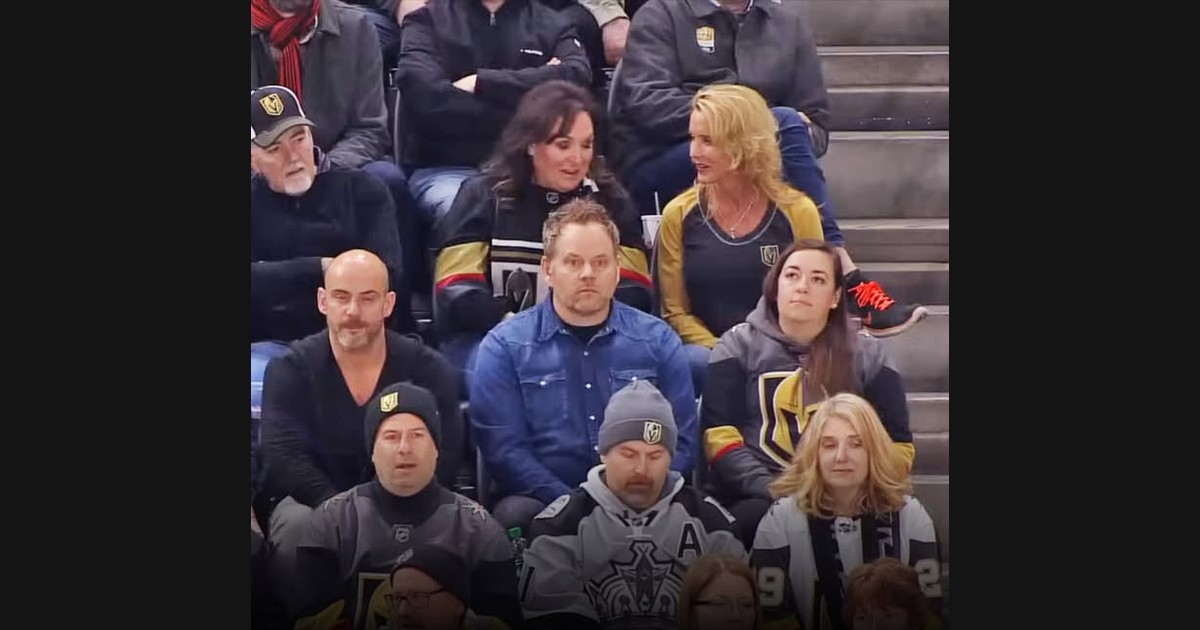
A hockey game already has its principal performers on the ice. Cameron Hughes’s work uses another part of the event: the gaps in play when attention can move into the stands. His “Vegas Golden Cheers!” recording places a brief musical act inside that wider sporting occasion.
Hughes’s own description identifies the Golden Knights setting at T-Mobile Arena and connects the moment with Billy Idol’s music. His professional website describes in-game entertainment during timeouts, intermissions and fan events. That gives the recording a clear performance context without presenting him as an unsuspecting spectator discovered by accident.
Watch on YouTube ↗
A short window needs a quick premise
In a theater, an audience has normally arrived expecting an act. During a game, entertainment must establish its focus inside another event’s running order. A recognizable musical pulse and a readable visual idea can help people understand quickly where to direct their attention.
The task is not only to attract a look. The act needs a second moment after the initial recognition. A changing gesture, an interaction or another visual reveal can give the audience a reason to keep following. The performance develops within a limited window rather than beginning a separate full-length show.
The surrounding spectators are part of the frame
A performer working among seated people has immediate neighbors as well as a larger arena audience. The people nearby can make the action feel local; an arena screen can give it a much wider scale. These are different relationships with the same act.
This is why a crowd setting is more than scenery. A response from nearby people can redirect attention, while the continuing music gives everyone a shared timeline. The entertainer works with that environment rather than asking it to disappear.
A different hockey audience
The second recording comes from Hughes’s own channel and identifies an Oilers setting with Billy Idol. It supplies another occasion for the same broad kind of in-game musical participation.
Watch on YouTube ↗
Compare what remains recognizable across locations. An entertainer can keep a consistent performance identity while responding to a different room, crowd and available interval. That continuity does not prove that every action is fixed in advance or that every reaction is spontaneous. It shows a format capable of being realized more than once.
A timeout makes the purpose explicit
The Ottawa Senators video names a timeout in its title. Here the gap around the sport is part of the performance’s own description.
Watch on YouTube ↗
A timeout has a beginning and an ending determined by the event around it. Entertainment needs to become legible quickly and leave room for attention to return to the game. A complete act can therefore be short while still having a setup, development and recognizable finish.
The three recordings are useful together because they show a continuing public role rather than one isolated novelty. Hughes makes the audience’s side of the arena into a temporary performance space. The musical reference, local interaction and limited time window give that work its practical shape, allowing a pause in the game to become an event without replacing the sport people came to see.


