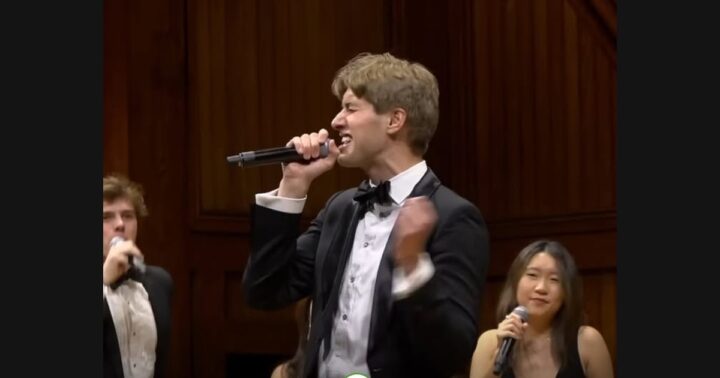
Recognizing a singer is not quite the same as recognizing a genre. A comic exchange between Michael Bublé and Josh Groban makes that distinction useful: a performer can suggest another vocal identity through a few selected features, while a broad stylistic label leaves much of the individual voice unexplained.
The main upload identifies the two singers but does not provide enough verified context to assign the exchange a particular event or year. Its value here is the public performance of vocal identity, followed by separate, officially identified performances from each artist.
Watch on YouTube ↗
An impression reduces the amount of information
An extended performance gives a listener time to hear many decisions. An impression has to make its reference quickly. It may foreground the beginning of a phrase, a way of sustaining a vowel, or a particular kind of emphasis because those details are sufficient to trigger recognition.
That selectivity is part of the comic construction. It does not mean the referenced singer always uses the same mannerism or that one exaggerated feature explains an entire technique. A useful description identifies the cue that worked for you without declaring the two voices identical.
Separate the cue from the context. You may recognize the person partly because the other performer names or invokes them. The surrounding exchange can prepare the audience to hear a resemblance that would be less immediately obvious in isolation.
Identity develops through a complete phrase
To move beyond the impression, listen to how a singer completes a musical thought. An opening can establish a recognizable sound, but the continuation reveals decisions about pacing, emphasis, and where a phrase seems to settle.
A broad label such as “crooner” or “classical crossover” cannot make those decisions for the listener. Such labels may suggest a repertoire or presentation, but two singers associated with the same category can organize a line differently.
Groban outside the exchange
BBC Music’s “You Raise Me Up” selection identifies Groban at Proms in Hyde Park in 2018. It changes the format from a shared stage exchange to a sustained performance of one song.
Watch on YouTube ↗
Choose a phrase and follow it through its entire direction. Pay attention to what happens after the point that would be easiest to imitate. The completion of a thought may reveal more of an interpretive identity than the single feature that made an impression recognizable.
This is not a test of whether a comic imitation is accurate enough. The impression and the full performance are undertaking different tasks: one presents a recognizable reference, while the other builds a musical course.
Bublé in his own concert presentation
The final selection is Bublé’s official “Feeling Good” from Tour Stop 148. It provides the same opportunity to move from a compact vocal identity toward a complete interpretation.
Watch on YouTube ↗
Keep the song’s arrangement in view alongside the singer. An entrance can feel different depending on the space before it and the support around it. A vocal identity is encountered within those relationships, rather than as a set of isolated traits.
The shared clip can be enjoyed as a meeting of recognizable performers. The related selections give that recognition depth, allowing each voice to be heard doing more than the limited job that a comic reference requires.