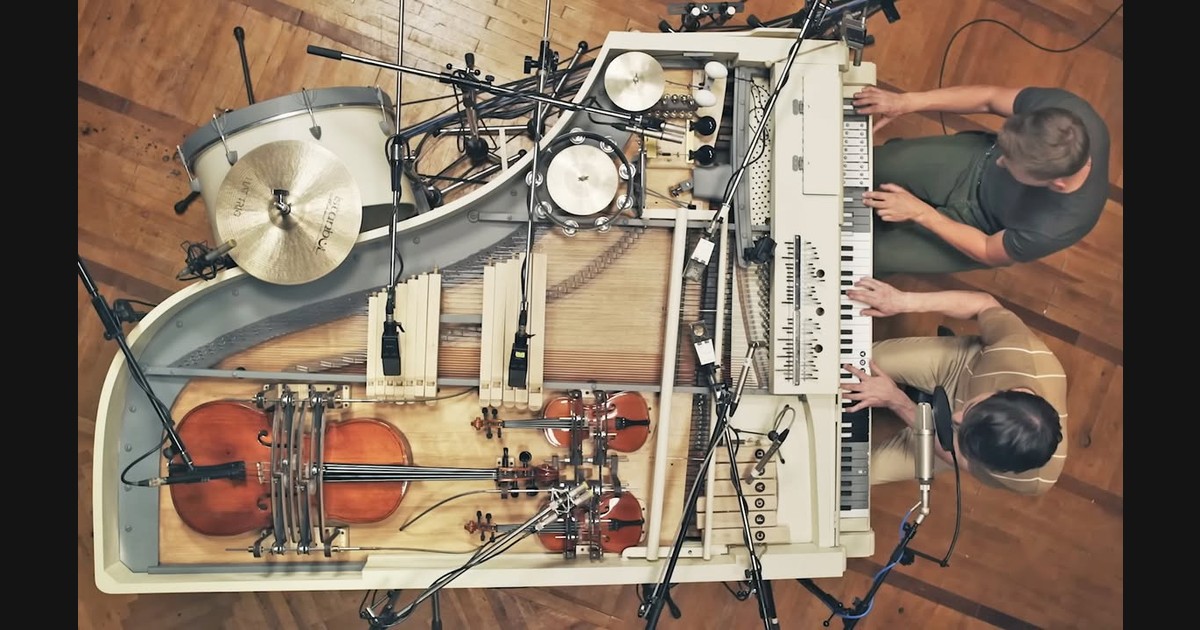
A piano keyboard is a familiar interface: press a key and expect a piano note. Brunettes Shoot Blondes’ “Houston” project changes the relationship behind that action. The band describes rebuilding a damaged vintage grand piano into a hybrid containing twenty instruments.
DW Euromaxx’s feature introduces the construction, while the band’s own release provides a detailed primary account. Its description names percussion operated by the piano hammers and special mechanical devices for strings and organ. This is a particular designed instrument, not simply a normal piano playing an orchestral recording.
Watch on YouTube ↗
Separate the control from the sound source
The keyboard supplies the performer’s point of contact. The sources producing the sounds can differ from the piano strings normally associated with that contact. Keeping those two jobs separate makes the project easier to understand.
The band identifies marimba, tambourine, cymbals, and castanets among the materials operated by hammer actions. It also describes mechanisms enabling cello, violins, and organ. The important point is not that every component behaves identically, but that different mechanisms are coordinated within one apparatus.
For example, striking a percussion component and operating a sustained instrumental sound create different practical tasks. A hybrid design needs a way for the available controls to activate those tasks in a playable relationship. The twenty-instrument headline names the scale; the mechanism explains the idea.
Construction is not the same as arrangement
An unusual instrument provides possibilities, but a song still has to organize them. Recognizable material, accompaniment, and transitions need to fit together. A new sound source does not automatically decide which passage it should carry.
When viewing the feature, distinguish a mechanism being demonstrated from that mechanism’s role within “Houston.” A demonstration answers “what can this do?” The complete performance answers “what does the arrangement ask it to do here?”
Watch on YouTube ↗
The song video has its own credits
The band publishes “Houston” as a live presentation and describes the apparatus as analog. Its description also credits backing vocalists, recording, and mixing/mastering. Those details should remain visible alongside the mechanical achievement.
“Analog apparatus” describes the instrument concept. It does not mean the released video contains no recording or production work. Likewise, the live label does not provide a complete technical account of every sound heard in the final release.
This is a useful distinction for any inventive music video. You can appreciate the physical construction while recognizing the separate work required to record the music and make its operation readable on screen.
“Knock Knock” changes the medium
Watch on YouTube ↗
The band’s “Knock Knock” video offers another coordinated visual project. In its own contemporary announcement, the group describes animation distributed across fourteen screens and brought together into one story.
The connection is a design principle rather than identical machinery: several components become meaningful through their coordination. In “Houston,” the components produce sound through a hybrid instrument; in “Knock Knock,” separate screens present related visual fragments.
The three selections therefore distinguish explanation, performance, and another creative project. Follow those functions and the twenty-instrument piano becomes more than a novelty count. It is a specific relationship between familiar controls, unfamiliar sound sources, and an arrangement made for the resulting apparatus.


